ISRO integrates artificial intelligence into space missions
Source:Indian Express ↗
Why It Matters
Crucial for understanding how India's space program leverages emerging technologies like AI for next-generation missions, automation, and data utilization.
Summary
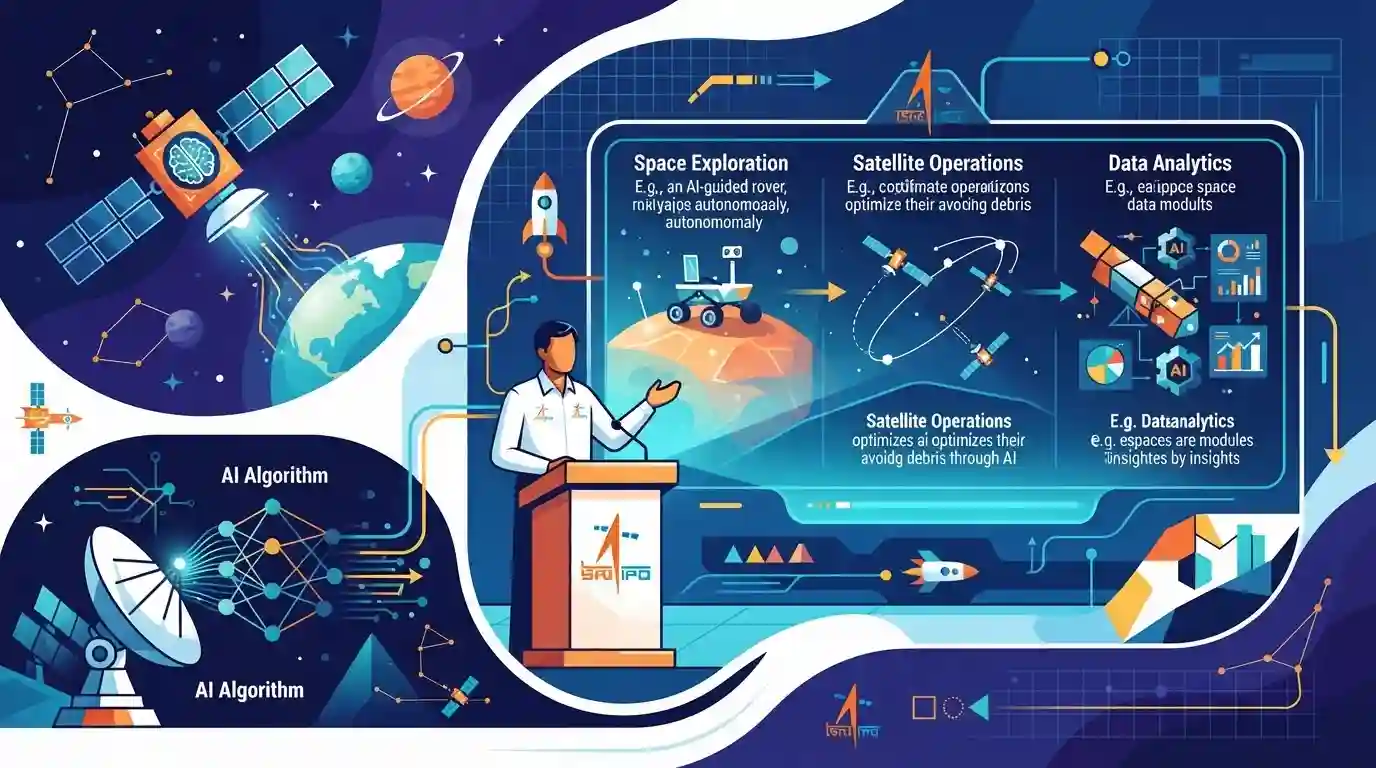
The article discusses the integration of Artificial Intelligence (AI) in space missions by ISRO, highlighting discussions from platforms like SMOPS 2026 where experts like Narayanan emphasized how AI is transforming space exploration, satellite operations, and data analytics.
Key Points
- ISRO is increasingly integrating Artificial Intelligence (AI) into space missions to optimize performance, automation, and data processing.
- Discussions at recent forums like SMOPS 2026 highlight the evolving intersection of AI and space technology.
- AI-driven autonomy helps spacecraft manage navigation, anomaly detection, and earth observation data processing efficiently without constant human intervention.
Important Terms
ISRO

India's national space agency responsible for planning, executing, and managing space exploration, satellite launches, and application programs.
UPSC context
GS Paper III (Science & Technology - Space Technology); tests knowledge of India's space achievements, institutional framework, and technological advancements like AI integration.
SMOPS
The International Conference on Spacecraft Mission Operations, a global platform focusing on smart, sustainable space mission management, automation, and AI/ML integration.
UPSC context
GS Paper III (Science & Technology - Space Technology); tests awareness of international/national scientific conferences addressing modern operational challenges in space missions.
Prelims Trap
All spacecraft navigation and anomaly correction decisions must be routed through ground control stations.
Aspirants often assume ISRO relies entirely on ground-station intervention for anomaly detection, ignoring the rapid shift toward autonomous on-board AI and edge computing.
Static Concepts Connected
What are the core applications of Artificial Intelligence and Machine Learning in modern space missions?
- Autonomous Navigation: Real-time hazard detection and obstacle avoidance during planetary descents (e.g., Chandrayaan-3 lunar landing).
- Edge Computing: Local processing of earth observation payloads using edge computing to minimize downlink bandwidth bottlenecks.
- Human Spaceflight: Monitoring life-support parameters and crew module conditions via robotic systems like Vyommitra.
Cross-Topic Patterns
Space Tech + AI Governance Linkage
ISRO's integration of AI for edge computing and in-orbit data processing connects space technology with digital public infrastructure and national semiconductor/AI missions.

AI-driven space autonomy (edge computing, Vyommitra, hazard avoidance) is high-yield for multi-statement prelims and S&T mains.
Linked PYQs · 2
Linked PYQs · 2
- 2023MainsGS3
Introduce the concept of Artificial Intelligence (AI). How does Al help clinical diagnosis? Do you perceive any threat to privacy of the individual in the use of Al in healthcare?
- 2026PrelimsGS1
Consider the following statements with regard to involvement of private entities in India's space programme : 1. The Indian National Space Promotion and Authorisation Centre (IN-SPACe) is an autonomous agency formed to facilitate participation of private entities. 2. Agnikul Cosmos launched the world's first flight using 3D-printed rocket engine. 3. Skyroot Aerospace has developed liquid fuel for GSLV. Which of the statements given above is/are correct ?
