ISRO Integration of Artificial Intelligence in Space Missions
Source:Indian Express ↗
ఇది ఎందుకు ముఖ్యం
Relevant for GS Paper III under Science & Technology (developments and applications of AI and space tech).
సారాంశం
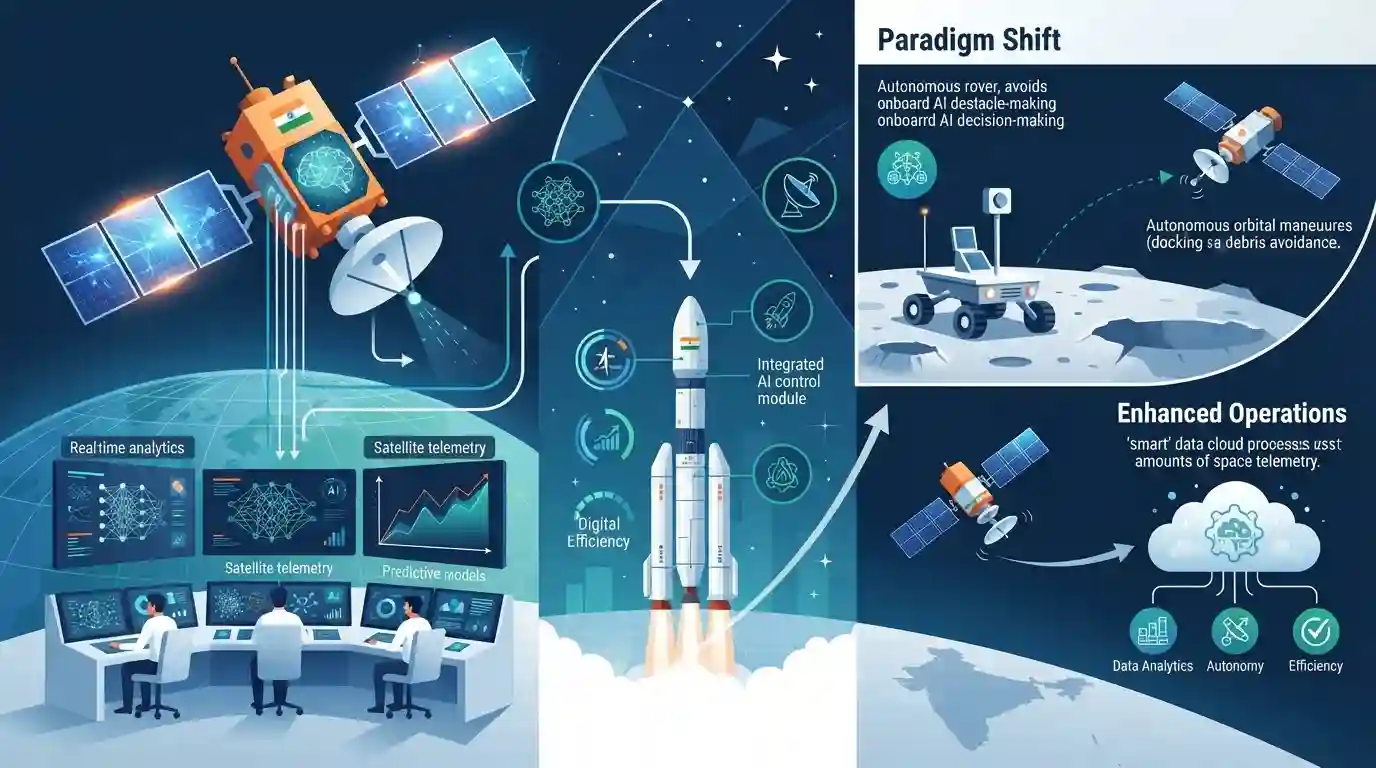
ISRO is incorporating Artificial Intelligence (AI) into space missions to boost autonomous operations, enhance data analytics, and improve mission efficiency, marking a paradigm shift in India's space technology landscape.
ముఖ్య అంశాలు
- ISRO is increasingly integrating Artificial Intelligence (AI) into its space missions to enhance autonomy, data processing, and decision-making capabilities.
- AI-driven technologies are becoming crucial for managing complex space operations, satellite monitoring, and deep space missions efficiently.
- The integration helps reduce reliance on ground control and optimizes resource utilization during missions.
ముఖ్యమైన పదాలు
ISRO

India's national space agency responsible for research, development, and execution of space programs, satellite launches, and deep-space exploration missions.
UPSC context
UPSC GS Paper III (Science & Technology - Space Technology): Tests knowledge of India's space achievements, institutional framework, and technological advancements.
Artificial Intelligence (AI) in Space Missions
The integration of machine learning and cognitive computing into spacecraft systems to enhance autonomous decision-making, satellite management, data analytics, and operational efficiency.
UPSC context
UPSC GS Paper III (Science & Technology - IT & Computers / Space): Evaluates applications of emerging technologies in strategic and scientific sectors.
SMOPS (International Conference on Spacecraft Mission Operations)
An international conference focusing on innovative operations, smart automation, sustainable management, and human-machine synergy for modern spacecraft missions.
UPSC context
UPSC GS Paper III (Science & Technology): Important for current updates on global space cooperation, mission operations, and satellite management.
అనుసంధానమైన స్థిర భావనలు
What is Onboard Autonomy in Spacecraft and how does AI enable it?
- Autonomous Navigation: Autonomous navigation allows spacecraft to determine position and trajectory without constant Earth-based tracking.
- Data Filtering: AI machine learning models process hyperspectral imagery onboard, transmitting only relevant scientific data to conserve bandwidth.
- Fault Detection: Real-time anomaly detection algorithms identify subsystem failures instantly, bypassing light-minute communication delays in deep space.
అంతర-అంశ నమూనాలు
Space AI + Defence Autonomous Systems
ISRO's integration of AI for autonomous space missions mirrors the Ministry of Defence's push for AI in autonomous weapon systems and unmanned aerial platforms (iDEX initiatives).
Satellite Edge Computing + National Tech Missions
AI-driven edge computing onboard Indian satellites directly supports the wider National Quantum Mission and National Deep Tech Stacking strategy for indigenous high-performance computing.

Expect statement-based questions on applications of onboard AI in spacecraft (e.g., collision avoidance, deep-space autonomy vs ground control).
అనుసంధాన PYQలు · 2
అనుసంధాన PYQలు · 2
- 2023MainsGS3
Introduce the concept of Artificial Intelligence (AI). How does Al help clinical diagnosis? Do you perceive any threat to privacy of the individual in the use of Al in healthcare?
- 2023MainsGS3
What is the main task of India's third moon mission which could not be achieved in its earlier mission? List the countries that have achieved this task. Introduce the subsystems in the spacecraft launched and explain the role of the Virtual Launch Control Centre' at the Vikram Sarabhai Space Centre which contributed to the successful launch from Sriharikota.
