Artificial Intelligence infrastructure and inclusive growth in India
Source:The Hindu ↗
Why It Matters
Provides significant corporate and technological perspectives on AI's developmental role in India. The emphasis on AI as public infrastructure, efforts to reduce computing costs via data centres, and alignment with state initiatives like the India Semiconductor Mission reflect core themes for GS-3 (Technology, Digital Infrastructure, Economy). It also touches upon global tech geopolitics and critical mineral supply chains, relevant for both GS-3 and GS-2.
Summary
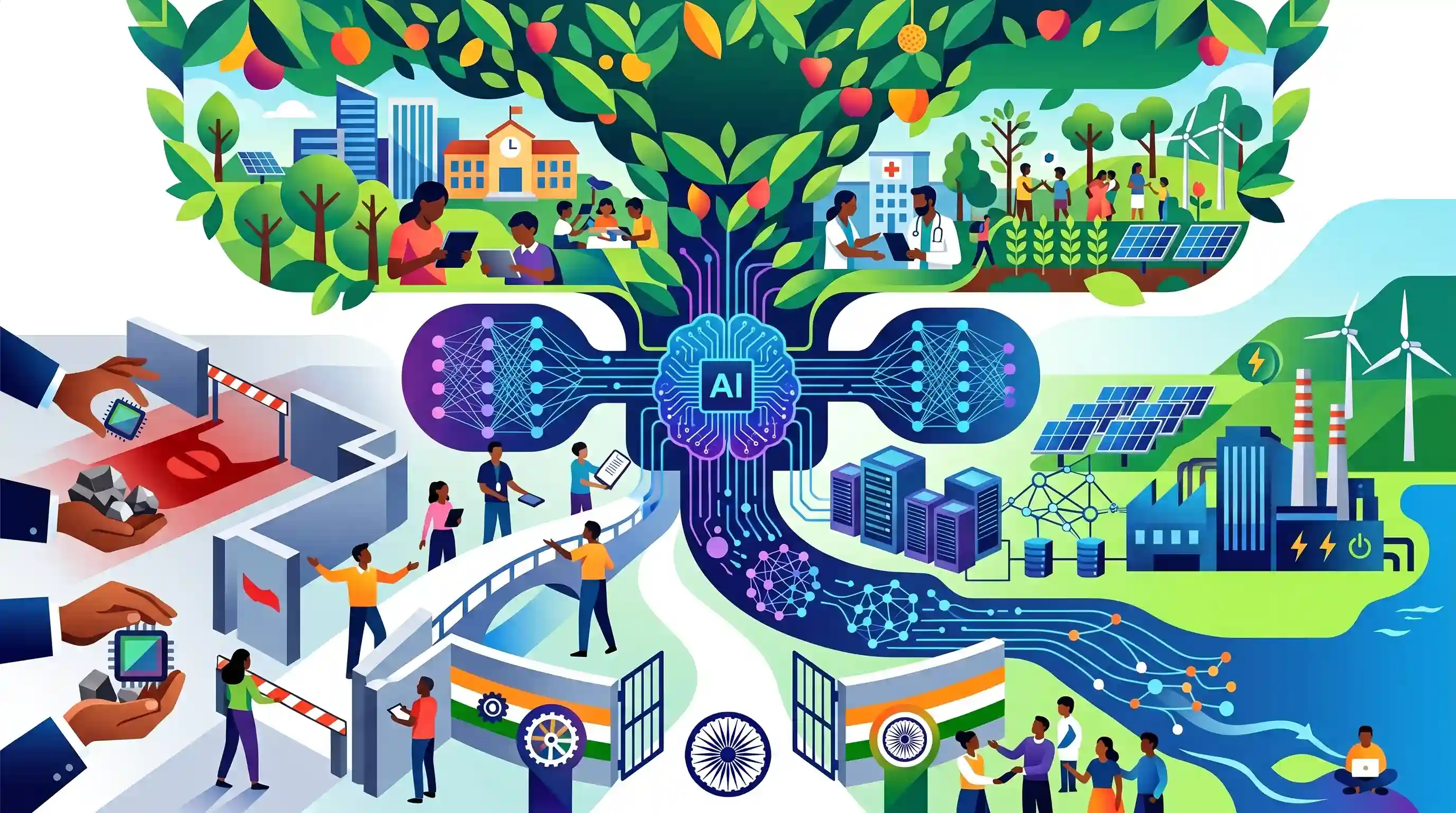
At the AI Impact Summit 2026, industry leaders N. Chandrasekaran and Mukesh Ambani highlighted that Artificial Intelligence (AI) must evolve from a technological novelty to a driver of real-world social impact and inclusive opportunity in India. They portrayed AI as a foundational infrastructure capable of revolutionizing public services, healthcare, and education, potentially ushering in an era of 'super-abundance.' To support this, massive investments are being made in digital infrastructure, such as Reliance Jio's multi-gigawatt, AI-ready data centres in Jamnagar, aiming to reduce the 'cost of intelligence.' The leaders also cautioned against the geopolitical hoarding of chips and critical minerals, stressing the need for technology democratization supported by frameworks like the IndiaAI Mission and the India Semiconductor Mission.
Key Points
- Tech leaders emphasize that AI's growth must be driven by social relevance and real-world usefulness across sectors like healthcare, education, and enterprise.
- Mukesh Ambani envisions AI fostering an era of 'super-abundance,' significantly boosting national productivity and public service delivery.
- N. Chandrasekaran raised concerns over tech embargoes and the hoarding of chips and critical minerals, advocating for democratized access to technology.
- Reliance Jio is building massive, multi-gigawatt AI-ready data centres in Jamnagar to lower the 'cost of intelligence' and make computing more accessible.
- Both leaders affirmed the importance of integrating AI development with national frameworks like the IndiaAI Mission and the India Semiconductor Mission to build trusted, scalable, and resilient digital infrastructure.
Important Terms
IndiaAI Mission

A national initiative to bolster India's AI ecosystem through public-private partnerships, focusing on compute capacity (10,000+ GPUs), indigenous foundational models, and datasets for social impact in healthcare and agriculture.
UPSC context
GS Paper 3: Science and Technology; critical for discussing technological sovereignty, AI governance, and digital economy targets.
India Semiconductor Mission (ISM)
A nodal agency under the Ministry of Electronics and Information Technology (MeitY) implementing a ₹76,000 crore program to develop a sustainable semiconductor and display manufacturing ecosystem in India.
UPSC context
GS Paper 3: Economy and S&T; evaluates India's electronics self-reliance and global supply chain integration.
Critical Minerals
Metallic or non-metallic elements (e.g., lithium, cobalt, rare earths) essential for high-tech industries, green energy, and AI hardware, often subject to geopolitical supply chain vulnerabilities.
UPSC context
GS Paper 1: Geography and GS Paper 2/3: Geopolitics/Economy; pertains to resource security and strategic autonomy.
Cost of Intelligence
A strategic objective to democratize AI access by reducing the expense of computing power and inference, aiming to make AI as affordable and ubiquitous as mobile data.
UPSC context
GS Paper 3: Economy/Infrastructure; relevant to inclusive growth and the 'Digital India' vision for the Global South.
Sovereign Compute Infrastructure
The domestic capacity to host, process, and control data and AI workloads without reliance on foreign-controlled hardware or cloud services, ensuring national security and data sovereignty.
UPSC context
GS Paper 3: Science and Tech/Security; essential for discussions on data protection and strategic technological independence.
Digital Public Infrastructure (DPI)
Open-source digital blocks like Aadhaar and UPI that enable population-scale service delivery; now viewed as the foundational layer for integrating AI into public services.
UPSC context
GS Paper 2/3: Governance/Economy; central to India's model of technology-led development and inclusive growth.
Prelims Trap
"The India Semiconductor Mission is an independent statutory body regulating electronics manufacturing."
ISM is not a statutory body; it is a specialized, independent business division within the Digital India Corporation (DIC) under MeitY.
Static Concepts Connected
What are the key features of the India Semiconductor Mission (ISM)?
- Nodal Agency: Established within the Digital India Corporation (DIC) under MeitY to drive India's long-term semiconductor strategy.
- Fiscal Support: Provides up to 50% capital subsidy on a pari-passu basis for setting up semiconductor and display fabs.
- Holistic Ecosystem: Covers the entire value chain, including fabrication, packaging (ATMP/OSAT), and design-linked incentives (DLI) for domestic startups.
Why are AI computing and modern data centres highly energy-intensive?
- Massive Compute: Training foundational AI models requires clusters of thousands of GPUs running continuously, consuming immense electrical power compared to traditional CPUs.
- Cooling Requirements: High-density AI servers generate extreme heat, necessitating complex, power-hungry cooling infrastructure, driving the need for multi-gigawatt green data facilities.
Cross-Topic Patterns
AI Data Centres + Renewable Energy
The multi-gigawatt power demand of AI data centres bridges GS3 Science & Tech with India's renewable energy transition and green grid modernization targets.
Chip Embargoes + Minerals Security Partnership
Hoarding of semiconductor materials links India's tech ambitions directly to IR concepts like the US-led Minerals Security Partnership and strategic export controls.

Expect a multi-statement question linking IndiaAI Mission’s compute capacity, semiconductor subsidies, and critical mineral supply chains.
Linked PYQs · 4
Linked PYQs · 4
- 2025MainsGS3
India aims to become a semiconductor manufacturing hub. What are the challenges faced by the semiconductor industry in India? Mention the salient features of the India Semiconductor Mission.
- 2020PrelimsGS1
With the present state of development, Artificial Intelligence can effectively do which of the following? 1. Bring down electricity consumption in industrial units 2. Create meaningful short stories and songs 3. Disease diagnosis 4. Text-to-Speech Conversion 5. Wireless transmission of electrical energy Select the correct answer using the code given below:
- 2023MainsGS3
Introduce the concept of Artificial Intelligence (AI). How does Al help clinical diagnosis? Do you perceive any threat to privacy of the individual in the use of Al in healthcare?
- 2023MainsGS3
What is the status of digitalization in the Indian economy? Examine the problems faced in this regard and suggest improvements.
