AI in modern warfare and India defense preparedness strategy
Source:Indian Express ↗
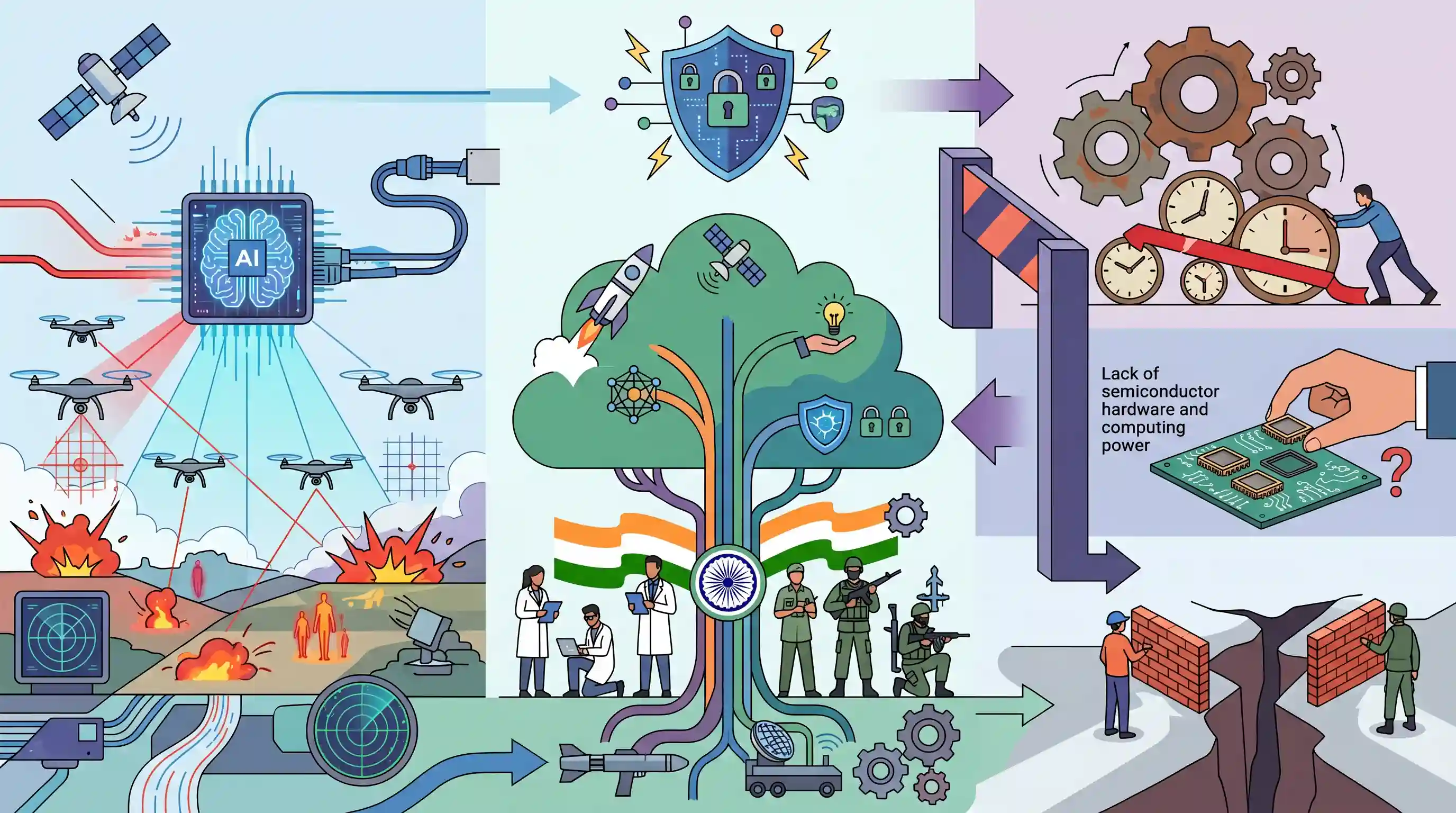
Why It Matters
The integration of AI in modern warfare is no longer theoretical, as seen in Ukraine. Facing a two-front threat paradigm, India must swiftly transition to algorithmic warfare, address defense procurement hurdles, and build a robust civil-military fusion model to prevent a widening strategic technology gap with adversaries like China.
Summary
The article examines the profound transformation of modern warfare through Artificial Intelligence (AI), fueled by lessons from the Russia-Ukraine conflict where AI-enabled drone targeting, autonomous guidance, and rapid sensor-fusion systems are reshaping combat. It evaluates India's defensive and technological preparedness, highlighting its institutional setups (DAIC, DAIPA, iDEX, and the ADITI scheme) designed to foster indigenous defense AI applications. Despite positive strides, India faces significant hurdles, including rigid bureaucratic procurement cycles designed for hardware rather than agile software, lack of domestic high-performance computing hardware (semiconductors), and an underdeveloped civil-military fusion architecture, prompting calls for rapid systemic reforms to keep pace.
Key Points
- Russia-Ukraine War as an AI Testbed: The conflict has acted as a 'living lab' for AI integration, shifting warfare from hardware-centric platforms to software-driven, algorithmic combat where the sensor-to-shooter loop is reduced from minutes to seconds.
- Autonomous Strike Capabilities: First Person View (FPV) drones equipped with terminal AI guidance and computer vision are being utilized to lock onto targets automatically, successfully bypassing hostile electronic warfare (EW) jamming and GPS spoofing.
- India's Institutional Framework: India has established the Defence AI Council (DAIC) and the Defence AI Project Agency (DAIPA) to direct military AI adoption. The 'AIDef' program actively targets AI integration across cyber defense, robotics, autonomous systems, and predictive maintenance.
- Startup and Deep-Tech Integration: Schemes like iDEX and ADITI are funding private-sector and dual-use startups to pioneer defense-grade AI technologies, showing a shift towards utilizing commercial innovations for national security.
- Major Structural Barriers: India's traditional procurement system (Defense Acquisition Procedure) is structurally unsuited for rapid, iterative software development; additionally, the nation suffers from a deficit in advanced semiconductor hardware (GPUs) and standardized defense datasets.
- Civil-Military Fusion & Policy Imperatives: To catch up with global leaders like the US and China, India must reform its software procurement cycles, cultivate a specialized technical cadre within the military, and leverage national technology programs like the IndiaAI and Semiconductor Missions.
Important Terms
ADITI scheme

A Ministry of Defence initiative under the iDEX framework that provides grants of up to ₹25 crore to startups and MSMEs for developing critical, strategic deep-tech defence technologies.
UPSC context
GS Paper III: Defence Indigenisation and Security; tests knowledge of funding mechanisms for critical and strategic deep-tech development in India.
Innovations for Defence Excellence (iDEX)
The flagship framework of the Ministry of Defence, launched in 2018, to foster innovation and technological development in defence and aerospace by funding startups, MSMEs, and individual innovators.
UPSC context
GS Paper III: Science & Technology and Security; tests strategies for military modernization, defense indigenization, and fostering startup ecosystems.
Defence Acquisition Procedure (DAP)
The primary policy framework established by India's Ministry of Defence to govern and streamline capital procurement of weapons, systems, and equipment for the armed forces, prioritizing domestic manufacturing and indigenization.
UPSC context
GS Paper III: Security challenges and indigenisation; tests understanding of procurement reform, defense industrial corridors, and self-reliance.
Initiative on Critical and Emerging Technology (iCET)
A bilateral strategic framework launched in 2023 by India and the United States to enhance cooperation, co-development, and co-production in advanced technology sectors like AI, semiconductors, space, and defense.
UPSC context
GS Paper II: Bilateral agreements and International Relations; tests knowledge of India-US strategic partnerships and cooperation in critical technologies.
Defence AI Council (DAIC)
A high-level Indian Ministry of Defence body, established in 2019 under the chairmanship of the Defence Minister, that provides strategic direction, policy guidelines, and oversight for adopting AI in the military.
UPSC context
GS Paper III: Cyber security, Science & Technology; tests governance, policymaking, and strategic adoption of artificial intelligence in national defense.
Defence AI Project Agency (DAIPA)
An executive arm under the Indian Ministry of Defence, established in 2019, tasked with standardizing, implementing, and adopting AI-led and AI-enabled projects, systems, and technologies across the armed forces.
UPSC context
GS Paper III: Science & Technology, internal security; tests technical execution, standardization, and military-industrial transition towards modern defense systems.
India Semiconductor Mission (ISM)
A specialized agency under the Ministry of Electronics and Information Technology, launched in 2021, to build a robust domestic semiconductor and display ecosystem and position India as a global manufacturing hub.
UPSC context
GS Paper III: Indigenization of technology; tests policy initiatives for self-reliance in critical electronic infrastructure and supply chain security.
Prelims Trap
The Defence Artificial Intelligence Council (DAIC) is chaired by the Prime Minister as part of national security integration.
The DAIC, established in 2019 based on the N. Chandrasekaran Task Force recommendations, is chaired by the Union Defence Minister, not the Prime Minister.
Static Concepts Connected
What is Civil-Military Fusion (CMF) in modern defense ecosystems?
- Core Definition: Merging civilian industrial and technological advancements with military applications to accelerate defense innovation and dual-use capabilities.
- Dual-use Focus: Leveraging commercial advancements in AI, quantum computing, and biotechnology for defense, reducing dependency on isolated military R&D.
How does the DAP facilitate defense innovation via startups?
- iDEX Integration: The Defence Acquisition Procedure (DAP) includes fast-tracked procurement pathways specifically for technologies successfully developed under the iDEX framework.
- Buy (Indian-IDDM): Prioritizes products with high Indigenous Content, encouraging domestic deep-tech startups to scale from prototype to military induction.
Cross-Topic Patterns
Military AI + Semiconductor sovereignty
India’s military AI capabilities remain heavily reliant on imported advanced microprocessors, linking national defense readiness directly to the strategic success of the India Semiconductor Mission.
Autonomous weapons + Humanitarian Law
Algorithmic targeting and terminal autonomous guidance in drones challenge the Geneva Conventions' core principles of human-in-the-loop accountability, distinction, and proportionality.

Expect 2026 questions to test the institutional framework of DAIC and ADITI alongside structural challenges of software-centric procurement.
Linked PYQs · 3
Linked PYQs · 3
- 2026PrelimsGS1
Which of the following statements with regard to drone swarms is/are correct ? 1. They use Terahertz band of frequency to communicate with the command centre. 2. Individual drones in the swarm can communicate with other drones in the swarm. 3. GPS Spoofing is a commonly used technique to counter drone swarm attack. Select the answer using the code given below :
- 2023MainsGS3
The use of unmanned aerial vehicles (UAVs) by our adversaries across the borders to ferry arms/ammunitions, drugs, etc., is a serious threat to the internal security. Comment on the measures being taken to tackle this threat.
- 2021MainsGS3
Keeping in view India's internal security, analyse the impact of cross-border cyber attacks. Also discuss defensive measures against these sophisticated attacks.
