Jaipur Deploys Rajasthan First AI Powered Traffic Awareness System
Source:india-today ↗
Why It Matters
This is a prime example of e-governance and artificial intelligence integration in smart-city infrastructure. It demonstrates real-world application of digital databases (like VAHAN) and automated enforcement technology to encourage voluntary compliance, representing a shift towards 'nudge theory'-based governance.
Summary
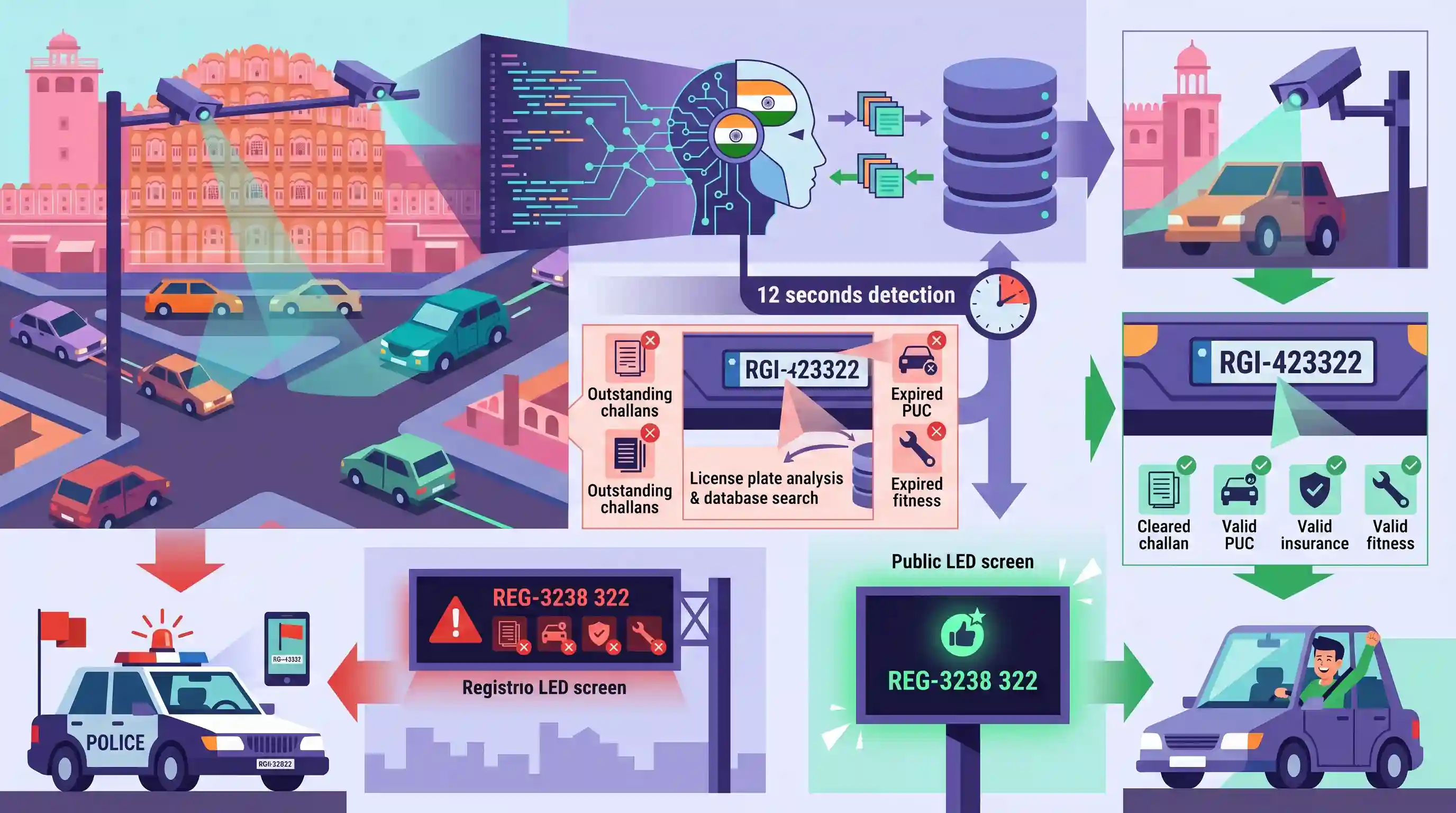
Jaipur has introduced Rajasthan's first AI-powered, real-time traffic awareness system. Using Automated Number Plate Recognition (ANPR) cameras and integration with the national database, the system instantly identifies vehicles with outstanding challans or expired documents (PUC, insurance, fitness), displaying infractions on public LED screens within 12 seconds and alerting police at subsequent checkpoints while also publicly appreciating compliant drivers.
Key Points
- Jaipur Traffic Police has launched Rajasthan's first AI-powered real-time traffic awareness system to track and manage vehicle compliance.
- The system uses Automated Number Plate Recognition (ANPR) cameras installed at junctions to scan registration numbers.
- Captured numbers are instantly cross-verified with the national transport database to identify pending challans, expired insurance, invalid PUC certificates, and missing fitness certificates.
- Violations are displayed on large, public LED screens at intersections within 12 seconds to nudge motorists towards immediate compliance.
- Simultaneously, real-time alerts are sent to the traffic police at the next checkpoint to intercept and caution violating vehicles.
- The system also acknowledges and encourages responsible drivers with clean compliance history by showing positive messages on the screens.
- The pilot phase started at Rambagh Circle (expanding to JLN Marg and Tonk Road) with a central control room established at Yadgar, Ajmeri Gate.
Important Terms
Automated Number Plate Recognition (ANPR)

An image-processing technology using optical character recognition to read vehicle license plates automatically from digital video feeds, enabling real-time monitoring and electronic enforcement.
UPSC context
GS Paper 3 (Science & Tech/Everyday applications); tests familiarity with technology-driven governance and public safety tools.
VAHAN Database
A centralized national vehicle registry developed by the National Informatics Centre to track vehicle registrations, fitness certificates, road tax, and pollution compliance across Indian states.
UPSC context
GS Paper 2 (E-governance/Government policies); evaluates understanding of digital public infrastructure and centralized information systems.
Intelligent Transportation System (ITS)
An advanced integration of information and communication technologies in road transport and traffic management to optimize urban mobility, reduce congestion, and enhance safety.
UPSC context
GS Paper 3 (Infrastructure/Smart Cities); tests knowledge of technology-driven solutions for urban planning and traffic management.
SMART Policing
A modernization vision to transform police into a force that is Strict & Sensitive, Modern & Mobile, Alert & Accountable, Reliable & Responsive, and Techno-savvy & Trained.
UPSC context
GS Paper 3 (Internal Security/Police Reforms); tests understanding of law enforcement modernization and technology-enabled public safety initiatives.
Prelims Trap
VAHAN is the national database for driving licenses, whereas SARATHI registers vehicles and tracks PUC certificates.
Aspirants often confuse the two primary MoRTH databases. VAHAN handles vehicle registration and fitness data, while SARATHI processes driving licenses.
Static Concepts Connected
What are VAHAN and SARATHI under the National e-Governance Plan?
- VAHAN Database: Centralized national repository for vehicle registration, road tax, fitness certificates, and national permits, managed by MoRTH.
- SARATHI Database: National database for driving licenses, conductor licenses, driving school licenses, and learner licenses across all states.
- Tech Architecture: Both systems were developed and are maintained by the National Informatics Centre (NIC) to standardize transport data across India.
What is the legal basis for electronic traffic enforcement in India?
- Section 136A: Introduced by the Motor Vehicles (Amendment) Act 2019, mandating electronic monitoring and enforcement of road safety.
- Central Rules: Central Motor Vehicles Rules require state governments to use electronic enforcement devices to issue automated digital challans.
Cross-Topic Patterns
Nudge theory in public governance
Using public LED displays to show compliance is a classic behavioral "nudge," promoting voluntary tax and challan compliance through social proof rather than punitive measures.
Automated surveillance vs Right to Privacy
Real-time public broadcasting of license plate infractions tests the boundaries of personal data privacy and public disclosure under the KS Puttaswamy guidelines.

Mains 2026 may ask how AI-driven e-governance tools (like ANPR and VAHAN integration) balance administrative efficiency with data privacy.
Linked PYQs · 2
Linked PYQs · 2
- 2025RPSC_PRELIMSGS1
Recently, Jaipur Municipal Corporation, Heritage, has launched which app to report civic issues and for the government to analyze, track, manage and resolve them?
- 2023RPSC_PRELIMSGS1
Where will the “Artificial Intelligence of Things Innovation Hub” be established in Rajasthan?
