AI tools for tracing missing persons in India and security challenges
Source:The Hindu ↗
Why It Matters
This article serves as an excellent case study of leveraging emerging technologies (AI and machine learning) in law enforcement, public safety, and human rights protection. It highlights the practical application of tech to secure vulnerable populations (women and children), while simultaneously illustrating the policy challenges regarding institutional database integration and the delicate trade-off between surveillance and the fundamental right to privacy.
Summary
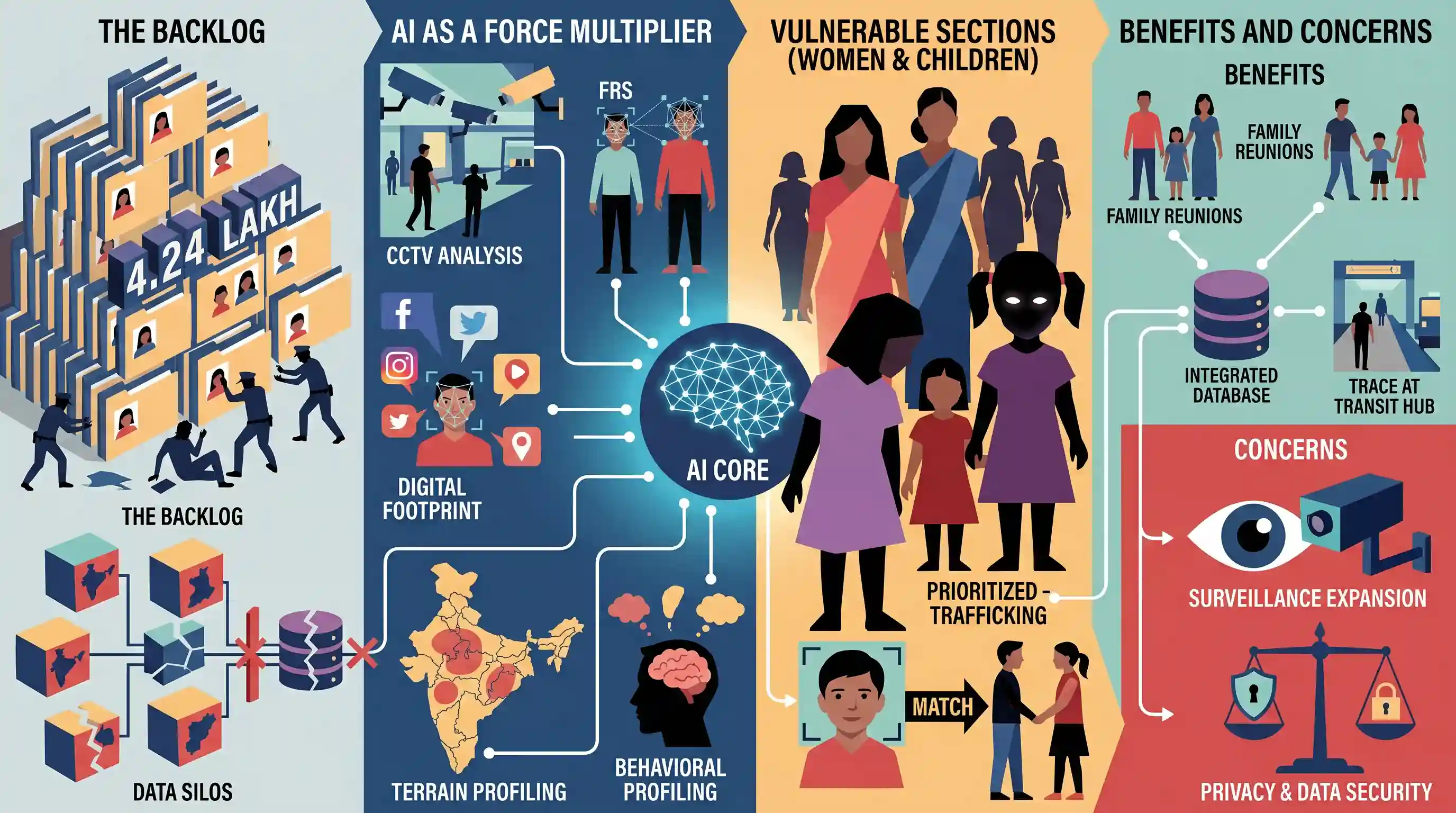
Cybersecurity and forensic experts are advocating the use of Artificial Intelligence (AI) and Facial Recognition Systems (FRS) as critical tools to trace missing persons across India. Faced with a massive backlog of over 4.24 lakh untraced individuals (including a high percentage of women and children) and severe police manpower shortages, AI acts as a vital force multiplier. AI systems can rapidly analyze real-time CCTV feeds at transit hubs, trace digital footprints on social media, and utilize terrain and behavioral profiling to prioritize search areas. However, the lack of integrated databases across state jurisdictions remains a key bottleneck, while the expansion of these surveillance technologies highlights critical concerns regarding personal privacy and data security.
Key Points
- The 'Golden Hour' Dilemma: The first 24 to 48 hours are critical for tracing missing persons (especially children). AI tools speed up detection, which is crucial as traditional search methods are slow and human-resource constrained.
- Overcoming Police Manpower Constraints: Human operators experience cognitive fatigue monitoring multiple CCTV feeds. AI-powered video analysis can continuously scan feeds, recognize faces, detect movement patterns, and raise automated alerts.
- NCRB Missing Person Statistics: According to National Crime Records Bureau data, over 4,24,235 people, including 2,64,934 women and 13 transgender persons, remain untraced across India, underscoring the massive scale of the challenge.
- Multidimensional Digital Footprint Analysis: AI can scan public social media networks for geotags, activity logs, relational connections, and emotional distress markers to reconstruct a missing individual's last known status.
- Predictive Search Modeling: Machine learning models can analyze physical terrain, local weather patterns, and behavioral trends of the missing person to map out and prioritize search vectors.
- The Integration Bottleneck: The primary institutional hurdle is the lack of an integrated national database to link missing reports, hospital admission records, and shelter home registries across municipal and state borders.
- Civil Liberties Concerns: Increased reliance on automated surveillance and Facial Recognition Systems (FRS) triggers intense debates regarding mass surveillance, the right to privacy (Article 21), and the need for data protection safeguards.
Important Terms
Digital Personal Data Protection Act, 2023

India's first comprehensive law regulating the processing of digital personal data, balancing individual privacy rights with lawful data processing and establishing the Data Protection Board of India for compliance.
UPSC context
GS Paper III (Science & Technology/Internal Security): Tests privacy, surveillance, and data governance frameworks.
National Crime Records Bureau
An Indian government agency established in 1986 under the Ministry of Home Affairs to collect, compile, and analyze national crime data and manage databases like CCTNS.
UPSC context
GS Paper II/III (Governance/Internal Security): Crucial for understanding crime trends, police modernization, and database integration.
Southern Railway
Headquartered in Chennai, it is one of the earliest of the 18 zones of Indian Railways, created in 1951, serving the major states of South India.
UPSC context
GS Paper III (Infrastructure): Illustrates public infrastructure networks, transportation planning, and technological modernization.
Tamil Nadu Police
The primary law enforcement agency for Tamil Nadu, responsible for public order, crime investigation, and implementing safety initiatives like AI-assisted forensic tools.
UPSC context
GS Paper III (Internal Security/Policing): Demonstrates state police administration, policing reforms, and inter-state surveillance coordination.
Prelims Trap
The Supreme Court mandates a legal presumption of abduction/trafficking and immediate FIR for every missing person reported in India.
This landmark ruling (Bachpan Bachao Andolan case, 2013) applies specifically to missing children (under 18 years), not to adults.
Static Concepts Connected
What is the three-fold test established in the Justice K.S. Puttaswamy v. Union of India (2017) judgment?
- Legality: The state action restricting individual privacy must have legislative backing (a valid law).
- Legitimate Aim: The restriction must serve a state purpose or a pressing social need.
- Proportionality: There must be a rational nexus between the state objective and the means adopted, minimizing rights infringement.
What is the inter-relation between CCTNS and ICJS in India's police governance?
- CCTNS role: A nationwide e-governance system linking police stations for real-time criminal and crime database access.
- ICJS integration: Integrates courts, police, prisons, forensic labs, and prosecution databases to enable seamless information sharing.
- Central agency: Both central systems are managed and executed under the National Crime Records Bureau (NCRB), Ministry of Home Affairs.
Cross-Topic Patterns
Facial recognition and Article 21
Balancing law enforcement's use of real-time algorithmic tracking against the constitutional right to privacy, informational self-determination, and the Puttaswamy doctrine.
Gendered trafficking and Mission Vatsalya
The disproportionate number of missing minor girls links technological surveillance to broader socioeconomic issues of child trafficking, labor, and institutional care tracking.

Mains 2026 may analyze the ethical-security trade-off of AI surveillance tools like NAFRS against DPDP Act 2023 safeguards.
Linked PYQs · 3
Linked PYQs · 3
- 2025MainsGS2
The National Commission for Protection of Child Rights has to address the challenges faced by children in the digital era. Examine the existing policies and suggest measures the Commission can initiate to tackle the issue.
- 2023MainsGS3
Introduce the concept of Artificial Intelligence (AI). How does Al help clinical diagnosis? Do you perceive any threat to privacy of the individual in the use of Al in healthcare?
- 2020PrelimsGS1
With the present state of development, Artificial Intelligence can effectively do which of the following? 1. Bring down electricity consumption in industrial units 2. Create meaningful short stories and songs 3. Disease diagnosis 4. Text-to-Speech Conversion 5. Wireless transmission of electrical energy Select the correct answer using the code given below:
