Tamil Nadu Implements AI Software for Building Plan Approvals
Source:The Hindu ↗
આ શા માટે મહત્વનું છે
Demonstrates the practical application of AI in e-governance to improve public service delivery and reduce bureaucratic delays. It also highlights institutional mechanisms for urban planning (development authorities) and the state's responsibility in maintaining and upgrading affordable urban housing.
સારાંશ
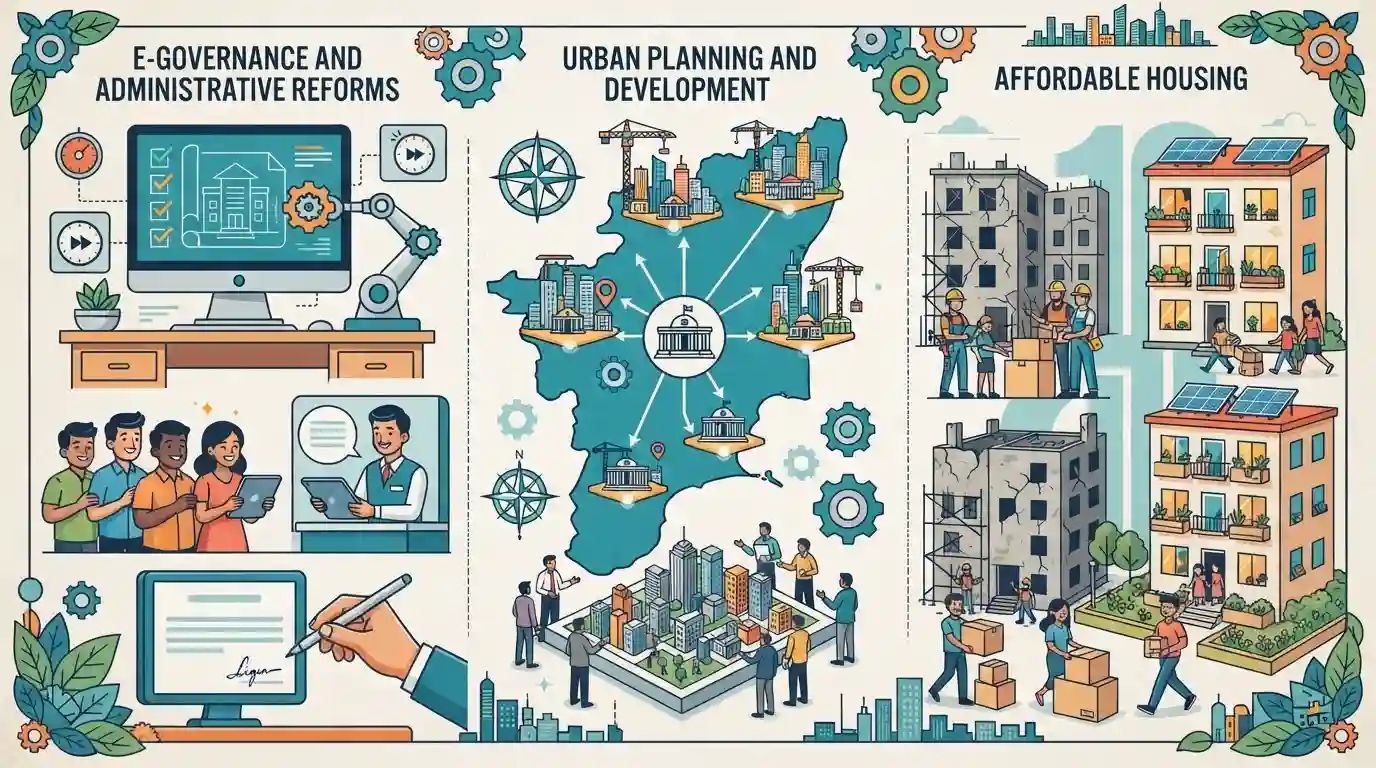
The Tamil Nadu government has announced multiple initiatives to upgrade urban administration and housing infrastructure. A key measure includes developing AI-powered software to fast-track building plan approvals by automatically processing compliant applications, thereby enhancing e-governance and reducing delays. Furthermore, the state is expediting the formal constitution of urban development authorities in six major cities—modeled after the Chennai Metropolitan Development Authority (CMDA)—to bolster decentralized urban planning. Simultaneously, the Tamil Nadu Urban Habitat Development Board (TNUHDB) will renovate or reconstruct approximately 28,000 dilapidated public housing tenements across the state to address residents' complaints and upgrade living conditions.
મુખ્ય મુદ્દા
- The Tamil Nadu government is developing AI-powered software to expedite and streamline building plan approvals in urban areas.
- The software aims to automatically process and clear applications that comply with prescribed building guidelines, significantly reducing approval timelines.
- The state is fast-tracking the formal constitution of urban development authorities in Hosur, Salem, Coimbatore, Tiruppur, Tiruchi, and Madurai to improve planned urbanization.
- The Tamil Nadu Urban Habitat Development Board (TNUHDB) is set to renovate or reconstruct around 28,000 dilapidated public housing tenements to improve residents' living conditions.
મહત્વપૂર્ણ શબ્દો
Chennai Metropolitan Development Authority (CMDA)

A statutory urban planning agency responsible for regulating, coordinating, and executing planned development, zoning, and building plan approvals within the Chennai Metropolitan Area.
UPSC context
GS Paper II (Governance) & III (Urbanization); tests administrative structures, decentralized planning, and urban governance reforms.
Tamil Nadu Urban Habitat Development Board (TNUHDB)
A state-run statutory body established to clear slums, construct affordable public housing tenements, and execute rehabilitation and resettlement schemes to improve living conditions in urban Tamil Nadu.
UPSC context
GS Paper II (Welfare Schemes) & III (Affordable Housing); tests state-level social housing initiatives and urban poverty alleviation.
Tamil Nadu Combined Development and Building Rules (TNCDBR), 2019
A unified regulatory framework that standardizes and governs land development, building construction, zoning, setbacks, and floor space index (FSI) compliance across all municipal and rural bodies in Tamil Nadu.
UPSC context
GS Paper III (Infrastructure & Urbanization); tests policies regulating building planning, safety standards, and sustainable real estate development.
E-Governance
The application of Information and Communication Technologies (ICT) by government agencies to deliver public services, exchange information, and conduct transactions transparently and efficiently.
UPSC context
GS Paper II (Governance); tests technological interventions, e-governance models, and administrative reforms for public service delivery.
પ્રિલિમ્સ ટ્રેપ
Urban Development Authorities (UDAs) are constitutionally mandated bodies under the 74th Amendment Act.
The 74th CAA mandates Metropolitan Planning Committees (MPCs), whereas Urban Development Authorities (like CMDA) are statutory parastatal entities created by state legislatures.
સંલગ્ન સ્થિર ખ્યાલો
What is the conflict between Parastatals and Urban Local Bodies (ULBs)?
- Functional Overlap: State-created parastatals (UDAs, water boards) often usurp planning and development functions earmarked for local bodies.
- Democratic Deficit: Parastatals are run by unelected bureaucrats, undermining the democratic accountability of elected municipal councillors.
- Financial Divestment: Major capital budgets flow directly to state-controlled parastatals, leaving ULBs financially crippled and dependent.
What are the constitutional provisions for Metropolitan Planning?
- Article 243ZE: Article 243ZE mandates the creation of an MPC in every metropolitan area to draft development plans.
- Democratic Composition: At least two-thirds of MPC members must be elected from among municipal and panchayat leaders in the area.
આંતર-વિષય પેટર્ન
AI Governance + Climate Resilience
Automated AI approval software can strictly enforce ecological zoning laws, directly preventing unauthorized development in floodplains to mitigate urban flooding.
Parastatals vs Municipal Autonomy
The expansion of state-appointed UDAs over elected ULBs reflects a persistent tension in fiscal and administrative federalism under the 74th Amendment.

Mains 2026 may contrast constitutional Metropolitan Planning Committees with statutory parastatals regarding local democratic governance.
સંલગ્ન PYQ · 3
સંલગ્ન PYQ · 3
- 2024MainsGS2
e-governance is not just about the routine application of digital technology in service delivery process. It is as much about multifarious interactions for ensuring transparency and accountability. In this context evaluate the role of the 'Interactive Service Model' of e-governance.
- 2023MainsGS2
e-governance, as a critical tool of governance, has ushered in effectiveness, transparency and accountability in governments. What inadequacies hamper the enhancement of these features ?
- 2013MainsGS1
Discuss the various social problems which originated out of the speedy process of urbanization in India.
