AI-enabled personal computers projected to become industry standard
Source:The Hindu ↗
Why It Matters
The transition to 'Edge AI' and local processing directly impacts data privacy, national cybersecurity, and the economics of emerging technologies. For UPSC aspirants, understanding the distinction between smartphone access and functional digital literacy (PC usage) is crucial for answers on human resource development and the digital divide. Furthermore, it ties into India's strategic goals under the India Semiconductor Mission to build a robust domestic hardware ecosystem.
Summary
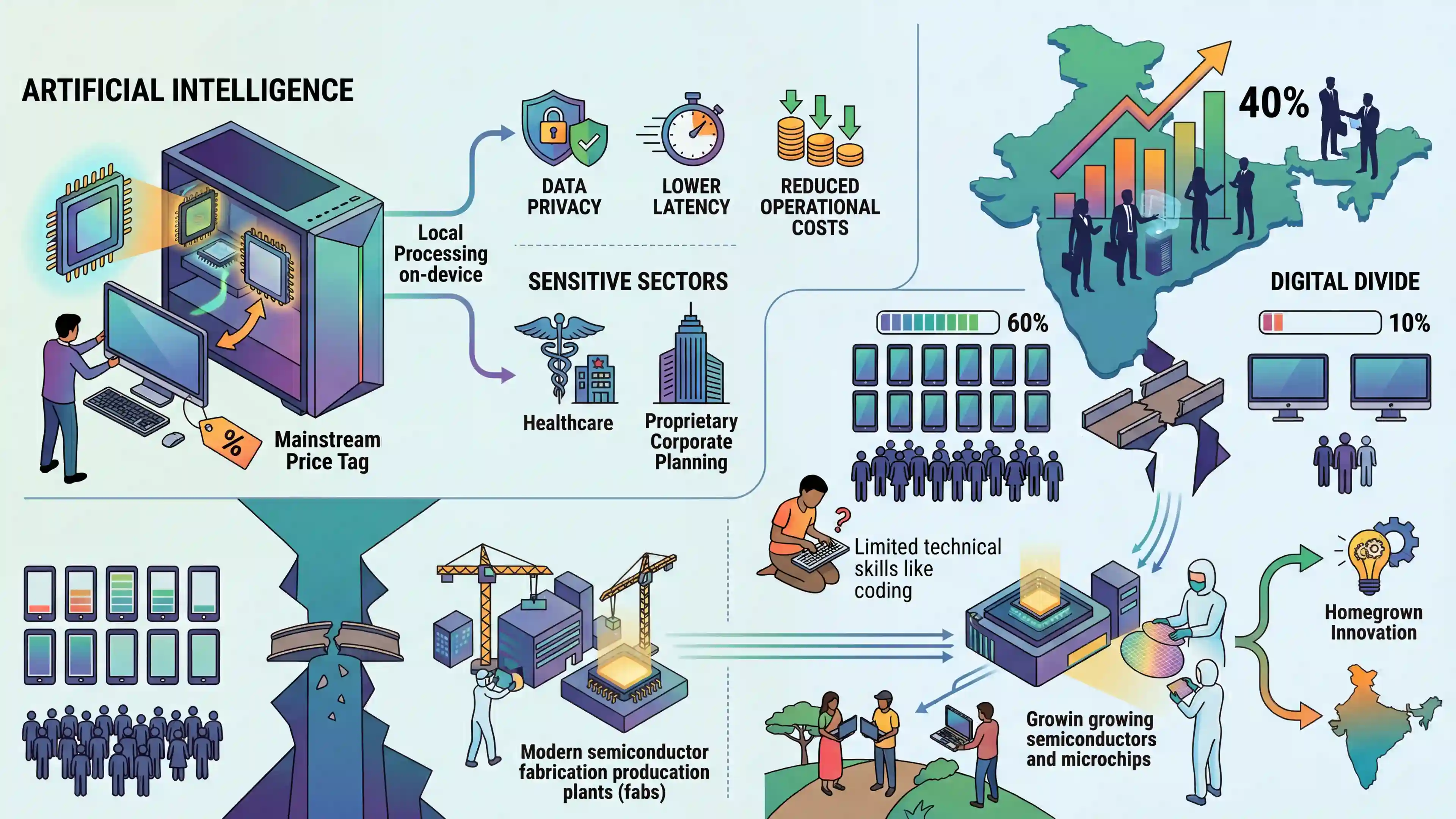
Intel's leadership projects that AI-enabled PCs will become the industry standard as prices become mainstream. These PCs leverage local CPUs, GPUs, and Neural Processing Units (NPUs) to process AI models directly on the device (edge computing). This shift from cloud to edge AI drastically reduces operational costs, mitigates latency, and ensures data privacy, making it highly suitable for sensitive sectors like healthcare and proprietary corporate planning. In India, the enterprise segment is driving a projected 40% CAGR in AI PC adoption to achieve significant efficiency gains. However, a significant 'digital divide' persists: while smartphone penetration is near 95%, PC penetration is under 10%, which limits the development of deeper technical skills like coding. Addressing this gap, alongside India's ongoing efforts to build domestic semiconductor fabs and supply chains, is seen as crucial for fostering homegrown innovation and extending technological benefits from urban enterprises to rural villages.
Key Points
- AI PCs integrate CPUs, GPUs, and NPUs to run complex AI models locally (Edge AI), reducing latency, cutting cloud computing costs, and protecting data privacy.
- India faces a critical digital skills divide: despite 95% smartphone penetration, PC penetration remains under 10%, limiting advanced skills like coding and AI experimentation.
- The Indian AI PC market is expected to grow at a 40% CAGR, heavily driven by enterprises seeking up to 30% gains in operational efficiency.
- India's strategic push for domestic semiconductor fabrication (chip fabs) and localized supply chains will further catalyze grassroots technological innovation and self-reliance.
Important Terms
Edge Computing

A distributed computing architecture where data is processed at or near the source (the 'edge') rather than in centralized cloud servers, reducing latency and enhancing data privacy.
UPSC context
GS Paper 3 (S&T); tests awareness of emerging IT infrastructure, IoT, and 5G applications.
Neural Processing Unit (NPU)
A specialized processor designed specifically to accelerate machine learning and AI tasks through parallel computing, offering higher efficiency for neural network processing than traditional CPUs or GPUs.
UPSC context
GS Paper 3 (S&T); tests knowledge of critical hardware components driving India's AI and electronics goals.
Digital Divide
The socio-economic gap between those with access to modern information technology (devices/internet) and those without, encompassing disparities in digital literacy, infrastructure, and usage patterns.
UPSC context
GS Papers 2 & 3; tests understanding of inclusive growth, e-governance, and socio-economic inequality.
Semiconductor Fabrication (Fab)
A highly advanced manufacturing facility (fab) where integrated circuits are produced on silicon wafers. These require massive capital, ultra-pure water, and uninterrupted power.
UPSC context
GS Paper 3 (Economy/S&T); relevant for topics on industrial policy and strategic self-reliance.
India Semiconductor Mission (ISM)
A government initiative launched in 2021 with a ₹76,000 crore outlay to develop a sustainable semiconductor and display ecosystem in India through fiscal support and PLI schemes.
UPSC context
GS Paper 3 (Economy/Governance); tests knowledge of industrial missions and tech-led growth strategies.
Prelims Trap
"AI PCs rely exclusively on cloud computing infrastructure to process complex machine learning models."
AI PCs specifically use NPUs to run complex models locally on the device (Edge Computing). This reduces cloud dependence, lowers latency, and enhances data privacy.
Static Concepts Connected
What is the difference between Edge Computing and Cloud Computing?
- Data Location: Edge computing processes data locally on the device (or nearby nodes), while cloud computing relies on distant, centralized servers.
- Latency & Bandwidth: Edge computing drastically reduces operational latency and saves bandwidth since data does not need to travel to a remote server and back.
- Privacy & Security: Edge AI keeps sensitive data on the device, minimizing exposure to interception during transmission or breaches at centralized cloud data centers.
What are India's key policy drivers for the semiconductor and IT hardware ecosystem?
- India Semiconductor Mission: A specialized business division created under the Digital India Corporation to build a sustainable semiconductor and display ecosystem.
- PLI Scheme: Financial incentives provided for manufacturing IT hardware (laptops, PCs) and setting up semiconductor fabs to cut import dependency.
- DLI Scheme: The Design Linked Incentive scheme offers financial and infrastructural support to domestic companies for semiconductor design and deployment.
Cross-Topic Patterns
Edge Computing and the DPDP Act
Localized data processing directly supports the data minimization and privacy-by-design principles of the Digital Personal Data Protection (DPDP) Act by eliminating the need to transfer sensitive data to external cloud servers.
Digital Divide + Demographic Dividend
India's 95% smartphone but <10% PC penetration creates a "consumption-only" digital literacy. Shifting to PC access is vital to unlock the demographic dividend through productive skill creation like coding.

A comparative Prelims question on NPUs vs GPUs, linked with the advantages of Edge Computing over Cloud AI, is highly probable for 2026.
Linked PYQs · 4
Linked PYQs · 4
- 2023MainsGS3
Introduce the concept of Artificial Intelligence (AI). How does Al help clinical diagnosis? Do you perceive any threat to privacy of the individual in the use of Al in healthcare?
- 2021MainsGS2
Has digital illiteracy, particularly in rural areas, coupled with lack of Information and Communication Technology (ICT) accessibility hindered socio-economic development? Examine with justification.
- 2020PrelimsGS1
With the present state of development, Artificial Intelligence can effectively do which of the following? 1. Bring down electricity consumption in industrial units 2. Create meaningful short stories and songs 3. Disease diagnosis 4. Text-to-Speech Conversion 5. Wireless transmission of electrical energy Select the correct answer using the code given below:
- 2025MainsGS3
India aims to become a semiconductor manufacturing hub. What are the challenges faced by the semiconductor industry in India? Mention the salient features of the India Semiconductor Mission.
