AI Nudify Apps and Intermediary Liability for Tech Giants
Source:Indian Express ↗
Why It Matters
The uncontrolled spread of AI-driven deepfakes poses severe threats to individual privacy and dignity, disproportionately affecting women. For UPSC aspirants, this case perfectly illustrates the practical challenges of regulating emerging technologies like AI, the ethical responsibilities of Big Tech platforms, and the evolving legal frameworks required to address new-age cybercrimes.
Summary
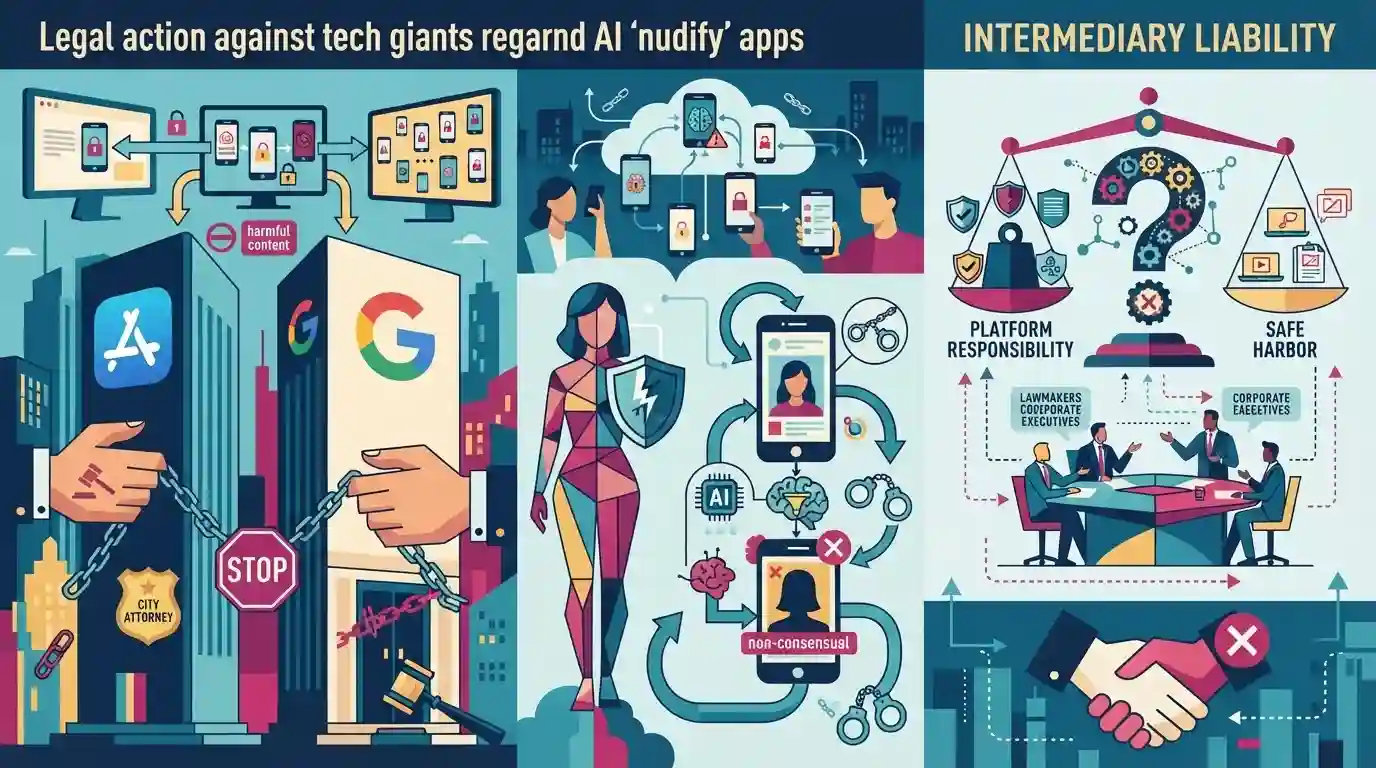
Legal action initiated by the San Francisco City Attorney against Apple and Google highlights the alarming proliferation of AI-powered 'nudify' apps that generate non-consensual intimate deepfakes. The authorities accused these tech giants of facilitating and profiting from such applications, violating California laws against deepfake pornography. The incident underscores critical issues surrounding the ethical use of Artificial Intelligence, digital privacy, and cybercrimes targeting women. It also brings to the forefront the debate on intermediary liability, questioning the extent to which major tech platforms must be held accountable for preemptively monitoring and removing harmful content from their app ecosystems.
Key Points
- AI-powered 'nudify' apps generating non-consensual intimate deepfakes (NCID) have prompted legal action against Apple and Google in San Francisco.
- The tech giants are accused of violating California laws by hosting, facilitating payments for, and profiting from apps that create non-consensual deepfake pornography.
- Investigations revealed that app stores not only hosted these apps but sometimes promoted them via search recommendations, raising questions about intermediary liability.
- Following the legal threats, both companies removed the identified apps and suspended the offending developer accounts.
- The case highlights the urgent need for stronger AI regulations, strict cyber laws protecting digital privacy, and greater ethical accountability for tech platforms.
Important Terms
Non-Consensual Intimate Imagery (NCII)

Any private, intimate, or sexually explicit image or video shared, created, or modified (such as AI deepfakes) and circulated online without the depicted individual's consent, violating their privacy and dignity.
UPSC context
Relevant for GS Paper III (Cyber Security & Cybercrimes against Women) and GS Paper II (Social Justice).
Intermediary Liability
The legal accountability of digital platforms and online services (such as app stores or social media hosts) for third-party content, applications, or communications hosted on their ecosystems.
UPSC context
Tested in GS Paper II (Government Policies & Digital Governance) and GS Paper III (IT Act and Cyber Security).
Safe Harbour Protection
A legal provision (such as Section 79 of India's IT Act) that immunizes internet intermediaries from liability for user-generated content, provided they adhere to prescribed due diligence and takedown guidelines.
UPSC context
Vital for GS Paper III (Cyber Security) and GS Paper II (E-Governance & Freedom of Speech debates).
California Assembly Bill 621 (AB 621)
A California law targeting deepfake pornography, granting victims a cause of action and extending civil liability to third-party services that knowingly facilitate or recklessly assist the ongoing operation of such services.
UPSC context
Useful for GS Paper II (Comparative Constitution & International Digital Governance frameworks).
Tech Transparency Project (TTP)
An initiative of the Campaign for Accountability that conducts investigative research to hold major technology monopolies and platforms accountable for issues regarding online safety, privacy, and regulatory compliance.
UPSC context
Important for GS Paper II (Role of NGOs, Civil Society, and Pressure Groups in digital governance).
Prelims Trap
Intermediaries in India enjoy absolute immunity for third-party AI deepfakes under the IT Act.
Safe harbour under Section 79 is strictly conditional. It is revoked if platforms fail to exercise due diligence or miss the strict 2-hour takedown window for intimate imagery.
Static Concepts Connected
What is 'Safe Harbour' protection for digital intermediaries under Indian law?
- Section 79 IT Act: Grants conditional immunity to platforms (e.g., Google, Apple) from legal liability for content posted by third-party users.
- Conditional Protection: Immunity applies only if the platform merely acts as a conduit and does not modify the transmission or initiate the content.
- Due Diligence Requirement: Protection is immediately lost if platforms fail to expeditiously remove unlawful content upon receiving a court or government order.
How do Generative Adversarial Networks (GANs) function to create deepfakes?
- Dual Networks: They utilize an AI architecture comprising two competing neural networks: a generator and a discriminator.
- The Generator: Creates synthetic images, audio, or video aiming to closely mimic real training data.
- The Discriminator: Evaluates the generated content against real data to detect fakes, forcing the generator to continuously improve until fakes are indistinguishable.
Cross-Topic Patterns
Deepfakes and Article 21 Privacy
Non-consensual deepfakes violate the fundamental right to privacy and bodily autonomy, directly linking emerging AI threats to the core constitutional principles of the Puttaswamy judgment.
Bletchley Declaration vs. Local Laws
Disjointed state-level lawsuits in the US contrast with India's strict IT Rules, highlighting the urgent need for cohesive international frameworks envisioned by the Bletchley Declaration.

Expect a 2026 Prelims question linking GAN neural networks, Section 79 safe harbour exemptions, and the Bletchley Declaration.
Linked PYQs · 5
Linked PYQs · 5
- 2023MainsGS3
Introduce the concept of Artificial Intelligence (AI). How does Al help clinical diagnosis? Do you perceive any threat to privacy of the individual in the use of Al in healthcare?
- 2020MainsGS3
Discuss different types of cyber crimes and measures required to be taken to fight the menace.
- 2024MainsGS3
Social media and encrypting messaging services pose a serious security challenge. What measures have been adopted at various levels to address the security implications of social media? Also suggest any other remedies to address the problem.
- 2024MainsGS4
The application of Artificial Intelligence as a dependable source of input for administrative rational decision-making is a debatable issue. Critically examine the statement from the ethical point of view.
- 2025MainsGS4
In the present digital age, social media has revolutionised our way of communication and interaction. However, it has raised several ethical issues and challenges. Describe the key ethical dilemmas in this regard.
