अध्ययन AI मॉडल के ऊर्जा और पर्यावरणीय पदचिह्न को उजागर करता है
स्रोत:द हिंदू ↗
क्यों मायने रखता है
It bridges two critical pillars of the GS3 syllabus: Science & Technology (IT, Computers) and Environmental Conservation. Aspirants must understand the hidden ecological trade-offs of rapid digital and AI transformation, highlighting the need for sustainable technological policies.
सारांश
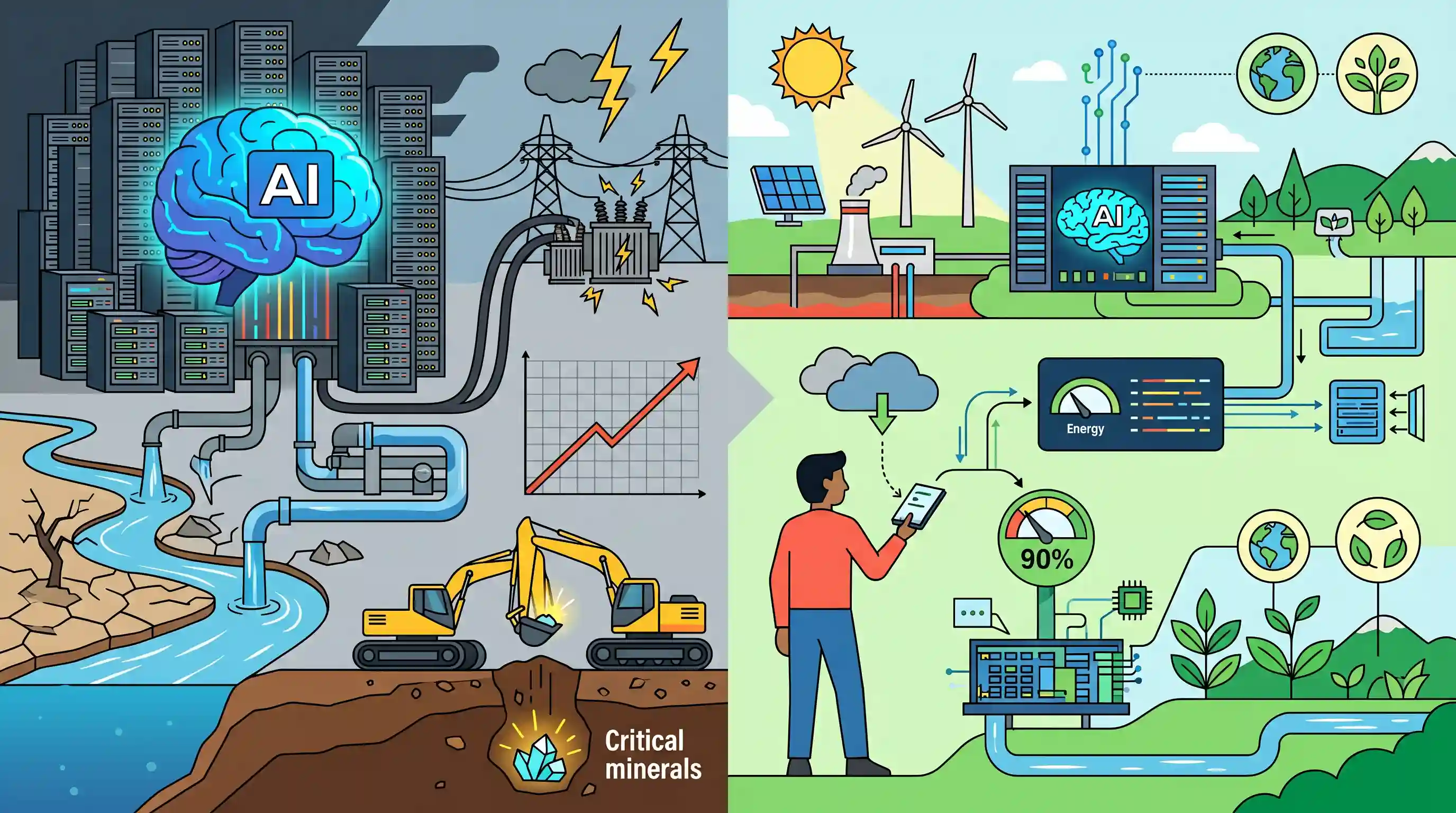
A recent UNESCO study released at the AI for Good global summit in Geneva highlights the massive and rapidly growing environmental footprint of artificial intelligence. The computational power required for generative AI models is severely straining global energy systems, water resources, and critical mineral supplies, with AI energy demand currently doubling every 100 days. However, the study suggests that adopting smaller, specialized AI models and writing concise user prompts can slash AI's energy consumption by up to 90%, offering a path toward more sustainable digital innovation.
मुख्य बिंदु
- A UNESCO study reveals that global energy demand for artificial intelligence is doubling every 100 days.
- Generative AI tools like ChatGPT consume approximately 0.34 Watt-hours per request, nearly 10 to 70 times more energy than a traditional Google search.
- The physical infrastructure required for AI expansion places immense strain on global energy grids, fresh water resources (for cooling data centers), and critical mineral supply chains.
- To mitigate this environmental impact, experts recommend utilizing smaller, task-specific AI models (like Google Gemma or GPT-4o mini) rather than massive general-purpose ones.
- Users can further reduce AI energy consumption by up to 90% simply by drafting shorter, more concise prompts and queries.
महत्वपूर्ण शब्द
UNESCO

The United Nations agency for education and culture, responsible for the 2025 report "Smarter, Smaller, Stronger" and the first global "Recommendation on the Ethics of Artificial Intelligence" (2021).
UPSC context
GS Paper 2/4: International organizations and ethical governance frameworks for emerging technologies and environmental sustainability.
International Telecommunication Union (ITU)
The specialized UN agency for information and communication technologies; it organizes the "AI for Good" Global Summit to align AI development with Sustainable Development Goals.
UPSC context
GS Paper 2: Role of international institutions in standardizing digital technology and bridging the global digital divide.
Small Language Models (SLMs)
AI systems with fewer parameters (typically under 30 billion) designed for efficiency, lower energy consumption, and on-device deployment compared to massive Large Language Models (LLMs).
UPSC context
GS Paper 3: Science and Technology; critical for sustainable AI, data privacy, and inclusive technology in resource-constrained settings.
Mistral AI
A French AI startup known for high-efficiency open-source models; it collaborated with UNESCO on the "Resilient AI Challenge" and published detailed environmental impact reports for its models.
UPSC context
GS Paper 3: Global technology trends; highlights the shift toward open-source, energy-efficient AI and international collaborative innovation.
Model Compression
Techniques like "quantization" that reduce the size and computational complexity of AI models, slashing energy use by up to 44% without significant performance loss.
UPSC context
GS Paper 3: Technology and Environment; innovative solutions for reducing the carbon footprint of digital infrastructure and data centers.
OpenAI
The creator of ChatGPT, frequently cited in sustainability studies because its massive generative models consume significantly more energy (0.34 Wh per query) than traditional internet searches.
UPSC context
GS Paper 3: Science & Tech; represents the "Large Language Model" paradigm and its impact on global energy and water resources.
प्रारंभिक ट्रैप
"The environmental footprint of artificial intelligence infrastructure is limited exclusively to its massive electricity consumption."
Aspirants often ignore the massive fresh water footprint required to cool data center servers and the critical mineral extraction needed for AI hardware manufacturing.
संबंधित अवधारणाएँ
How do AI data centers impact local environmental resources?
- Energy Intensity: Servers run continuously, requiring massive base-load electricity, often relying on fossil fuels if regional renewable grids are insufficient.
- Water Footprint: Liquid cooling systems in data centers consume millions of gallons of fresh water to prevent overheating, frequently straining local aquifers and municipal supplies.
- E-Waste Generation: Rapid cycles of upgrading specialized AI chips and servers lead to high volumes of hard-to-recycle electronic waste.
What is the difference between Large and Small Language Models?
- Architecture Scope: LLMs सामान्यीकृत कार्यों के लिए अरबों पैरामीटर्स का उपयोग करते हैं, जिसके लिए अत्यधिक कंप्यूट (compute) की आवश्यकता होती है। स्मॉल लैंग्वेज मॉडल्स (SLMs) को संकीर्ण और विशिष्ट कार्यों के लिए क्यूरेटेड डेटा पर प्रशिक्षित किया जाता है।
- Resource Efficiency: SLMs process queries with significantly less computational power, drastically reducing the associated carbon and energy footprint compared to general-purpose LLMs.
अंतर-विषय पैटर्न
AI compute meets critical mineral geopolitics
The exponential growth in AI data centers links S&T to geopolitics, driving massive demand for semiconductors and critical minerals (like gallium and rare earths), stressing global supply chains.
DPI expansion vs. Net Zero targets
As India scales AI-backed Digital Public Infrastructure (like Bhashini), balancing the resulting compute-driven carbon and water footprint against its Panchamrit climate commitments will become a key policy challenge.

Expect a 2026 prelims multi-statement question linking AI data centers' fresh water and mineral footprint with India's Net Zero targets.
संबद्ध PYQ · 4
संबद्ध PYQ · 4
- 2020PrelimsGS1
With the present state of development, Artificial Intelligence can effectively do which of the following? 1. Bring down electricity consumption in industrial units 2. Create meaningful short stories and songs 3. Disease diagnosis 4. Text-to-Speech Conversion 5. Wireless transmission of electrical energy Select the correct answer using the code given below:
- 2023MainsGS3
Introduce the concept of Artificial Intelligence (AI). How does Al help clinical diagnosis? Do you perceive any threat to privacy of the individual in the use of Al in healthcare?
- 2018MainsGS3
“Access to affordable, reliable, sustainable and modern energy is the sine qua non to achieve Sustainable Development Goals (SDGs).” Comment on the progress made in India in this regard.
- 2025PrelimsGS1
Consider the following statements : I. Carbon dioxide (CO2) emissions in India are less than 0.5 t CO2/ capita. II. In terms of CO2 emissions from fuel combustion, India ranks second in Asia-Pacific region. III. Electricity and heat producers are the largest sources of CO2 emissions in India. Which of the statements given above is/are correct?
