Artificial Intelligence Governance and Regulatory Challenges
Source:Indian Express ↗
Why It Matters
The widening gap between rapid technological advancement and slow regulatory mechanisms is a major contemporary governance challenge. The article highlights an industry perspective advocating for principle-based over rule-based regulation, which is highly relevant for UPSC questions exploring the administrative, ethical, and strategic dimensions of managing disruptive technologies like AI.
Summary
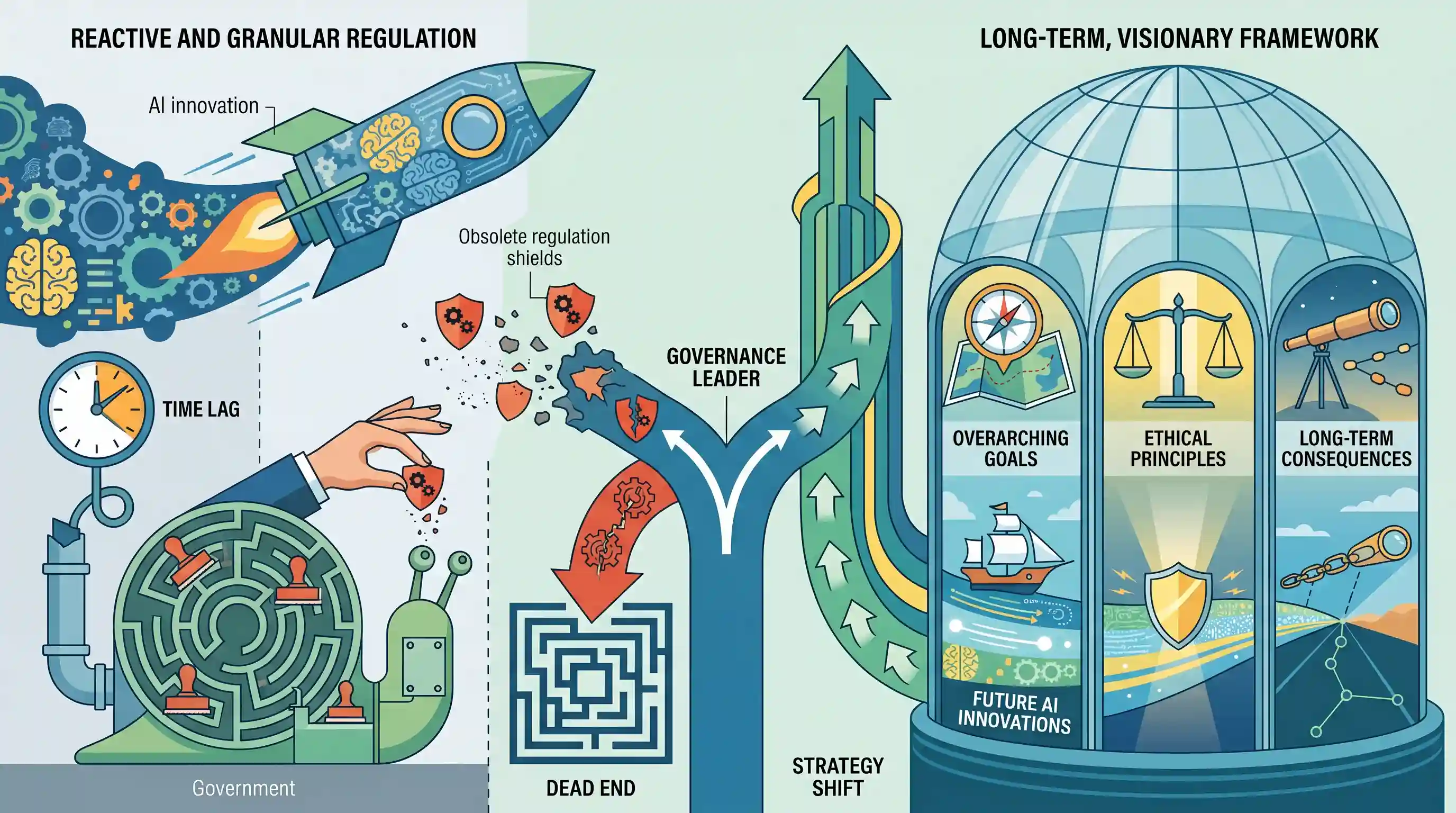
Dell CTO John Roese argues that governments must shift their Artificial Intelligence strategies away from regulating specific, rapidly evolving technologies and instead focus on establishing long-term, visionary frameworks. Because the pace of AI innovation far exceeds traditional bureaucratic processes, reactive and granular regulations quickly become obsolete. Roese advocates for a broader policy approach centered on overarching goals, ethical principles, and long-term consequences, which can provide necessary oversight while remaining adaptable to future technological advancements.
Key Points
- The rapid pace of Artificial Intelligence innovation inherently outpaces the speed of traditional government regulatory processes.
- Attempting to regulate specific AI tools or technologies is often ineffective, as these technologies evolve or become obsolete before regulations can be implemented.
- Governments should shift their focus towards establishing long-term visions and broad ethical frameworks for AI governance rather than granular, reactive rules.
- A principle-based approach to AI strategy allows for adaptability, ensuring that policies remain relevant as the technology continues to advance.
Important Terms
Artificial Intelligence (AI)

Simulation of human intelligence by machines, involving processes like machine learning and reasoning to perform tasks that typically require human cognition.
UPSC context
GS Paper 3 (Science & Technology); focuses on the impact of disruptive technology on growth and security.
Technology Governance
The framework of rules, norms, and institutions that manage the development and use of technologies to ensure they align with societal values and safety.
UPSC context
GS Paper 2 (Governance) and GS Paper 3; tests the ability to balance innovation with oversight.
Adaptive Regulation
A flexible regulatory approach that uses iterative feedback and data analysis to adjust rules as technology evolves, rather than relying on static legislation.
UPSC context
GS Paper 3 (S&T Policy); critical for understanding agile governance in the rapidly changing digital economy.
AI Ethics
A system of moral principles and techniques intended to inform the responsible development and use of artificial intelligence, addressing issues like bias and accountability.
UPSC context
GS Paper 4 (Ethics); essential for discussing transparency and fairness in automated decision-making.
Science, Technology, and Innovation Policy (STIP)
A national policy framework (e.g., STIP 2020) outlining strategies for scientific advancement, research funding, and technological indigenization to drive socio-economic growth.
UPSC context
GS Paper 3 (S&T); tests knowledge of institutional planning and India’s goal of scientific self-reliance.
Prelims Trap
India currently regulates AI by imposing stringent, granular legal rules on specific generative AI algorithms.
India currently avoids rigid, technology-specific AI laws, instead favoring a pro-innovation, principle-based 'techno-legal' framework and regulatory sandboxes to adapt to rapid technological changes.
Static Concepts Connected
What is a 'Regulatory Sandbox' in technology governance?
- Definition: A live testing environment where new technological products and services are trialed on real consumers under a relaxed regulatory framework.
- Purpose: It balances rapid technological innovation with consumer protection, allowing governments to learn about a technology without enforcing immediate, heavy compliance burdens.
What is the 'Black Box' problem in AI?
- Algorithmic Opacity: A scenario in advanced deep learning models where the internal decision-making process is completely hidden and unexplainable, even to the original developers.
- Regulatory Challenge: It makes granular regulation of specific AI tools nearly impossible, forcing governments to regulate overarching ethical outcomes and mandate 'Explainable AI' (XAI).
Cross-Topic Patterns
The Collingridge Dilemma in Tech
The difficulty of regulating a technology before it is entrenched applies equally to AI, cryptocurrencies, and CRISPR gene-editing. This demands agile, sandbox-based governance rather than static laws.
Generative vs. Agentic AI
UPSC frequently tests generational tech shifts (e.g., Web 1.0 vs 3.0). AI is shifting from Generative (smart assistants) to Agentic (autonomous agents executing tasks), requiring highly dynamic policy frameworks.

Expect a GS-3 question contrasting the EU's strict 'risk-based' AI Act with India's agile 'techno-legal' governance approach in 2026.
Linked PYQs · 5
Linked PYQs · 5
- 2023MainsGS3
Introduce the concept of Artificial Intelligence (AI). How does Al help clinical diagnosis? Do you perceive any threat to privacy of the individual in the use of Al in healthcare?
- 2024MainsGS4
The application of Artificial Intelligence as a dependable source of input for administrative rational decision-making is a debatable issue. Critically examine the statement from the ethical point of view.
- 2024MainsGS4
ABC Incorporated is a technological company named which is the second largest worldwide, situated in the Third World. You are the Chief Executive Officer and the majority shareholder of this company. The fast technological improvements have raised worries among environmental activists, regulatory authorities, and the general public over the sustainability of this scenario. You confront substantial issues about the business's environmental footprint. In 2023, your organization had a significant increase of 48% in greenhouse gas emissions compared to the levels recorded in 2019. The significant rise in energy consumption is mainly due to the surging energy requirements of your data centers, fuelled by the exponential expansion of Artificial Intelligence (AI). AI-powered services need much more computational resources and electrical energy compared to conventional online activities, notwithstanding their notable gains. The technology's proliferation has led to a growing concern over the environmental repercussions, resulting in an increase in warnings. Al models, especially those used in extensive machine learning and data processing, exhibit much greater energy consumption than conventional computer tasks, with an exponential increase. Although there is already a commitment and goal to achieve net zero emissions by 2030, the challenge of lowering emissions seems overwhelming as the integration of Al continues to increase. To achieve this goal, substantial investments in renewable energy use would be necessary. The difficulty is exacerbated by the competitive environment of the technology sector, where rapid innovation is essential for preserving market standing and shareholders' worth. To achieve a balance between innovation, profitability and sustainability, a strategic move is necessary that is in line with both, business objectives and ethical obligations. (a) What is your immediate response to the challenges posed in the above case? (b) Discuss the ethical issues involved in the above case. (c) Your company has been identified to be penalized by technological giants. What logical and ethical arguments will you put forth to convince about its necessity? (d) Being a conscience being, what measures would you adopt to maintain balance between AI innovation and environmental footprint?
- 2020PrelimsGS1
With the present state of development, Artificial Intelligence can effectively do which of the following? 1. Bring down electricity consumption in industrial units 2. Create meaningful short stories and songs 3. Disease diagnosis 4. Text-to-Speech Conversion 5. Wireless transmission of electrical energy Select the correct answer using the code given below:
- 2025MainsGS2
e-governance projects have a built-in bias towards technology and back-end integration than user-centric designs. Examine.
