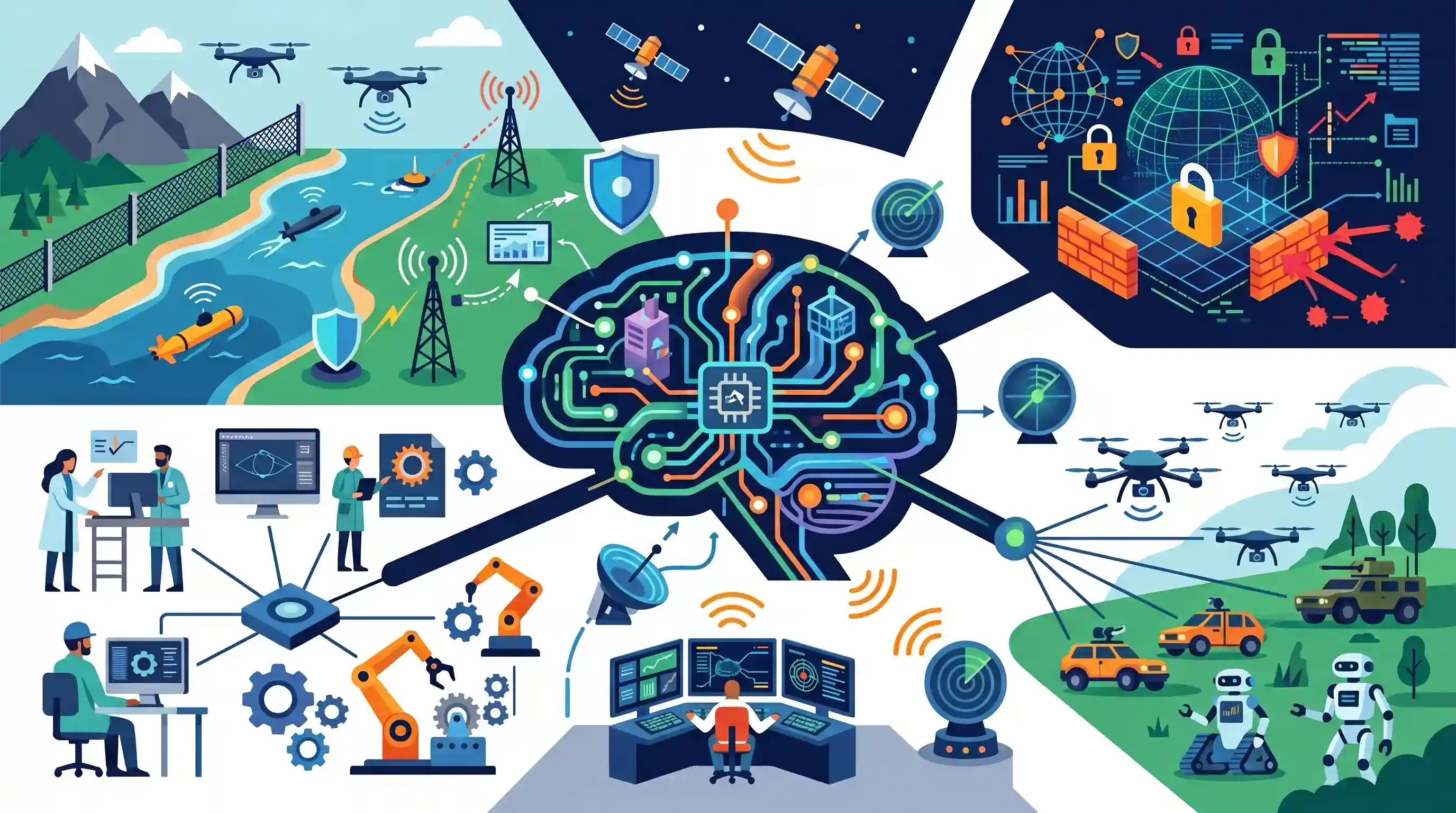
Artificial intelligence integration in modern defense and security
Source:Indian Express ↗
Why It Matters
Understanding AI's role in defense modernization is crucial for GS-3, where UPSC frequently evaluates emerging technologies, their strategic applications, cyber security threats, and India's push for self-reliance in military infrastructure.
Summary
The article argues that Artificial Intelligence has become the core operational framework—the "nervous system"—of modern defense strategies. To counter rapidly evolving global security threats and the modernization of adversarial militaries, India must adopt a "mission mode" approach to military AI. This requires moving beyond pilot projects to large-scale integration of AI across autonomous systems, cyber defense, and intelligence operations. Fostering indigenous capabilities in defense technology is highlighted as essential to maintain strategic autonomy and combat readiness.
Key Points
- Artificial Intelligence acts as the central nervous system of modern warfare, fundamentally altering Command, Control, Communications, Computers, Intelligence, Surveillance, and Reconnaissance (C4ISR) systems.
- India must transition from fragmented AI adoption to a unified 'mission mode' to build robust and scalable military capabilities.
- AI applications in defense encompass autonomous platforms (UAVs/drones), predictive maintenance, cyber threat detection, and intelligence processing.
- Achieving self-reliance (Atmanirbhar Bharat) in military AI is critical to prevent dependencies on foreign technologies and ensure national security.
Important Terms
iDEX (Innovations for Defence Excellence)

A framework launched in 2018 to foster innovation in defense and aerospace by engaging startups, MSMEs, and academia through grants and technological support.
UPSC context
GS Paper 3 (S&T/Indigenization); tests understanding of public-private partnerships and defense R&D ecosystems.
Atmanirbhar Bharat
A policy vision for self-reliant India, prioritizing domestic design, development, and manufacturing of critical technologies—particularly in defense—to reduce import dependence.
UPSC context
GS Paper 3 (Economy/Security); critical for questions on defense indigenization and strategic self-sufficiency.
DRDO (Defence Research and Development Organisation)
India's premier military R&D agency under the Ministry of Defence, focused on developing advanced indigenous weapon systems, sensors, and dual-use technologies like AI.
UPSC context
GS Paper 3 (S&T/Security); central to the institutional framework for national defense technological advancement.
Strategic Autonomy
A nation’s ability to make independent foreign policy and security decisions without being structurally dependent on external powers or alliance obligations.
UPSC context
GS Paper 2 (International Relations); fundamental concept in Indian foreign policy and defense posture.
Mission Mode
A governance approach where high-priority initiatives are executed with clearly defined objectives, specific timelines, focused resources, and measurable milestones.
UPSC context
GS Paper 2 (Governance); tests knowledge of project management frameworks in national technology missions.
Prelims Trap
"Project Sanjay is a civilian AI governance initiative under the Ministry of Electronics and Information Technology."
Project Sanjay is not a civilian or welfare AI scheme; it is the Indian Army's Battlefield Surveillance System, integrating multi-source sensors into a centralized GIS.
Static Concepts Connected
What is C4ISR in the context of modern military operations?
- Definition: It stands for Command, Control, Communications, Computers, Intelligence, Surveillance, and Reconnaissance.
- Strategic Purpose: It provides comprehensive situational awareness, enabling military commanders to make rapid, informed decisions through real-time data integration.
- AI Integration: AI acts as the central processor, rapidly filtering vast sensor data to automate threat detection, predictive maintenance, and target acquisition.
How does the Comprehensive Integrated Border Management System (CIBMS) utilize technology?
- Core Objective: To replace manual patrolling with an electronic, multi-tier surveillance network to curb cross-border infiltration and smuggling.
- Hardware Components: It utilizes thermal imagers, aerostats, ground radar, and fiber-optic sensors to feed continuous data to centralized command-and-control rooms.
- Role of AI: AI algorithms process real-time feeds to distinguish between genuine threats and environmental noise, drastically reducing false alarms.
Cross-Topic Patterns
Military AI + Semiconductor Geopolitics
Military AI relies on advanced microchips. India's push for Atmanirbhar Bharat in defence is strictly bottlenecked by its success in the India Semiconductor Mission to prevent supply-chain blackmail.
Cyber Security + Civil-Military Fusion
Dual-use technologies from iDEX are increasingly scaling across civilian infrastructure. Predictive AI used for military cyber defence directly mirrors the systems needed to protect civilian power grids from state-sponsored hacks.

Prelims 2026 will likely test 'Project Sanjay', 'DAIC', and 'DAIPA' as match-the-following pairs under emerging defense technologies.
Linked PYQs · 4
Linked PYQs · 4
- 2023MainsGS3
Introduce the concept of Artificial Intelligence (AI). How does Al help clinical diagnosis? Do you perceive any threat to privacy of the individual in the use of Al in healthcare?
- 2023MainsGS3
The use of unmanned aerial vehicles (UAVs) by our adversaries across the borders to ferry arms/ammunitions, drugs, etc., is a serious threat to the internal security. Comment on the measures being taken to tackle this threat.
- 2021MainsGS3
Keeping in view India's internal security, analyse the impact of cross-border cyber attacks. Also discuss defensive measures against these sophisticated attacks.
- 2020PrelimsGS1
With the present state of development, Artificial Intelligence can effectively do which of the following? 1. Bring down electricity consumption in industrial units 2. Create meaningful short stories and songs 3. Disease diagnosis 4. Text-to-Speech Conversion 5. Wireless transmission of electrical energy Select the correct answer using the code given below:
