IndiaAI Mission and Compute Deficits in the Global AI Race
Source:The Hindu ↗
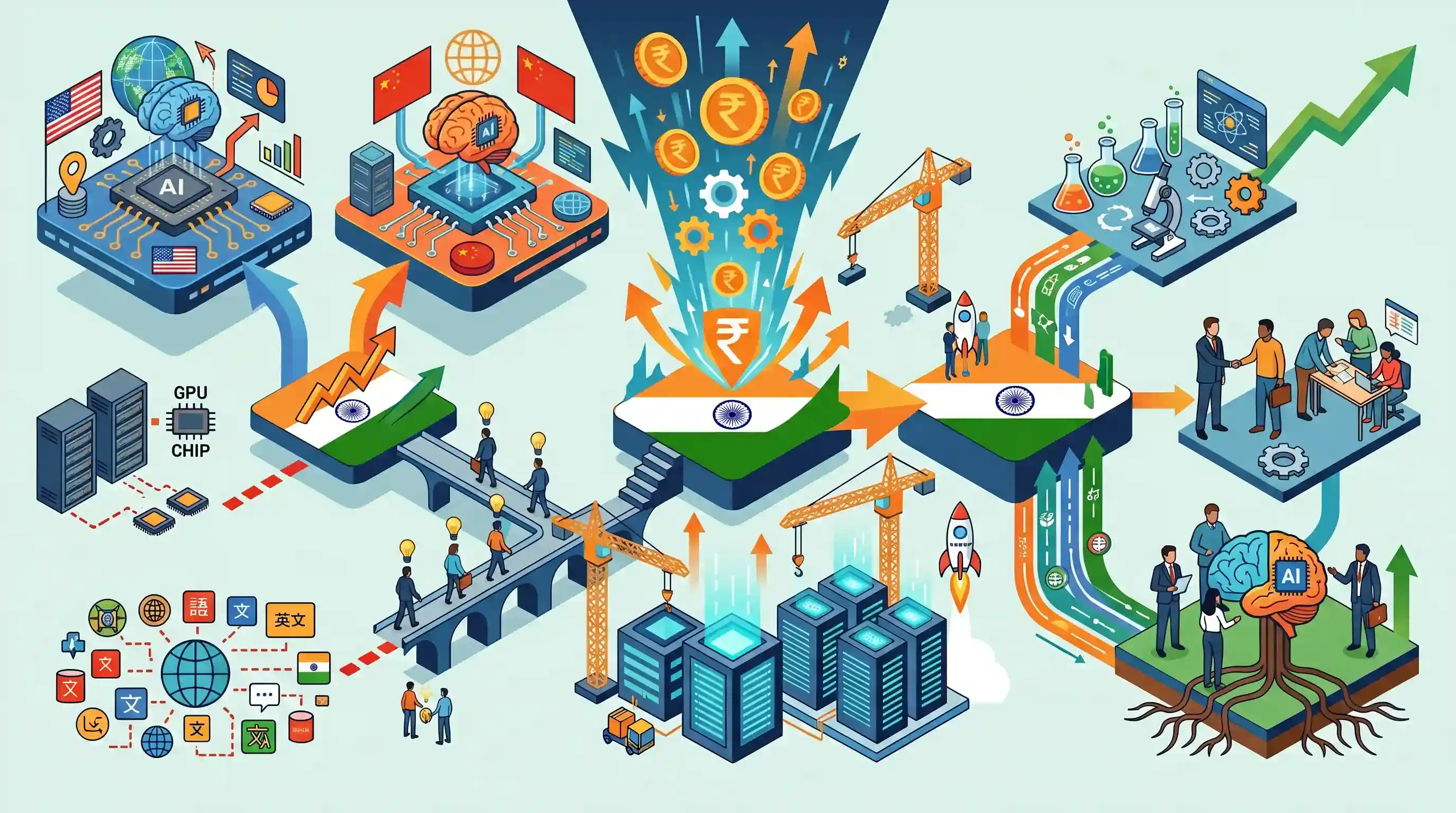
Why It Matters
AI is a transformative technology shaping global economic and security paradigms. Understanding India's infrastructural deficits (like GPU shortages), talent retention challenges, and corrective government policies (IndiaAI Mission) is crucial for GS-3 answers on Science & Technology, indigenization, and digital infrastructure.
Summary
The article evaluates India's position in the global Artificial Intelligence (AI) race, highlighting a growing concern that the country is falling behind leaders like the US and China in foundational AI research and model development. Despite a thriving broader tech sector, India faces critical shortages in advanced computing infrastructure (such as GPUs) and high-quality indigenous datasets. The continuous migration of top AI talent to the West further exacerbates the issue. While the recently approved ₹10,372 crore IndiaAI Mission aims to address these infrastructural deficits and support startups, achieving self-reliance in AI requires sustained investments in R&D, stronger public-private collaboration, and robust strategies to retain technical talent.
Key Points
- India currently lags behind global leaders like the US and China in the development of foundational Artificial Intelligence (AI) models.
- A primary bottleneck is the severe deficit in domestic compute infrastructure, specifically the high-end GPUs required for training large language models.
- The ₹10,372 crore IndiaAI Mission is a key government intervention aiming to democratize access to computing power for startups and researchers.
- The persistent 'brain drain' of top AI talent to Western countries due to better research facilities and compensation remains a critical challenge for India's AI ecosystem.
- While initiatives like Bhashini harness India's linguistic diversity, there is a broader need for high-quality, structured indigenous datasets to train localized AI models.
Important Terms
IndiaAI Mission

A ₹10,372 crore national initiative under MeitY to establish a comprehensive AI ecosystem, including compute infrastructure (10,000+ GPUs), foundational model development, and support for deep-tech startups.
UPSC context
GS III: Science & Technology (S&T); crucial for topics on indigenization of technology and digital public infrastructure.
Bhashini
An AI-powered multilingual platform under the National Language Translation Mission (NLTM) designed to break language barriers and provide digital services in 22 official Indian languages.
UPSC context
GS III: S&T; tests knowledge of AI applications for social inclusion and the 'Digital India' initiative.
Graphics Processing Units (GPUs)
Specialized hardware essential for high-speed parallel processing required to train Large Language Models (LLMs). The IndiaAI Mission focuses on building a 'Compute Capacity' pool of these processors.
UPSC context
GS III: S&T; relevant for infrastructure deficits in India's tech sector and emerging technology hardware.
AI Kosh
A central repository under the IndiaAI Mission providing high-quality, non-personal indigenous datasets to researchers and startups to ensure data sovereignty and accurate training of Indian-context AI.
UPSC context
GS III: S&T; concerns data sovereignty and the foundational requirements for indigenous technology development.
Anusandhan National Research Foundation (ANRF)
A statutory body established under the ANRF Act, 2023, to provide strategic direction and funding for national R&D, replacing the Science and Engineering Research Board (SERB).
UPSC context
GS III: S&T; central to discussions on institutional frameworks for research, innovation, and R&D funding.
Indigenization of Technology
Developing technological capabilities and manufacturing within India to reduce import reliance. In AI, this refers to building 'Sovereign AI' using local infrastructure and models.
UPSC context
GS III: S&T; a core syllabus theme involving self-reliance (Atmanirbharta) and defense/IT sectors.
Prelims Trap
"India hosts over 20% of global data centre capacity in line with its massive share of global data generation."
While India generates roughly 20% of global data, it currently hosts only about 3% of global data centre capacity, creating a severe compute deficit.
Static Concepts Connected
What distinguishes a Foundational AI Model from traditional AI?
- Broad adaptability: Trained on massive, unlabelled datasets, allowing the same base model to be adapted to a wide variety of downstream tasks.
- Resource intensity: Requires extraordinary computing power (thousands of high-end GPUs) and vast data centre infrastructure, unlike narrow AI applications.
- Generative capacity: Forms the core architecture capable of generating novel text, code, or images (e.g., Large Language Models).
What are the primary objectives of the newly approved IndiaAI Mission?
- Compute capacity: Establishing a sovereign computing ecosystem of over 10,000 GPUs for startups and researchers via a Public-Private Partnership model.
- Indigenous models: Developing local Foundational Models through the IndiaAI Innovation Centre to reduce dependence on foreign hyperscalers.
- Dataset access: Creating a unified IndiaAI Datasets Platform to provide innovators seamless access to high-quality, non-personal datasets.
Cross-Topic Patterns
Sovereign AI + DPDP Act 2023
Building indigenous AI models (Sovereign AI) aligns directly with the Digital Personal Data Protection Act by keeping the processing of sensitive Indian datasets within domestic borders, limiting foreign hyperscaler reliance.
AI Compute + Semiconductor Mission
India's AI ambitions are bottlenecked by reliance on imported GPUs. The success of the IndiaAI Mission fundamentally depends on the long-term silicon fabrication goals of the India Semiconductor Mission.

Expect a multi-statement Prelims question merging IndiaAI Mission’s GPU targets with Project Bhashini’s linguistic dataset capabilities.
Linked PYQs · 2
Linked PYQs · 2
- 2020PrelimsGS1
With the present state of development, Artificial Intelligence can effectively do which of the following? 1. Bring down electricity consumption in industrial units 2. Create meaningful short stories and songs 3. Disease diagnosis 4. Text-to-Speech Conversion 5. Wireless transmission of electrical energy Select the correct answer using the code given below:
- 2023MainsGS3
Introduce the concept of Artificial Intelligence (AI). How does Al help clinical diagnosis? Do you perceive any threat to privacy of the individual in the use of Al in healthcare?
