Integration of artificial intelligence in urban water management
Source:Indian Express ↗
Why It Matters
Provides an excellent, actionable case study for Mains GS3 on how emerging technologies (AI, robotics, IoT) can solve acute urban resource crises, specifically freshwater management and leakage prevention. It also serves as a strong governance example for modernizing municipal infrastructure.
Summary
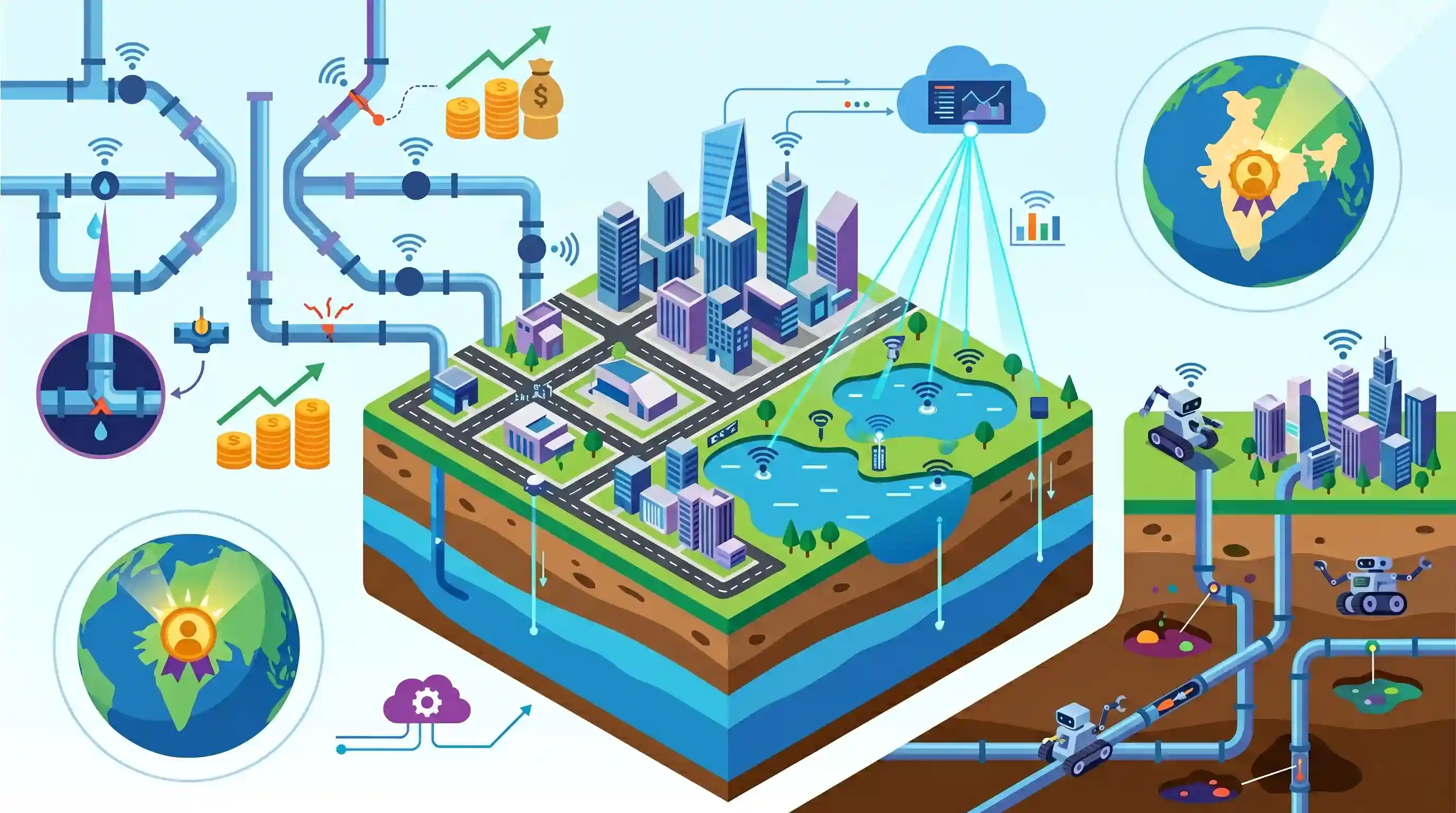
Ram Prasath Manohar, Chairman of the Bangalore Water Supply and Sewerage Board (BWSSB), has been selected for the Senior Utility Advisory Group of the global Smart Water Networks Forum (SWAN)—the only Indian in the cohort. This global recognition highlights BWSSB's successful integration of AI, IoT, and robotics to modernize Bengaluru's water infrastructure. Key interventions include saving ₹40 crore annually by curbing leakages, using IoT for real-time groundwater monitoring in 40 urban lakes, and deploying robots to efficiently detect contamination sources without extensive road digging.
Key Points
- BWSSB Chairman Ram Prasath Manohar is the only Indian appointed to the Senior Utility Advisory Group of the global Smart Water Networks Forum (SWAN).
- AI tools deployed in water pumping stations and sewage treatment plants have saved ₹40 crore annually by actively preventing leakages.
- AI-enabled IoT sensors are providing real-time monitoring of groundwater levels across approximately 40 lakes in Bengaluru.
- Advanced robotics are being utilized to pinpoint drinking water contamination sources swiftly, mitigating the need for disruptive road excavations.
- The initiative showcases a successful model of leveraging digital transformation for sustainable urban water governance.
Important Terms
Bangalore Water Supply and Sewerage Board (BWSSB)

A statutory body established in 1964 under the BWSSB Act, responsible for water supply, sewerage disposal, and wastewater management in Bengaluru.
UPSC context
GS Paper 2 & 3: Statutory bodies; urban infrastructure and water security challenges.
Smart Water Networks Forum (SWAN)
A leading global non-profit organization that accelerates the adoption of data-driven 'smart' solutions for water, wastewater, and stormwater networks worldwide.
UPSC context
GS Paper 3: Science and Technology; international cooperation in digital transformation of public utilities.
Non-Revenue Water (NRW)
Water produced by a utility that is 'lost' through leaks, theft, or metering errors before it reaches the customer, resulting in financial and resource loss.
UPSC context
GS Paper 3: Environmental conservation and efficiency in urban resource management.
Smart Water Management
The application of sensors, real-time data, and AI to monitor water flow, pressure, and quality, enabling predictive maintenance and efficient resource distribution.
UPSC context
GS Paper 3: Application of AI and IoT in improving public service delivery.
Urban Governance
The administrative, political, and technical processes through which city-level authorities manage resources and provide essential services to urban populations.
UPSC context
GS Paper 2: Local self-government, transparency, and administrative efficiency in megacities.
Prelims Trap
"The Smart Water Networks Forum (SWAN) is a specialized intergovernmental agency under UN-Water."
SWAN is a global non-profit industry forum, not an intergovernmental body. UPSC often traps students by associating tech/climate initiatives with the UN framework.
Static Concepts Connected
What is Non-Revenue Water (NRW) in urban utilities?
- Definition: Treated water that is lost before it reaches the end customer and generates no revenue.
- Primary causes: Driven by physical losses (leaks, pipe bursts), commercial losses (meter inaccuracies, theft), and unbilled authorized consumption.
- Economic impact: High NRW (averaging 38-50% in major Indian metros) severely depletes municipal budgets and exacerbates urban water stress.
How are IoT and Robotics applied in municipal utility management?
- IoT Sensors: Enables real-time telemetry for tracking groundwater levels, pressure variations, and lake recharge without reactive manual sampling.
- Pipeline Robotics: Provides 'trenchless' diagnostics to accurately pinpoint underground leaks and contamination sources, avoiding disruptive urban road excavations.
- Predictive Analytics: Analyzes sensor data to detect invisible leak anomalies in pumping stations, actively preventing sewage overflows and freshwater loss.
Cross-Topic Patterns
NRW's impact on municipal finances
High Non-Revenue Water directly cripples Urban Local Bodies' (ULBs) financial autonomy. Tech-driven leak prevention is crucial for securing municipal performance grants under the 15th Finance Commission.
Urban flood-drought paradox + AI solutions
Bengaluru's dual challenge of flooding and extreme drought is a classic GS1 urbanization theme. AI and IoT bridge this by simultaneously monitoring stormwater runoff and groundwater recharge patterns.

Expect a Prelims question on tech applications combining 'Non-Revenue Water', IoT telemetry, and trenchless robotics in urban governance.
Linked PYQs · 3
Linked PYQs · 3
- 2024MainsGS3
The world is facing an acute shortage of clean and safe freshwater. What are the alternative technologies which can solve this crisis? Briefly discuss any three such technologies citing their key merits and demerits.
- 2020MainsGS3
Suggest measures to improve water storage and irrigation system to make its judicious use under depleting scenario.
- 2025MainsGS3
Examine the factors responsible for depleting groundwater in India. What are the steps taken by the government to mitigate such depletion of groundwater?
