Military AI Deployment in Venezuela and UPSC Governance Concerns
Source:Indian Express ↗
Why It Matters
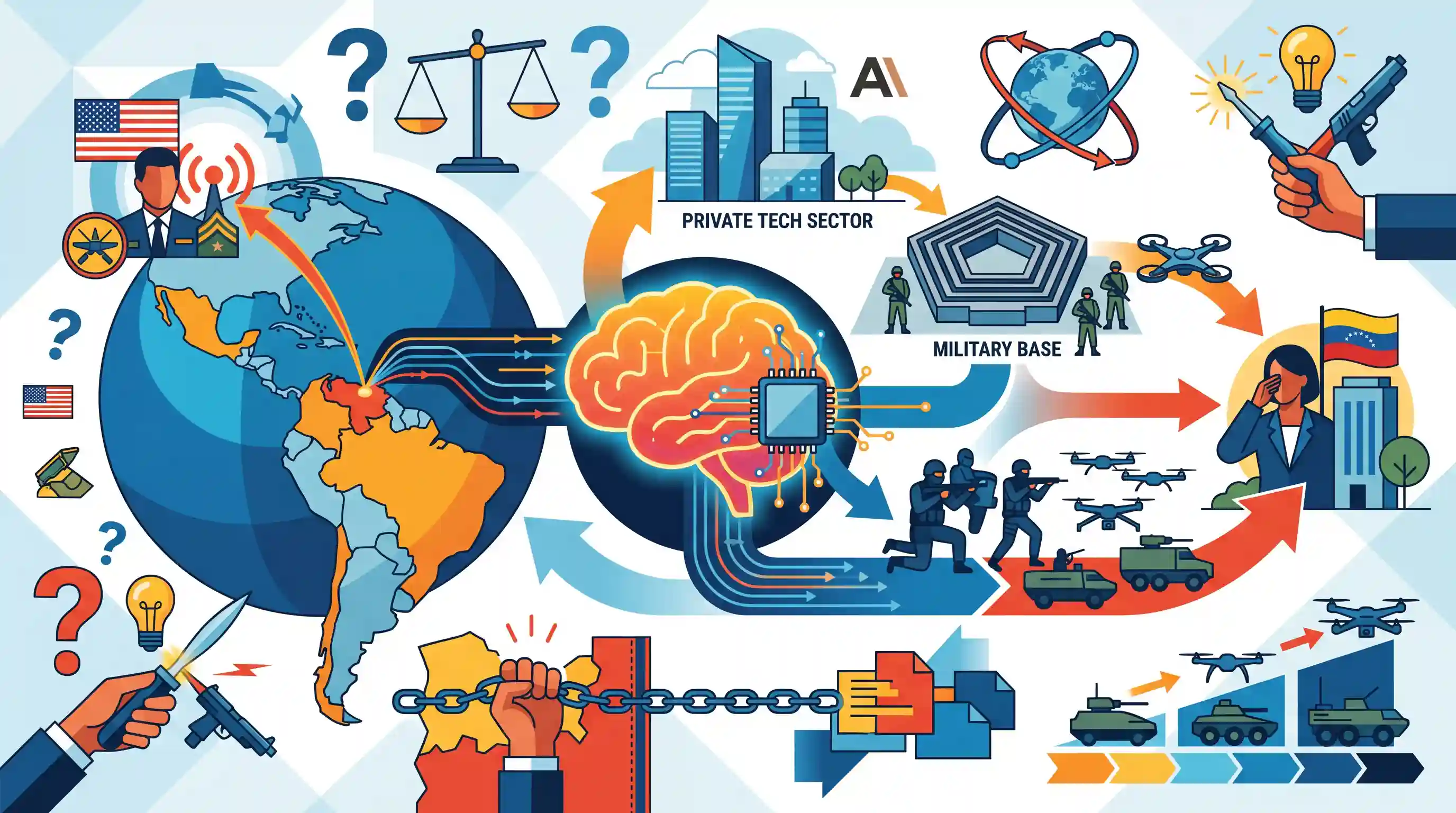
The practical use of commercial AI in a covert military operation underscores the rapid militarization of AI, challenging existing frameworks for global technology governance, AI ethics, and international law regarding sovereignty and intervention.
Summary
The US Military reportedly used Anthropic's generative AI model, Claude, during a covert intelligence and special operations mission in Venezuela aimed at capturing President Nicolás Maduro. This deployment marks a significant escalation in the application of commercial AI technologies for active military and intelligence purposes, demonstrating AI's capability for real-time data processing in high-stakes environments. The incident exposes the growing collaboration between private tech firms and defense establishments, raising profound ethical, legal, and geopolitical questions concerning dual-use technologies, international sovereignty, and the future of AI in warfare.
Key Points
- The US Military reportedly utilized Anthropic's Claude AI model to assist in a covert mission aimed at capturing Venezuelan President Nicolás Maduro.
- The operation demonstrates the growing integration of generative AI in active military and intelligence operations for rapid data processing and strategic analysis.
- The deployment of a commercial AI model in a combat-oriented mission highlights the dual-use nature of AI technologies and the complexities of enforcing corporate ethical guardrails.
- This incident raises significant geopolitical and international law concerns regarding state sovereignty, foreign intervention, and the future of AI-assisted warfare.
Important Terms
Anthropic

A US-based AI safety and research company that developed 'Claude.' It represents the 'constitutional AI' approach, balancing high-performance commercial models with strict ethical constraints against misuse in violence or surveillance.
UPSC context
GS Paper III: Science & Technology and Ethics. Tests understanding of private sector's role in national security and ethical AI governance.
Dual-Use Technology
Technologies, like AI or nuclear energy, developed for civilian use but applicable in military contexts. They pose significant regulatory challenges regarding export controls and preventing weaponization by state or non-state actors.
UPSC context
GS Paper III: Internal Security and Science. Crucial for discussing emerging threats, SCOMET guidelines, and international technology regimes.
Generative AI (GenAI)
Artificial Intelligence capable of creating text, images, or code. In military contexts, it processes vast intelligence data in real-time to assist in battlefield decision-making and operational planning.
UPSC context
GS Paper III: Internal Security. Evaluates the shift toward 'AI-led warfare' and its implications for cybersecurity and misinformation.
International Sovereignty
The legal principle that a state has supreme authority over its territory and domestic affairs. Covert foreign military operations to capture a sitting leader often trigger debates over violations of international law.
UPSC context
GS Paper II: International Relations. Essential for analyzing global power dynamics, interventionism, and the UN Charter's principles.
Covert Operations
Military or intelligence missions designed to remain secret, where the sponsor's identity is concealed. They are used for high-stakes objectives like regime change or apprehending high-value targets without formal war declarations.
UPSC context
GS Paper II & III: International Relations and Security. Tests knowledge of strategic statecraft and ethical dilemmas in non-conventional warfare.
Palantir Technologies
A major US data analytics firm that facilitates the integration of commercial AI models into classified military networks, acting as a bridge between private tech and defense establishments.
UPSC context
GS Paper III: Security. Illustrates the growing dependency of national defense on 'Big Tech' and specialized data platforms.
Prelims Trap
Dual-use export controls like SCOMET and Wassenaar apply exclusively to physical goods and materials, not software or AI.
Modern dual-use control lists (like the Wassenaar Arrangement and India's SCOMET) explicitly regulate intangible transfers of technology (ITT), including software, AI algorithms, and encryption.
Static Concepts Connected
What is the SCOMET list in India's export control regime?
- Dual-Use Focus: Regulates Special Chemicals, Organisms, Materials, Equipment, and Technologies (SCOMET) that have both civilian and military applications.
- Intangibles Included: The list explicitly covers the transfer of software and technology (like AI models), not just physical goods or biological materials.
- Administered By: It is managed and enforced by the Directorate General of Foreign Trade (DGFT) under India's Foreign Trade Policy.
What is the Principle of Non-Intervention under International Law?
- UN Charter Base: Derives from Article 2 of the UN Charter, establishing the sovereign equality and territorial integrity of all member states.
- Scope of Prohibition: Forbids states from intervening, directly or indirectly (via covert ops or funding rebels), in the internal affairs of another sovereign state.
- Legal Exceptions: Intervention is only lawful if authorized by the UN Security Council (Chapter VII) or conducted strictly in self-defense.
Cross-Topic Patterns
Dual-Use AI & Export Regimes
Commercial AI weaponization connects to the Wassenaar Arrangement and India's SCOMET list, which must evolve to regulate intangible software and algorithmic weights to prevent military diversion.
Sovereign Immunity vs Covert Ops
US operations targeting a sitting head of state (Maduro) test the absolute limits of Westphalian sovereignty and the principle of non-intervention, echoing debates seen around ICC arrest warrants.

Dual-use AI, the REAIM summit, and SCOMET lists will likely form a multi-statement Prelims question on civilian tech militarization in 2026.
Linked PYQs · 3
Linked PYQs · 3
- 2023MainsGS3
Introduce the concept of Artificial Intelligence (AI). How does Al help clinical diagnosis? Do you perceive any threat to privacy of the individual in the use of Al in healthcare?
- 2020PrelimsGS1
With the present state of development, Artificial Intelligence can effectively do which of the following? 1. Bring down electricity consumption in industrial units 2. Create meaningful short stories and songs 3. Disease diagnosis 4. Text-to-Speech Conversion 5. Wireless transmission of electrical energy Select the correct answer using the code given below:
- 2025MainsGS2
"With the waning of globalization, post-Cold War world is becoming a site of sovereign nationalism.” Elucidate.
