Integration of Artificial Intelligence in Healthcare Delivery
Source:The Hindu ↗
Why It Matters
AI in healthcare is a highly relevant topic for UPSC, explicitly covered in the GS3 syllabus under 'Awareness in the fields of IT, Space, Computers, Robotics'. It directly links to issues of digital health initiatives (like ABDM), data privacy concerns, and ethical use of technology, which have been frequently tested in recent Mains examinations.
Summary
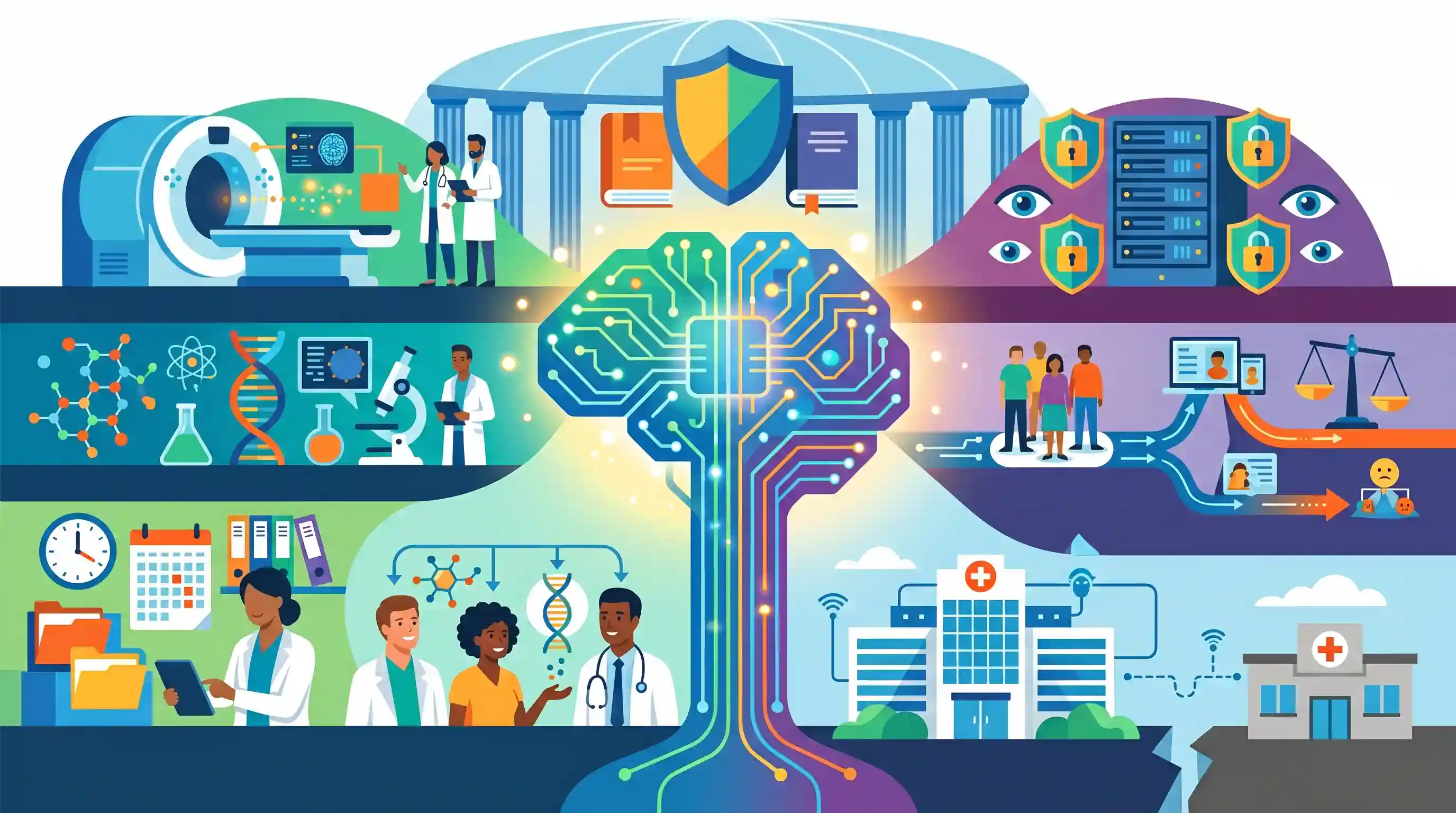
This opinion piece examines the growing role of Artificial Intelligence (AI) in the healthcare sector, highlighting its potential to revolutionize clinical diagnosis, medical research, and administrative efficiency. While AI offers unprecedented opportunities for precision medicine and improved health outcomes, its adoption presents significant ethical and practical challenges. Chief among these are concerns surrounding patient data privacy, the risk of inherent biases in AI algorithms leading to unequal treatment, and the digital divide that may restrict access to advanced care. The article underscores the necessity of establishing comprehensive regulatory guidelines and robust data protection frameworks to ensure that AI is deployed ethically, safely, and equitably in healthcare systems.
Key Points
- Artificial Intelligence (AI) holds transformative potential in healthcare, offering advancements in clinical diagnosis, predictive analytics, drug discovery, and personalized medicine.
- AI tools, such as machine learning algorithms, can significantly enhance the accuracy of medical imaging and enable early detection of diseases, thereby improving patient outcomes.
- The integration of AI can also streamline administrative tasks, reducing burnout among healthcare professionals and optimizing resource allocation.
- However, the deployment of AI in healthcare raises critical concerns regarding patient data privacy, algorithmic bias, and the potential exacerbation of existing healthcare inequities.
- To harness AI's benefits responsibly, there is an urgent need for robust regulatory frameworks, stringent data protection laws, and measures to ensure algorithmic transparency and equitable access to AI-driven healthcare services.
Important Terms
Digital Personal Data Protection Act, 2023

India’s comprehensive legislation for regulating digital personal data processing, mandating informed consent and protecting privacy rights while allowing data use for legitimate purposes.
UPSC context
GS Paper II (Governance/Privacy) & GS Paper III (IT). Critical for legal/ethical AI deployment.
Ayushman Bharat Digital Mission (ABDM)
A national initiative to create a unified digital health ecosystem through unique Health IDs (ABHA), digital health records, and registries for professionals and facilities.
UPSC context
GS Paper II (Government Policies) & GS Paper III (E-governance). Key for universal health coverage.
Indian Council of Medical Research (ICMR)
India’s premier biomedical research agency responsible for setting research priorities and ethical standards, including the 2023 guidelines for AI in healthcare and research.
UPSC context
GS Paper II (Statutory Bodies) & GS Paper III (S&T). Vital for national medical ethics.
World Health Organization (WHO)
The UN's specialized health agency that sets international standards and provides global ethical frameworks for the safe deployment of AI in medical services.
UPSC context
GS Paper II (International Institutions). Important for global health norms and cooperation.
Precision Medicine
A healthcare approach that tailors disease prevention and treatment to individual genetic, environmental, and lifestyle factors using data-driven insights like AI.
UPSC context
GS Paper III (S&T/Biotechnology). Represents the cutting edge of AI-driven personalized healthcare.
Digital Divide
The socio-economic gap between those with and without access to digital technology and literacy, leading to unequal access to advanced healthcare benefits.
UPSC context
GS Paper II (Social Justice). A significant barrier to equitable health outcomes in the digital age.
Prelims Trap
"Under the Ayushman Bharat Digital Mission, possessing an ABHA ID is mandatory to access government healthcare."
Creating an ABHA number is strictly voluntary. No public or private healthcare facility can deny treatment or services to citizens who choose not to generate one.
Static Concepts Connected
What are the core building blocks of the Ayushman Bharat Digital Mission (ABDM)?
- ABHA ID: A voluntary 14-digit number used to standardize and link digital health records across different healthcare providers.
- National Registries: The Healthcare Professionals Registry (HPR) and Health Facility Registry (HFR) act as verified, single sources of truth for medical infrastructure.
- Unified Health Interface: Open network protocols enabling seamless interoperability and data exchange between patients and diverse healthcare applications.
What is "Algorithmic Bias" in the context of Artificial Intelligence?
- Definition: Systematic and repeatable errors in a computer system that create unfair outcomes, typically stemming from unrepresentative training datasets.
- Healthcare Impact: Leads to lower accuracy in diagnosing demographics (e.g., rural populations, women) that were underrepresented during the AI model's training phase.
Cross-Topic Patterns
AI Bias & Social Justice
Intersects GS3 Tech with GS2 Vulnerable Sections. AI models trained predominantly on urban, affluent data can misdiagnose rural or marginalized populations, inadvertently exacerbating existing healthcare disparities.
DPI framework in Healthcare
ABDM extends India's Digital Public Infrastructure (like UPI) into health. The Unified Health Interface (UHI) ensures interoperability between different hospital IT systems without centralizing data.

Expect a 2026 Prelims question testing the voluntary nature of ABHA IDs paired with the consent requirements under the DPDP Act 2023.
Linked PYQs · 2
Linked PYQs · 2
- 2023MainsGS3
Introduce the concept of Artificial Intelligence (AI). How does Al help clinical diagnosis? Do you perceive any threat to privacy of the individual in the use of Al in healthcare?
- 2024MainsGS3
Describe the context and salient features of the Digital Personal Data Protection Act, 2023.
