AI Integration in Global Commerce and MSME Credit Challenges
Source:The Hindu ↗
Why It Matters
It highlights the intersection of emerging technologies (AI, FinTech) with real-world economic challenges (MSME credit access, digital literacy). This is crucial for GS3 topics related to inclusive growth, technology indigenization, and the digital economy.
Summary
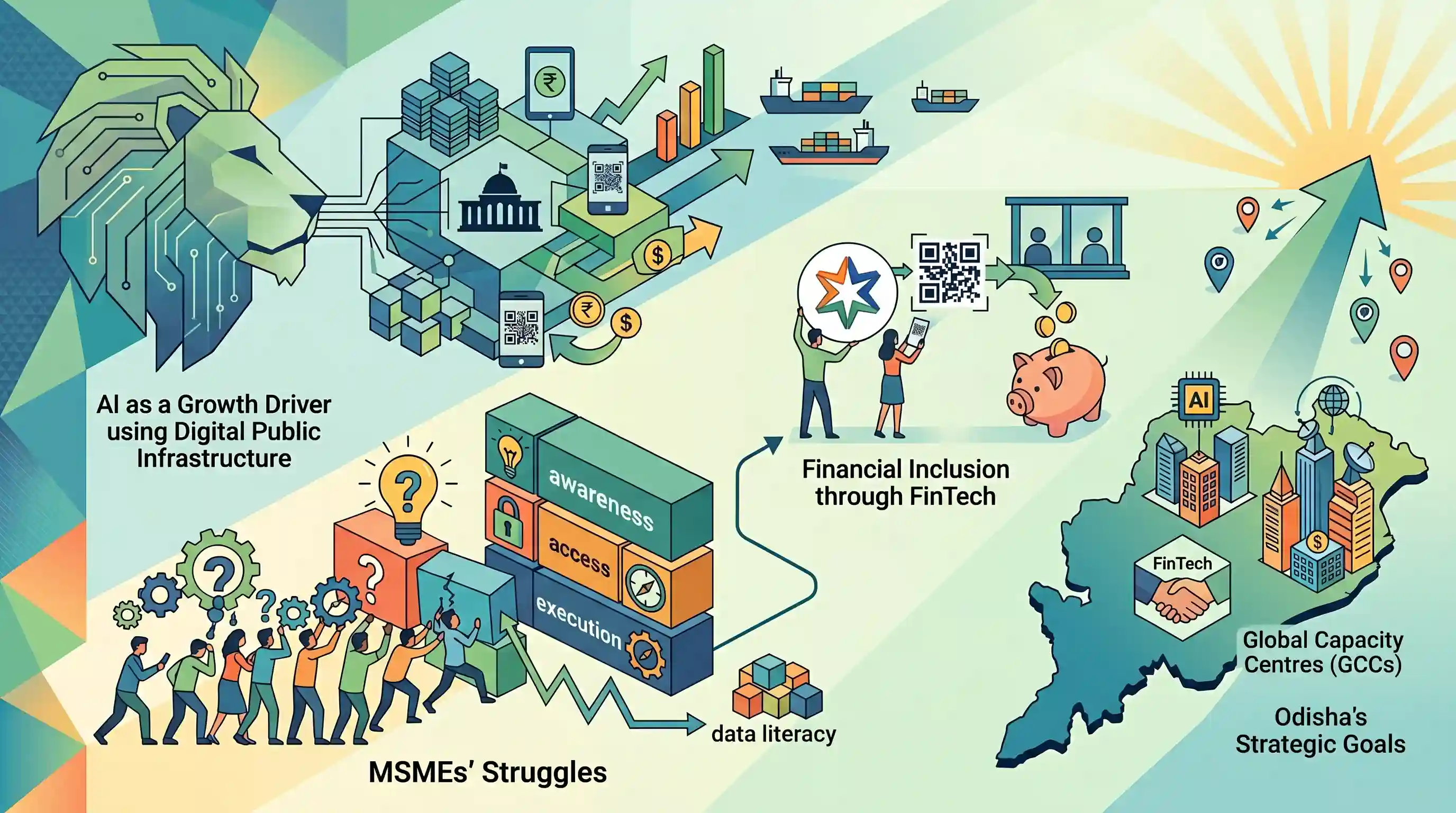
The article covers discussions from the Black Swan Summit in Bhubaneswar regarding the integration of Artificial Intelligence (AI) into global commerce. Industry leaders emphasized that while AI can drive economic growth by leveraging India's Digital Public Infrastructure, MSMEs still struggle with challenges like data literacy and a three-layered barrier to credit (awareness, access, and execution). Additionally, the summit highlighted Odisha's strategic efforts to emerge as a premier destination for FinTech, AI, and Global Capacity Centres (GCCs).
Key Points
- AI represents a major opportunity in global commerce but requires addressing systemic gaps like data literacy.
- MSMEs face significant barriers in accessing credit, characterized by a three-layered challenge: awareness, access, and execution.
- India's robust Digital Public Infrastructure (DPI) and widespread use of mobile wallets provide a strong foundation for integrating AI in financial services.
- Odisha is positioning itself as a future hub for FinTech, Artificial Intelligence, and Global Capacity Centres (GCCs), evidenced by the Black Swan Summit.
Important Terms
Digital Public Infrastructure (DPI)

Foundational digital blocks like Aadhaar and UPI that enable public and private service delivery. They foster financial inclusion and competitive digital markets through open, interoperable technical standards.
UPSC context
GS Paper III (Economy/S&T); tests knowledge of digital governance, financial inclusion, and India's tech leadership.
Global Capacity Centres (GCCs)
Captive units established by multinational corporations to handle high-value operations like R&D and strategic IT internally. India is a global leader, hosting nearly half of all such centers.
UPSC context
GS Paper III (Economy); tests understanding of India's service sector evolution from outsourcing to high-end innovation.
Global Finance & Technology Network (GFTN)
A Singapore-based not-for-profit launched in 2024 to foster global fintech innovation. It facilitates international collaboration among policymakers, regulators, and tech leaders to build inclusive financial ecosystems.
UPSC context
GS Paper II (International Relations) & III (Economy); relevant for international regulatory cooperation and global financial technology.
BharatNetra
Odisha government's flagship initiative to transform the state into a global hub for FinTech, AI, and InsurTech through youth skilling, innovation hubs, and specialized digital infrastructure.
UPSC context
GS Paper III (Economy/Regional Development); tests awareness of state-level digital policies and human capital development.
Black Swan Event
A rare, unpredictable event that has an outsized impact on the economy or society. The summit focuses on using emerging technologies like AI to build resilience against such shocks.
UPSC context
GS Paper III (Economy/Disaster Management); tests conceptual understanding of economic resilience and risk management in a volatile world.
Prelims Trap
"India's Digital Public Infrastructure automatically guarantees formal credit access to registered MSMEs."
DPI only provides foundational data and payment architectures. Credit requires commercial underwriting, where MSMEs still face severe execution and data literacy barriers.
Static Concepts Connected
What are the three core layers of India's Digital Public Infrastructure (India Stack)?
- Identity Layer: Centered on Aadhaar and eSign, enabling secure, paperless digital authentication and eKYC services at population scale.
- Payments Layer: Driven by UPI and APBS/AEPS, facilitating high-volume, low-cost, and interoperable financial transactions.
- Data Empowerment Layer: Governed by DEPA and the Account Aggregator framework, allowing users to securely consent to sharing their data with third parties.
How are MSMEs currently classified in India for targeted scheme and credit access?
- Composite Criteria: Since 2020, classification uses a composite formula based on both investment in plant/machinery and annual turnover.
- Micro Enterprises: Defined as having an investment up to ₹1 crore and an annual turnover up to ₹5 crore.
- Udyam Registration: A fully digital and paperless prerequisite portal that integrates MSME identity with CBDT and GSTN databases.
Cross-Topic Patterns
GCC expansion & Tier-2 urbanization
States like Odisha attracting Global Capacity Centres signals a shift from saturated metros, driving balanced regional development and creating new urban economic clusters.
Alternative credit & Financial Inclusion
AI leverages DPI data trails (like UPI payments) to bypass traditional collateral requirements, directly solving MSME credit gaps and accelerating economic formalization.

Multi-statement question likely in 2026 linking India's Data Empowerment layer (DEPA) with AI-based alternative credit scoring for MSMEs.
Linked PYQs · 4
Linked PYQs · 4
- 2023MainsGS3
What is the status of digitalization in the Indian economy? Examine the problems faced in this regard and suggest improvements.
- 2023MainsGS3
Faster economic growth requires increased share of the manufacturing sector in GDP, particularly of MSMEs. Comment on the present policies of the Government in this regard.
- 2022MainsGS3
Is inclusive growth possible under market economy ? State the significance of financial inclusion in achieving economic growth in India.
- 2023MainsGS3
Introduce the concept of Artificial Intelligence (AI). How does Al help clinical diagnosis? Do you perceive any threat to privacy of the individual in the use of Al in healthcare?
