India AI summit set to focus on semiconductor supply and jobs
Source:The Hindu ↗
Why It Matters
The article touches upon critical GS3 themes (AI applications, semiconductor self-reliance) and GS2 themes (international initiatives, multilateral vs. multistakeholder governance). India's entry into the Pax Silica initiative and its stance on AI governance are highly likely topics for both Prelims and Mains.
Summary
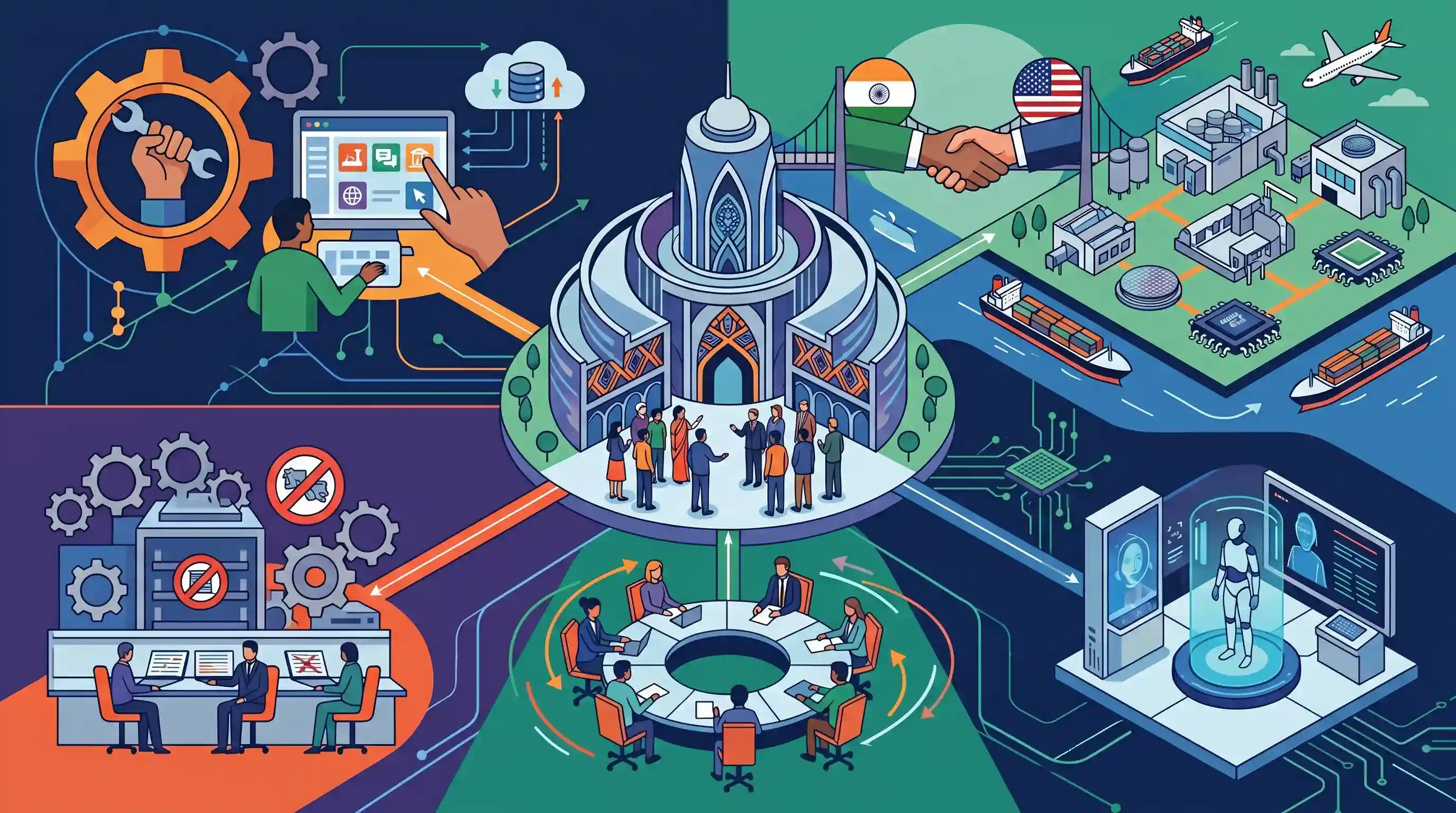
The upcoming India AI Impact Summit 2026, hosted by MeitY in New Delhi, seeks to define tangible global deliverables on artificial intelligence, focusing on its impact on jobs and e-governance. A major confirmed outcome is India's induction into the US-led Pax Silica initiative to secure resilient electronics and semiconductor supply chains. Furthermore, the summit highlights India's preference for a multistakeholder approach to AI governance over rigid multilateral institutions, alongside the operationalization of India's virtual AI Safety Institute.
Key Points
- The Ministry of Electronics and Information Technology (MeitY) is hosting the India AI Impact Summit 2026 in New Delhi, expecting participation from over 100 countries.
- The summit aims to yield at least 15 tangible deliverables focusing on AI's role in job creation and governance, avoiding a mere 'talking shop' scenario.
- India will formally join the US-led Pax Silica initiative, a strategic alliance designed to build resilient global electronics and semiconductor supply chains.
- India's AI Safety Institute is being developed as a virtual consortium of researchers from premier institutions like IITs and universities, rather than a centralized physical entity.
- Instead of a rigid multilateral body for AI governance (similar to the International Solar Alliance), India is advocating for a multistakeholder approach to manage AI technologies globally.
Important Terms
Pax Silica initiative

A US-led strategic coalition launched in late 2025 to secure the "silicon stack"—including critical minerals, semiconductors, and AI infrastructure. India joined in 2026 to enhance tech sovereignty and supply chain resilience.
UPSC context
GS Paper II (International Relations) and III (Economy); concerns semiconductor diplomacy and India-US strategic technology partnerships.
India AI Safety Institute (AISI)
A nodal agency established under the "Safe and Trusted" pillar of the IndiaAI Mission. It focuses on risk assessment, safety standards, and indigenous research to ensure responsible AI deployment.
UPSC context
GS Paper III (Science & Tech); essential for understanding regulatory frameworks, ethics, and national security in emerging technologies.
Multistakeholder Governance
A decentralized governance model involving governments, the private sector, academia, and civil society. India champions this for AI to foster flexible, inclusive norms rather than rigid, top-down multilateral treaties.
UPSC context
GS Paper II (Global Institutions); tests knowledge of digital diplomacy and evolving international regulatory frameworks for technology.
New Delhi Declaration on AI Impact
The 2026 summit’s consensus document (endorsed by 92+ entities) outlining seven "Chakras" for global AI cooperation, with a focus on democratizing resources and using AI for social empowerment.
UPSC context
GS Paper II (International Treaties/Conferences); tracks India’s leadership in setting technology policy agendas for the Global South.
IndiaAI Mission
A comprehensive national program aimed at democratizing the AI ecosystem through large-scale compute infrastructure, indigenous datasets, foundational model development, and high-impact applications for governance.
UPSC context
GS Paper III (Economy & S&T); a core topic for Digital Public Infrastructure and India's technological self-reliance (Atmanirbharta).
Prelims Trap
"India's newly formed AI Safety Institute is a centralized statutory body headquartered in New Delhi."
The Institute is actually being developed as a decentralized, virtual consortium of researchers from premier institutions like IITs, rather than a centralized physical or statutory entity.
Static Concepts Connected
What are the key raw materials required for semiconductor manufacturing?
- Silicon & Quartz: Ultra-pure quartz is processed into electronic-grade silicon to form the foundational wafers upon which microchip circuits are etched.
- Gallium & Germanium: Crucial trace elements used in high-frequency, power, and optoelectronic chips. Global supply and refining for these are currently heavily dominated by China.
- Rare Earth Elements: Essential for specialized components, polishing compounds, and packaging materials in the later stages of semiconductor fabrication.
How does Multistakeholder tech governance differ from Multilateralism?
- Multilateralism: State-centric, treaty-based institutions with formal voting structures and binding legal frameworks, such as the United Nations or International Solar Alliance.
- Multistakeholder approach: Flexible, consensus-driven frameworks that directly involve governments, private tech firms, academia, and civil society in rule-making, such as ICANN for the internet.
Cross-Topic Patterns
Pax Silica + PLI scheme synergy
India's induction into the US-led Pax Silica aligns geopolitical 'friend-shoring' of critical tech with its domestic Production Linked Incentive (PLI) scheme, reducing reliance on single-market monopolies.
Tech Diplomacy vs Rigid Treaty Models
India’s preference for a multistakeholder AI model over a rigid ISA-style treaty reflects a broader IR trend of using flexible alliances (like the Quad) for rapidly evolving critical technologies.

Pax Silica and India's virtual AI Safety Institute are prime candidates for a multi-statement 'emerging tech alliances' Prelims question.
Linked PYQs · 3
Linked PYQs · 3
- 2023MainsGS3
Introduce the concept of Artificial Intelligence (AI). How does Al help clinical diagnosis? Do you perceive any threat to privacy of the individual in the use of Al in healthcare?
- 2025MainsGS3
India aims to become a semiconductor manufacturing hub. What are the challenges faced by the semiconductor industry in India? Mention the salient features of the India Semiconductor Mission.
- 2016PrelimsGS1
Consider the following statements: 1. The International Solar Alliance was launched at the United Nations Climate Change Conference in 2015. 2. The Alliance includes all the member countries of the United Nations. Which of the statements given above is/are correct?
