India Sovereign AI Mission and Digital Public Infrastructure
Source:Indian Express ↗
Why It Matters
AI is a transformative general-purpose technology with profound economic, social, and security implications. Understanding India's evolving approach to AI governance, its push for technological sovereignty, and its balancing act between innovation and ethical regulation is crucial for GS-III (Science and Technology) and GS-II (Governance and Policies).
Summary
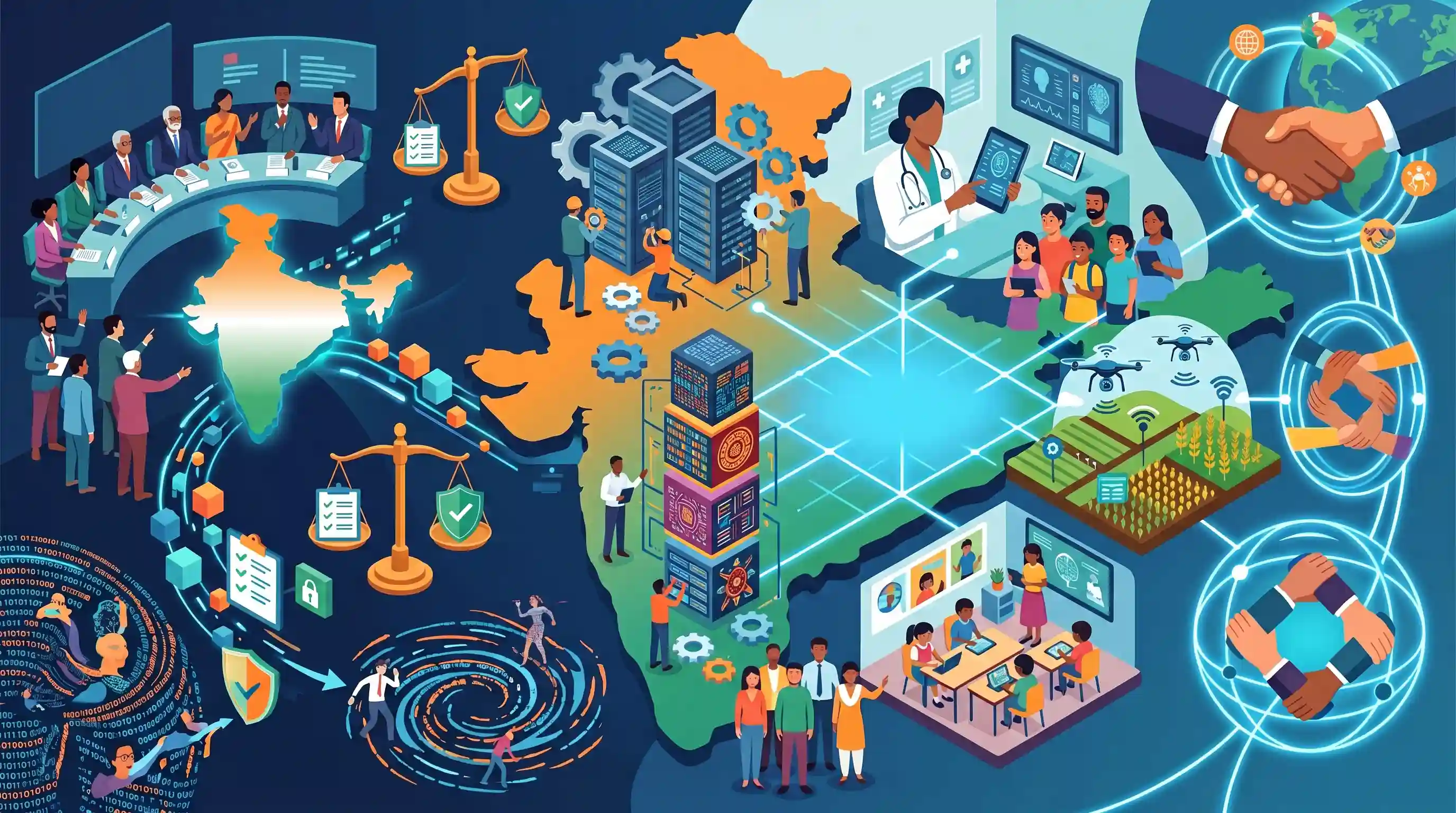
The AI Impact Summit in New Delhi highlights India's strategic intent to lead global AI governance by advocating for ethical, inclusive, and democratized Artificial Intelligence. Moving beyond a hands-off approach, India is pursuing a risk-based regulatory framework to mitigate AI-related harms—such as deepfakes and bias—while simultaneously fostering a vibrant innovation ecosystem. Key initiatives discussed include building 'Sovereign AI' capabilities under the IndiaAI Mission, which entails developing indigenous computing infrastructure and creating localized foundational models. By applying its proven Digital Public Infrastructure (DPI) model to AI, India aims to unlock transformative use-cases in critical areas like healthcare, agriculture, and education, ensuring that the benefits of AI reach all segments of society while shaping international guardrails.
Key Points
- India is hosting the AI Impact Summit to shape the global discourse on Artificial Intelligence, focusing on inclusive growth and prioritizing the needs of the Global South.
- The government advocates for a risk-based regulatory framework to balance technological innovation with critical safeguards against harms like deepfakes and algorithmic bias.
- A core focus of the summit is the development of 'Sovereign AI,' which includes building indigenous computing capacity and foundational models capable of processing diverse Indian languages.
- India plans to extend its successful Digital Public Infrastructure (DPI) approach to AI, seeking to democratize access to AI applications in crucial sectors such as healthcare, education, and agriculture.
- The event underscores India's active leadership in international AI governance and diplomacy, working through forums to establish global ethical guardrails.
Important Terms
IndiaAI Mission

A ₹10,372-crore national program aimed at establishing a self-reliant AI ecosystem through indigenous compute capacity (10,000+ GPUs), foundational models, and a centralized dataset platform to foster inclusive innovation.
UPSC context
GS III: Science & Technology (Indigenization); tests knowledge of national technology missions and India's 'Atmanirbhar' (self-reliant) goals.
Digital Public Infrastructure (DPI)
A framework of open, interoperable digital systems—such as Aadhaar, UPI, and DigiLocker—that enable societal-scale service delivery and democratize digital access for both public and private sectors.
UPSC context
GS II: Governance (Public Service Delivery) and GS III: Economy; tests understanding of India's globally-recognized digital transformation model.
Sovereign AI
A nation's capacity to develop, deploy, and govern AI using domestic infrastructure, local data, and indigenous talent to ensure strategic autonomy and cultural relevance while reducing foreign tech dependencies.
UPSC context
GS III: Science & Technology (Strategic Autonomy); critical for essays and questions on data sovereignty and technological self-governance.
Global Partnership on Artificial Intelligence (GPAI)
A multi-stakeholder international initiative of 29 members (including India) aimed at bridging the gap between AI theory and practice by promoting responsible, human-centric AI development.
UPSC context
GS II: International Relations (Global Governance); tests knowledge of India's leadership in multilateral technology forums and the 'New Delhi Declaration'.
Digital India Act (DIA)
Proposed legislation meant to replace the Information Technology Act, 2000, focusing on online safety, accountability of digital intermediaries, and a risk-based framework for regulating emerging technologies.
UPSC context
GS II: Polity/Governance (Legislations) and GS III: Cybersecurity; tests awareness of legal reforms needed for the evolving digital landscape.
Ministry of Electronics and Information Technology (MeitY)
The nodal executive agency responsible for policy-making and implementation regarding electronics, IT, and the digital economy, including spearheading the Digital India campaign and IndiaAI Mission.
UPSC context
GS II: Governance (Institutional Frameworks); tests understanding of the administrative machinery driving India’s digital and technological policies.
Prelims Trap
India has enacted a strict statutory framework that bans the deployment of high-risk AI models entirely.
India has not enacted a statutory ban. It is pursuing an adaptive, risk-based framework (through the upcoming Digital India Act) that mandates transparency, not a blanket ban.
Static Concepts Connected
What is 'Sovereign AI' and how does it prevent 'Compute Colonialism'?
- Sovereign AI: Developing indigenous AI capabilities, including local foundational models, proprietary data repositories, and domestic computing infrastructure.
- Compute Colonialism: The risk of developing nations becoming entirely dependent on Western tech giants for computing power and AI infrastructure, leading to data and economic exploitation.
- India's Mitigation: Through the ₹10,372 crore IndiaAI Mission, procuring 10,000 GPUs to democratize compute access for domestic researchers and startups.
What is the Global Partnership on Artificial Intelligence (GPAI)?
- Origin & Mandate: An international initiative launched in 2020 to guide the responsible development and use of AI, grounded in human rights.
- Secretariat: The Organisation for Economic Co-operation and Development (OECD) currently hosts the GPAI Secretariat.
- India's Role: India is a founding member of GPAI and recently served as its Lead Chair, emphasizing AI for the Global South.
Cross-Topic Patterns
Evolution of DPI from Transactional to Cognitive
India is transitioning from transactional DPIs (like UPI and Aadhaar) to cognitive DPIs (like AI Kosha and Bhashini), creating open-source foundational AI platforms for domestic startups.
Tech Diplomacy & Global South Leadership
Much like its G20 presidency focused on digital public goods, India uses AI diplomacy to champion "Global South" tech access, contrasting with the West's restrictive AI paradigms.

Sovereign AI + Compute Colonialism + IndiaAI Mission targets (e.g., 10,000 GPUs) likely to form a multi-statement Prelims question in 2026.
Linked PYQs · 5
Linked PYQs · 5
- 2020PrelimsGS1
With the present state of development, Artificial Intelligence can effectively do which of the following? 1. Bring down electricity consumption in industrial units 2. Create meaningful short stories and songs 3. Disease diagnosis 4. Text-to-Speech Conversion 5. Wireless transmission of electrical energy Select the correct answer using the code given below:
- 2024PrelimsGS1
Consider the following statements: I. It is expected that Majorana 1 chip will enable quantum computing. II. Majorana 1 chip has been introduced by Amazon Web Services (AWS). III. Deep learning is a subset of machine learning. Which of the statements given above are correct?
- 2024MainsGS4
The application of Artificial Intelligence as a dependable source of input for administrative rational decision-making is a debatable issue. Critically examine the statement from the ethical point of view.
- 2021MainsGS4
Impact of digital technology as reliable source of input for rational decision making is a debatable issue. Critically evaluate with suitable example.
- 2023MainsGS3
What is the status of digitalization in the Indian economy? Examine the problems faced in this regard and suggest improvements.
