AI Impact Summit in Delhi and India AI Governance Strategy
Source:Indian Express ↗
Why It Matters
With AI disrupting economies globally, India's role in setting regulatory standards and building domestic capabilities is critical for GS3 (Science & Tech) and GS2 (Global Governance). Questions on AI applications, ethical concerns, data privacy, and digital diplomacy are highly probable.
Summary
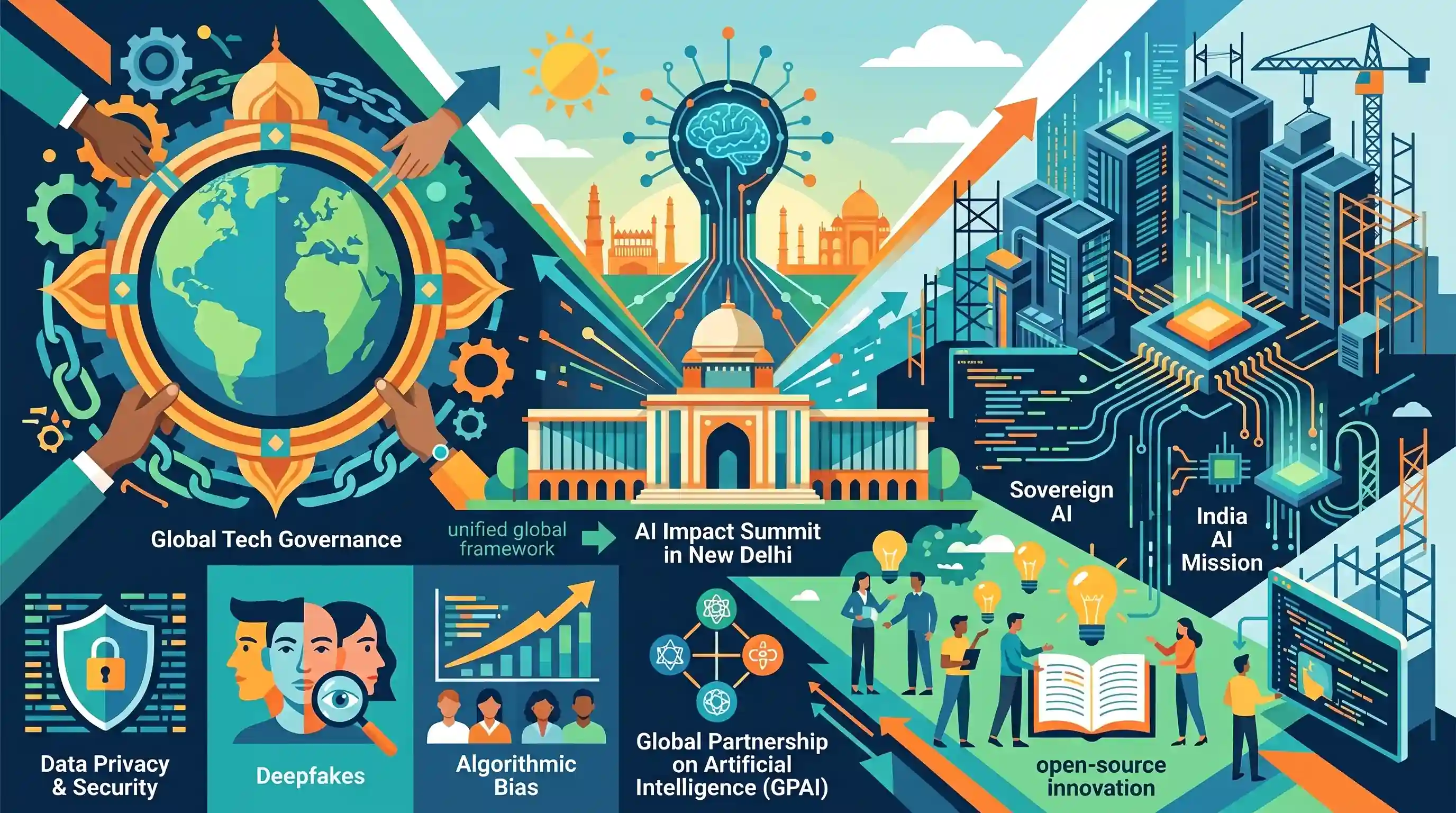
The AI Impact Summit in New Delhi marks India's proactive effort to shape the global discourse on Artificial Intelligence. The summit highlights India's strategic focus on developing 'Sovereign AI', building domestic compute capacity through the India AI Mission, and promoting open-source innovation. It also underscores India's push for a unified global framework for AI governance, balancing rapid technological advancement with regulatory guardrails to address data privacy, deepfakes, and algorithmic bias, leveraging platforms like the Global Partnership on Artificial Intelligence (GPAI).
Key Points
- India is hosting the AI Impact Summit to steer global conversations on AI governance, regulation, and ethical deployment.
- The focus is on 'Sovereign AI' and the India AI Mission, emphasizing the need for robust domestic computing infrastructure to reduce reliance on foreign models.
- India advocates for an open-source AI ecosystem to democratize access for startups, academia, and researchers.
- The summit highlights the urgent need for a cohesive global regulatory framework, moving beyond fragmented approaches to tackle shared challenges like deepfakes, algorithmic bias, and data privacy.
- Discussions align with India's broader digital diplomacy and its leadership role in global forums such as the Global Partnership on Artificial Intelligence (GPAI).
Important Terms
India AI Mission

A ₹10,300+ crore national mission launched in 2024 to build a self-reliant AI ecosystem, focusing on 10,000+ GPU compute capacity, indigenous foundational models, and datasets.
UPSC context
GS-3 (Science and Technology); tests knowledge of national missions and strategies for indigenous technological development.
Global Partnership on Artificial Intelligence (GPAI)
An international multi-stakeholder initiative of 29 members (including India as 2024 Lead Chair) aimed at bridging the gap between AI theory and practice for responsible development.
UPSC context
GS-2 (International Institutions) and GS-3 (S&T); tests India's role in global tech governance.
Digital Personal Data Protection Act
India's 2023 legislation governing the processing of digital personal data, establishing a framework to protect individual privacy while permitting lawful data usage by fiduciaries.
UPSC context
GS-2 (Fundamental Rights) and GS-3 (Cybersecurity); tests understanding of privacy rights and regulatory frameworks.
Bletchley Declaration
A 2023 global agreement signed by 28 nations, including India, prioritizing international cooperation to mitigate risks from advanced 'frontier AI' models regarding safety and security.
UPSC context
GS-2 (International Relations) and GS-3 (S&T); tests knowledge of global norms and consensus on AI safety.
Ministry of Electronics and Information Technology (MeitY)
India's nodal ministry for formulating IT policies, electronics manufacturing, and digital governance. It implements the India AI Mission to ensure technological sovereignty.
UPSC context
GS-2 (Government Policies); tests awareness of institutional frameworks driving India's digital transformation.
Prelims Trap
"The Global Partnership on Artificial Intelligence (GPAI) is a specialized agency of the United Nations."
GPAI is an international multi-stakeholder initiative whose secretariat is hosted by the OECD in Paris, not the United Nations.
Static Concepts Connected
What is the primary objective of the India AI Mission?
- National Compute Grid: Aims to establish a robust domestic computing framework comprising over 10,000 GPUs under public-private partnerships.
- Sovereign AI: Focuses on developing indigenous AI capabilities trained on diverse, localized Indian datasets to eliminate foreign algorithmic bias.
- Democratizing Access: Provides critical, subsidized compute infrastructure to startups, academia, and researchers to foster an open-source innovation ecosystem.
How does the Bletchley Declaration attempt to govern AI?
- Frontier AI Focus: It is the world's first international pact specifically targeting the unique safety risks posed by highly capable, cutting-edge "Frontier AI" models.
- Global Coordination: Emphasizes a collaborative, risk-based approach among signatory nations (including India, US, and China) to identify and mitigate severe AI misuse.
Cross-Topic Patterns
DPI Evolution: From Identity to AI
India is positioning its AI compute grid as the next layer of Digital Public Infrastructure (DPI), mirroring the public-private structural success of UPI, Aadhaar, and ONDC.
DPDP Act vs. Algorithmic Scraping
The DPDP Act 2023 establishes stringent consent rules for data processing, creating a direct legal intersection with how generative AI companies aggressively scrape localized data for model training.

Expect a 2026 multi-statement Prelims question interlinking the India AI Mission's GPU grid, GPAI membership, and the DPDP Act.
Linked PYQs · 3
Linked PYQs · 3
- 2023MainsGS3
Introduce the concept of Artificial Intelligence (AI). How does Al help clinical diagnosis? Do you perceive any threat to privacy of the individual in the use of Al in healthcare?
- 2020PrelimsGS1
With the present state of development, Artificial Intelligence can effectively do which of the following? 1. Bring down electricity consumption in industrial units 2. Create meaningful short stories and songs 3. Disease diagnosis 4. Text-to-Speech Conversion 5. Wireless transmission of electrical energy Select the correct answer using the code given below:
- 2024MainsGS3
Describe the context and salient features of the Digital Personal Data Protection Act, 2023.
