Automation Risks and Employment Challenges in India
Source:Indian Express ↗
Why It Matters
The article highlights the critical intersection of emerging technologies (AI/automation) and core socio-economic challenges (job creation), which is a recurring theme in UPSC GS3 (Economy, Employment, and Science & Technology).
Summary
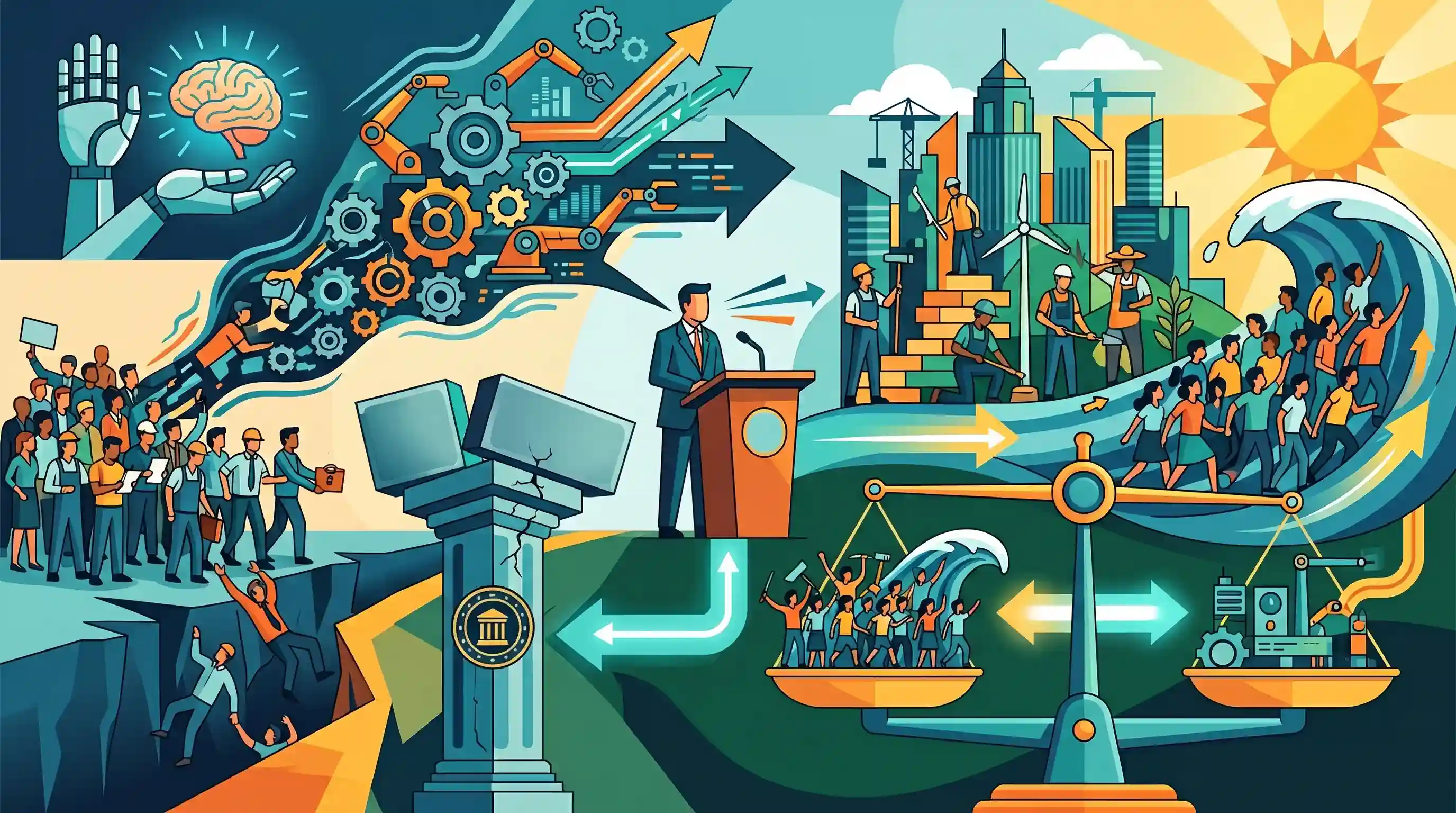
Speaking at the AI Impact Summit 2026, Chief Economic Advisor V. Anantha Nageswaran highlighted that the rapid rise of Artificial Intelligence and automation poses a significant 'stress test' to India's state capacity. He cautioned that unchecked technological adoption risks worsening India's job crisis by displacing labor. Nageswaran emphasized the urgent need for policymakers to balance technological progress with mass employability to prevent structural unemployment and effectively utilize the country's demographic dividend.
Key Points
- Chief Economic Advisor V. Anantha Nageswaran warned that rapid AI adoption and automation could exacerbate India's existing job crisis.
- He described the rise of AI as a 'stress test' for India's state capacity to manage socio-economic transitions.
- There is a critical need to align technological advancements and deployment with the goal of mass employability to harness India's demographic dividend.
- Policymakers must ensure that economic growth remains labor-intensive rather than leading to structural unemployment through unchecked automation.
Prelims Trap
"AI-driven automation primarily causes frictional unemployment as workers transition to new technology roles."
Automation causes structural unemployment, not frictional. It permanently alters the skillsets required in the economy, rendering old skills obsolete rather than causing temporary transition delays.
Static Concepts Connected
What are the key types of unemployment relevant to technological shifts?
- Structural Unemployment: Arises from a permanent mismatch between the jobs available and the skill levels of the unemployed (e.g., AI replacing data entry).
- Frictional Unemployment: Temporary unemployment that happens while workers are searching for new jobs or transitioning between roles.
- Cyclical Unemployment: Macroeconomic unemployment driven by downturns in the business cycle and overall economic recessions.
What defines "jobless growth" and its impact on the demographic dividend?
- Jobless Growth: An economic phenomenon where a country's GDP expands, but the economy fails to generate a proportionate number of new jobs.
- Demographic Dividend: Economic growth potential resulting from an optimal population age structure (more working-age individuals than dependents).
- Intersection Impact: If jobless growth persists, the demographic dividend can become a "demographic disaster," increasing dependency ratios and social unrest.
Cross-Topic Patterns
AI regulation & State Capacity
The ability to regulate AI and reskill workers (GS3) directly tests institutional state capacity (GS2), requiring agile policymaking and robust social safety nets.
Capital vs Labor Intensity
Echoes the historical economic debate on whether a labor-abundant India should focus on labor-intensive manufacturing (like textiles) or capital-intensive tech models.

Expect a GS3 Mains question evaluating whether AI-driven automation will turn India's demographic dividend into a demographic disaster.
Linked PYQs · 4
Linked PYQs · 4
- 2023MainsGS3
Most of the unemployment in India is structural in nature. Examine the methodology adopted to compute unemployment in the country and suggest improvements.
- 2014MainsGS3
While we flaunt India's demographic dividend, we ignore the dropping rates of employability. What are we missing while doing so? Where will the jobs that India desperately needs come from? Explain.
- 2022MainsGS3
Economic growth in the recent past has been led by increase in labour productivity." Explain this statement. Suggest the growth pattern that will lead to creation of more jobs without compromising labour productivity.
- 2023MainsGS3
Introduce the concept of Artificial Intelligence (AI). How does Al help clinical diagnosis? Do you perceive any threat to privacy of the individual in the use of Al in healthcare?
