AI Hiring Trends and Structural Shifts in Indian IT Sector
Source:The Hindu ↗
Why It Matters
The Indian IT-BPM sector has traditionally been the largest formal private-sector employer and a primary driver of urban middle-class expansion. A structural shift toward automated 'AI agents' and specialized senior hiring, coupled with a decline in mass entry-level recruitment, has deep socio-economic ramifications—including exacerbating youth structural unemployment, disrupting campus placement models, and demanding immediate, large-scale national upskilling strategies.
Summary
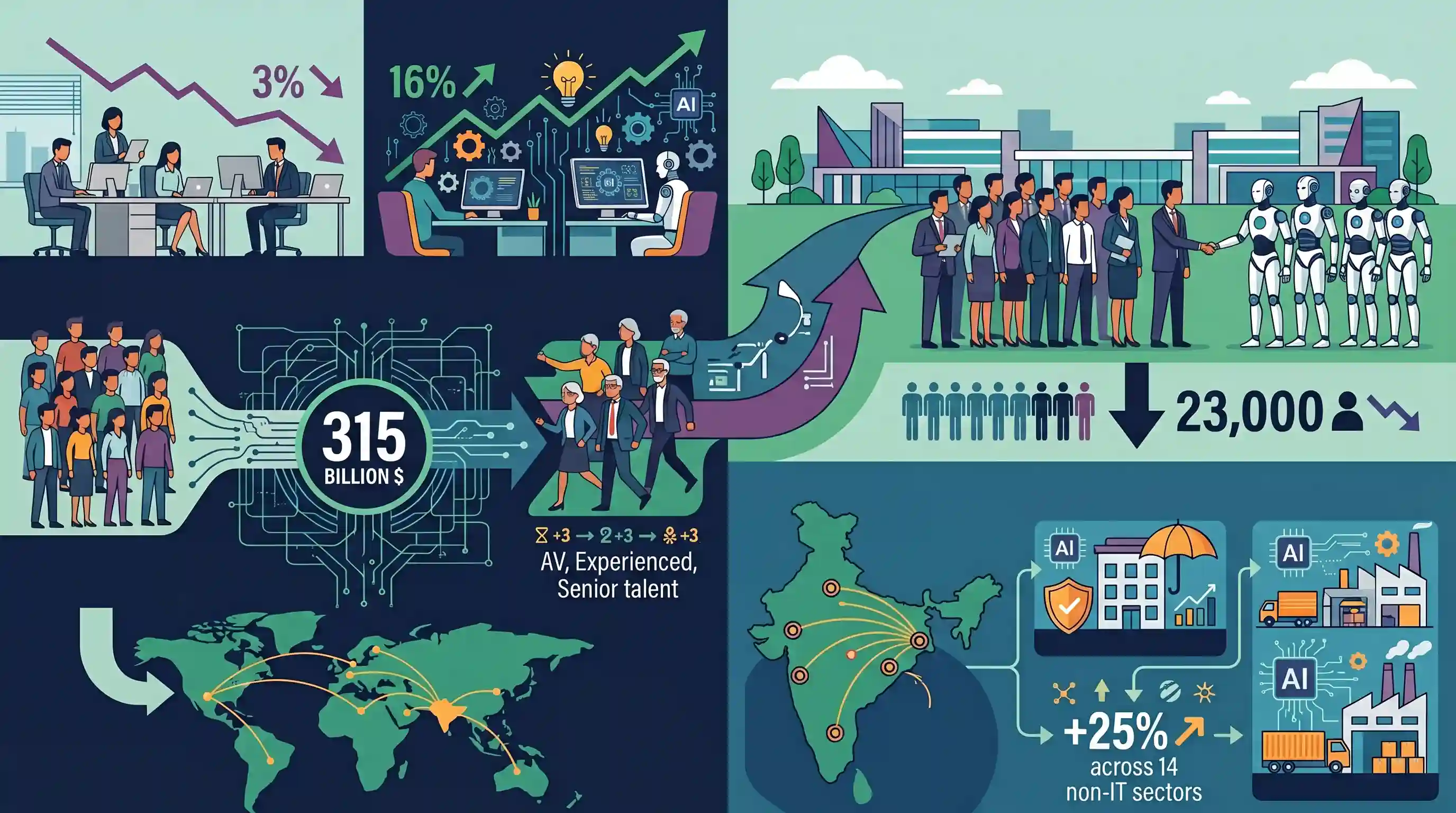
A Naukri JobSpeak report highlights a stark divergence in India's IT recruitment landscape: while overall IT jobs fell by 3% YoY, AI-specific hiring increased by 16%. This shift marks a broader transition within India's $315 billion IT-BPM industry, which is moving away from bulk fresher recruitment toward specialized, senior AI talent. Large players like TCS are planning for a future that balances human employees with AI agents, registering a net headcount reduction of over 23,000 in FY26. Furthermore, AI hiring is expanding beyond tech, showing a 25% increase across 14 non-IT sectors, led by insurance and consumer goods, while Global Capability Centers (GCCs) in India spearhead global enterprise AI mandates.
Key Points
- AI hiring in India's IT sector surged 16% year-on-year in June, whereas overall IT jobs declined by 3% (per Naukri's JobSpeak report, which collates listings from over 150,000 firms).
- The $315 billion Indian IT industry is experiencing pressure from a weak macroeconomic environment, lower client tech spending, and structural disruptions caused by generative AI tools replacing traditional workflows.
- The nature of talent demand is shifting away from entry-level/fresher roles towards senior and specialized AI/ML professionals.
- Major market players like TCS are actively anticipating slower hiring, aiming for a hybrid workforce balance with equal parts human employees and digital AI agents. TCS's net headcount fell by over 23,000 in the fiscal year ending March 2026.
- AI-related hiring is transcending the traditional tech sector, with AI and ML jobs increasing 25% across 14 different domains—most notably in insurance and consumer goods.
- Global Capability Centers (GCCs) located in India are taking a leading role in the AI mandates of global enterprises, shifting their function toward high-value strategic creation.
Important Terms
NASSCOM

The premier non-profit trade association and apex body of India's IT-BPM industry, which advocates for policies, promotes digital skilling, and fosters global tech collaborations.
UPSC context
GS Paper 3: Science & Technology and Indian Economy; tests institutional bodies driving digital infrastructure, tech employment, and service exports.
Zinnov
A leading global management consulting firm specializing in globalization and digital transformation, providing authoritative research and benchmarks on India's Global Capability Center ecosystem.
UPSC context
GS Paper 3: Indian Economy and S&T; tests trends in technology offshoring, intellectual property creation, and tech-led growth.
Global Capability Centers
Wholly-owned captive offshore centers established by multinational corporations to perform high-value, strategic operations internally—such as R&D, product engineering, and AI-led transformation—rather than outsourcing.
UPSC context
GS Paper 3: S&T and Economic Development; tests structural shifts from labor arbitrage to high-value technology and innovation hubs.
Tata Consultancy Services
India's largest multinational information technology services and consulting company, serving as a core bellwether for the country's private-sector job market and IT export economy.
UPSC context
GS Paper 3: Indian Economy and employment; analyzes private sector employment trends and technology adaptation strategies like corporate AI integration.
Naukri
India's premier online recruitment platform, famed for its monthly "JobSpeak" index, which serves as a trusted high-frequency private barometer of white-collar hiring trends.
UPSC context
GS Paper 3: Indian Economy and Employment; analyzes labor market indicators and real-time private sector job growth dynamics.
Info Edge
A leading Indian internet technology holding company that owns and operates major digital platforms like Naukri.com, 99acres, and Jeevansathi, driving India's digital services economy.
UPSC context
GS Paper 3: Indian Economy and S&T; tests growth of internet entrepreneurship, corporate startups, and digital service platforms.
Prelims Trap
Global Capability Centers (GCCs) in India function primarily as back-office BPOs focusing on low-cost data entry and support.
GCCs have evolved significantly from basic outsourcing back-offices to strategic innovation, technology design, and global enterprise AI hubs.
Static Concepts Connected
What is structural unemployment and how does AI-driven automation fit in?
- Structural Unemployment: A persistent mismatch between the skills of the available workforce and the requirements of newly emerging jobs in the market.
- Technological Unemployment: A subset of structural unemployment occurring when technology, software, or AI agents directly automate tasks, displacing human labor.
What are Global Capability Centers (GCCs) and their economic role?
- Definition: In-house captive centers established by foreign multinationals to perform specialized IT, R&D, and strategic corporate functions.
- Evolution: Transitioned from cost-arbitrage 'back-offices' to high-value centers driving global digital mandates, contributing significantly to service exports and direct GVA.
Cross-Topic Patterns
IT transition and employment elasticity
The shift from bulk fresher hiring to specialized AI roles reduces the IT sector's ability to absorb India's mass engineering graduates, worsening the problem of jobless growth.
Services GVA and trade balance
High-value GCCs driving global enterprise AI mandates strengthen India's software service exports and current account balance, even as domestic IT majors reduce headcounts.

Mains 2026 may contrast AI-driven tech-unemployment with the rise of high-value GCCs to assess India's evolving services export model.
Linked PYQs · 3
Linked PYQs · 3
- 2021MainsGS1
What are the main socio-economic implications arising out of the development of IT industries in major cities of India?
- 2022MainsGS3
Economic growth in the recent past has been led by increase in labour productivity." Explain this statement. Suggest the growth pattern that will lead to creation of more jobs without compromising labour productivity.
- 2023MainsGS3
Most of the unemployment in India is structural in nature. Examine the methodology adopted to compute unemployment in the country and suggest improvements.
