Generative Artificial Intelligence Impact on Higher Education Pedagogy
Source:Indian Express ↗
Why It Matters
Offers a profound philosophical and practical critique of current educational assessment methods in the age of AI. This perspective is highly relevant for GS2 (Education Sector), GS3 (Impact of AI), and Essay topics concerning the fundamental purpose and values of education.
Summary
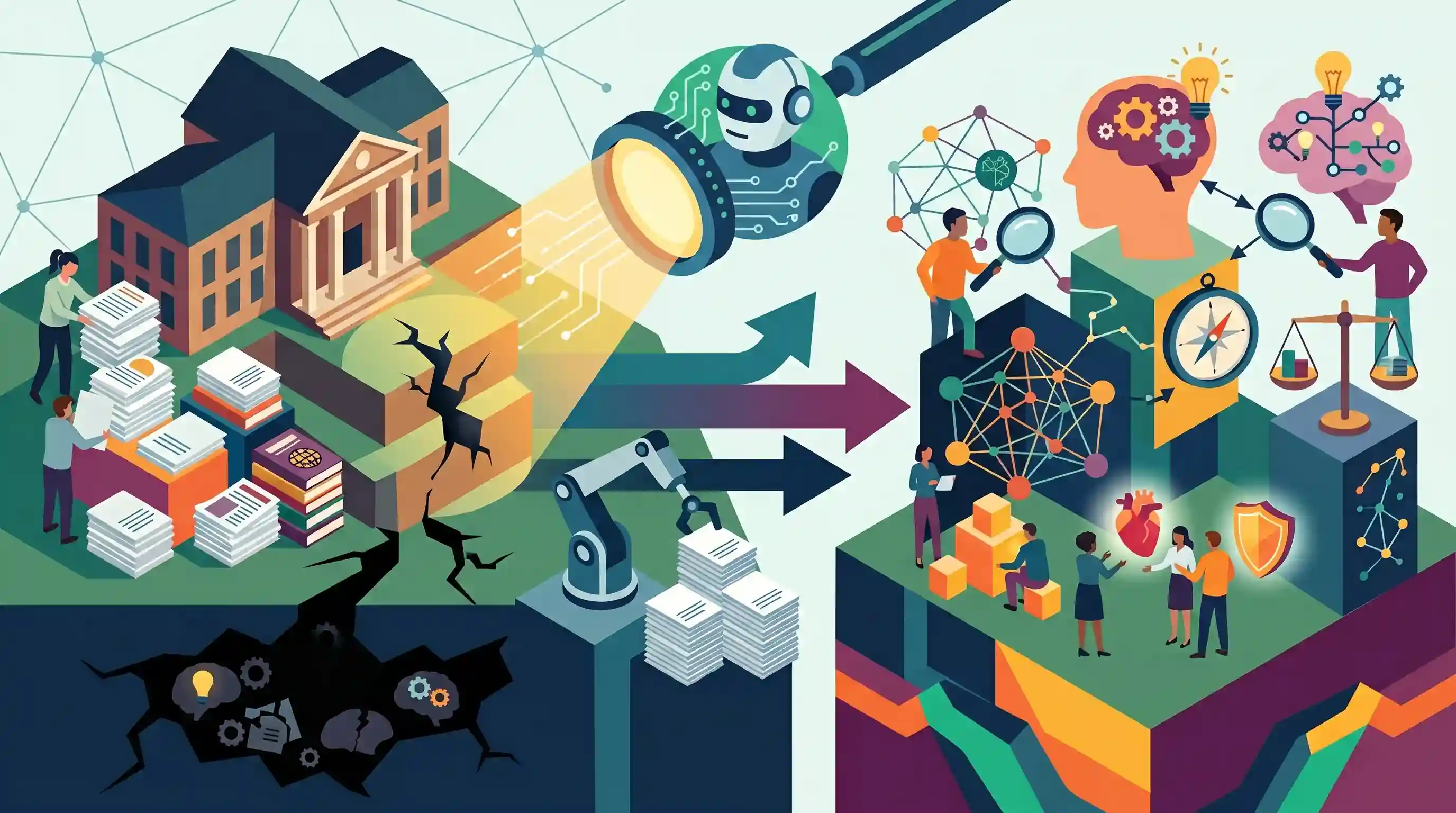
The article argues that generative AI is not a disruptive force in higher education but rather a diagnostic tool exposing an ongoing learning crisis. It asserts that higher education has progressively conflated genuine learning with easily measurable proxy outputs like grades and publications, at the expense of cultivating critical thinking, judgment, and epistemic rigor. Because AI systems can now mimic these outputs without true understanding, universities must urgently reform their pedagogy. The focus must shift from merely evaluating final products to assessing the cognitive processes, reasoning, epistemic standards, and moral judgments that lead to them.
Key Points
- Generative AI is not disrupting higher education; instead, it serves as a diagnostic tool exposing a pre-existing learning crisis.
- Higher education systems have mistakenly conflated genuine learning with easily measurable outputs like grades, exams, and publications.
- While AI models can mimic these outputs, they lack true reasoning, intent, and epistemic understanding.
- The true objective of higher education should be the cultivation of judgment, logical reasoning, and epistemic rigor to evaluate and verify information.
- To adapt to AI, universities must reform their pedagogical strategies to assess the process of inquiry and moral reasoning rather than just the final product.
Prelims Trap
Generative AI possesses epistemic rigor and true reasoning capabilities to validate moral judgments.
Aspirants often assume advanced LLMs possess genuine cognition. GenAI merely predicts statistically probable outputs without actual epistemic understanding, intentionality, or moral reasoning.
Static Concepts Connected
How does NEP 2020 shift the paradigm of educational assessment?
- Formative Focus: Mandates a shift from high-stakes, summative exams assessing rote memorization to regular, formative assessments.
- Competency-based: Focuses on testing core capacities, higher-order skills, analysis, critical thinking, and conceptual clarity.
- PARAKH Center: Establishes PARAKH (Performance Assessment, Review, and Analysis of Knowledge for Holistic Development) as a national standard-setting body.
What fundamentally distinguishes Generative AI from traditional analytical AI?
- Creation vs Analysis: GenAI creates novel content (text, images, code) based on learned patterns, while traditional AI analyzes data primarily for prediction, classification, or clustering.
- Foundational Models: GenAI relies on massive Foundational Models (like LLMs) using transformer architectures to probabilistically generate outputs.
- Lack of Intent: Despite fluent outputs, GenAI generates statistically probable sequences without genuine cognition, reasoning intent, or inherent "epistemic truth."
Cross-Topic Patterns
NEP 2020 + AI Assessment Reforms
The shift from output-based metrics to formative assessment under NEP 2020 is no longer just policy but a necessity, accelerated by AI's ability to flawlessly spoof summative outputs.
GS4: Ethics of AI and Epistemic Rigor
As AI commodifies content generation, the burden of truth-seeking (epistemic rigor) and moral judgment falls strictly on human evaluators, bridging GS3 Technology with GS4 Ethics.

AI's role in education shifts from a GS3 tech question to a GS4/Essay theme focusing on epistemic rigor, moral judgment, and NEP 2020.
Linked PYQs · 3
Linked PYQs · 3
- 2023MainsGS3
Introduce the concept of Artificial Intelligence (AI). How does Al help clinical diagnosis? Do you perceive any threat to privacy of the individual in the use of Al in healthcare?
- 2015MainsGS2
The quality of higher education in India requires major improvements to make it internationally competitive. Do you think that the entry of foreign educational institutions would help improve the quality of higher and technical education in the country? Discuss.
- 2023MainsEssay
Education is what remains after one has forgotten what one has learned in school.
