IICT scientists use AI to spot potential drugs for viral diseases
Source:The Hindu ↗
Why It Matters
The integration of Artificial Intelligence in biotechnology and drug discovery is a highly relevant topic for UPSC GS3 (Science and Technology). This article provides a concrete Indian example (CSIR-IICT) of how AI tools like AlphaFold are being used for drug repurposing to combat critical viral diseases (Monkeypox and Lumpy Skin Disease), which directly aligns with mains questions on the applications of AI in healthcare and clinical diagnosis.
Summary
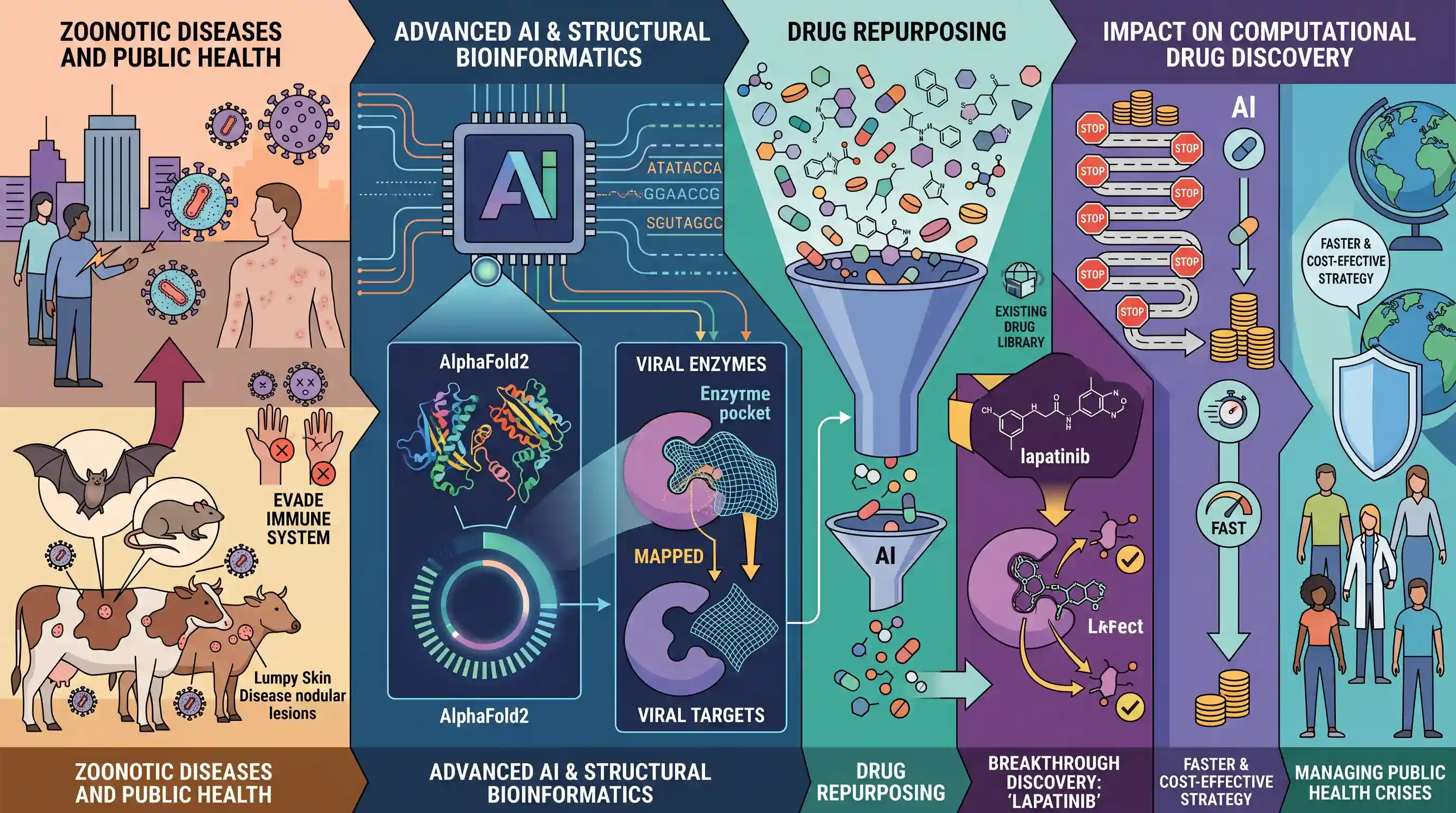
Scientists at the CSIR-Indian Institute of Chemical Technology (IICT) have successfully leveraged artificial intelligence to identify potential therapies for emerging viral threats like Monkeypox (Mpox) and Lumpy Skin Disease Virus (LSDV). By utilizing advanced AI tools such as AlphaFold2 in a structural bioinformatics pipeline, the researchers mapped viral enzymes that help pathogens evade the immune system. They applied a "drug repurposing" approach to discover that the existing drug 'lapatinib' is a promising inhibitor for these viral targets. This breakthrough underscores the transformative role of AI in accelerating computational drug discovery, making it a faster and more cost-effective strategy for managing public health crises and zoonotic outbreaks.
Key Points
- Scientists at CSIR-IICT applied an AI-driven structural bioinformatics pipeline to identify potential drug targets for Lumpy Skin Disease Virus (LSDV) and Monkeypox (Mpox).
- The researchers used advanced AI tools, including AlphaFold2 and ESMFold, to predict the 3D structures of viral enzymes that lacked experimental data.
- The study identified two highly conserved viral kinases across the Poxviridae family, which are crucial for the viruses to evade host immune systems.
- By employing a 'drug repurposing' strategy, the team found that the existing drug 'lapatinib' serves as a promising competitive inhibitor against these viral targets.
- This AI-integrated approach demonstrates a faster and more cost-effective method for developing therapies against emerging zoonotic viral outbreaks.
Important Terms
CSIR-Indian Institute of Chemical Technology (IICT)

A premier national research laboratory under the Council of Scientific and Industrial Research (CSIR), established in 1944, specializing in chemical technology, drugs, and bioinformatics.
UPSC context
GS Paper 3: Science & Technology (Indigenization of technology; development of new technology). Tests knowledge of India's R&D infrastructure.
AlphaFold2
An AI system developed by Google DeepMind that predicts three-dimensional protein structures with atomic accuracy from amino acid sequences, solving a 50-year-old biological challenge.
UPSC context
GS Paper 3: Science & Technology (AI applications). Relevant for questions on modern drug discovery and the 2024 Nobel Prize in Chemistry.
Drug Repurposing
The strategy of identifying new therapeutic uses for existing, approved drugs to reduce the time, cost, and risk associated with traditional 'de novo' drug development.
UPSC context
GS Paper 3: S&T (Public Health/Health technology). Tests knowledge of cost-effective strategies for managing emerging diseases and outbreaks.
Lumpy Skin Disease Virus (LSDV)
A highly infectious viral disease of cattle and buffalo caused by a capripoxvirus, causing skin nodules, fever, and reduced milk production.
UPSC context
GS Paper 3: Agriculture (Livestock). Tests awareness of animal diseases impacting India's dairy economy and rural livelihoods.
Mpox (Monkeypox)
A viral zoonotic disease caused by the Mpox virus (Poxviridae family), characterized by skin rashes and fever; formerly declared a Public Health Emergency by the WHO.
UPSC context
GS Paper 3: Science & Technology (Public Health). Tests understanding of viral transmission, global health governance, and zoonotic outbreaks.
Bioinformatics
An interdisciplinary field that uses computational tools, algorithms, and statistics to store and analyze large-scale biological data, such as DNA sequences and protein structures.
UPSC context
GS Paper 3: S&T (Biotechnology/IT intersection). Frequently tested in Prelims (e.g., transcriptome) and Mains (Indigenization of tech).
Zoonotic Diseases
Infectious diseases that are transmitted from vertebrate animals to humans (and vice versa), such as rabies, Ebola, and COVID-19.
UPSC context
GS Paper 3: Environment/Public Health. Tests knowledge of the 'One Health' approach and the environmental drivers of pandemics.
Prelims Trap
"Both Monkeypox and Lumpy Skin Disease Virus (LSDV) are zoonotic viral diseases that can transmit to humans."
While Mpox is zoonotic, LSDV is epizootic. It strictly affects cattle and buffaloes and does not transmit to humans. UPSC often swaps these classifications.
Static Concepts Connected
What is 'Drug Repurposing' in pharmacology?
- Definition: Identifying new therapeutic uses for already approved or investigational drugs, such as using an existing cancer drug against emerging viruses.
- Key Benefits: Bypasses phase-1 clinical safety trials, drastically reducing the time and cost of drug development compared to de novo (from scratch) discovery.
How do tools like AlphaFold2 aid computational biology?
- Protein Folding: Accurately predicts the 3D structure of proteins/enzymes from 1D amino acid sequences, solving a long-standing biological challenge.
- In Silico Testing: Allows researchers to map viral targets and test drug interactions via computer simulation (in silico) before conducting expensive physical lab trials.
Cross-Topic Patterns
LSDV & Livestock Economy
Lumpy Skin Disease directly links viral epidemiology to rural economics by reducing milk yields, impacting India's massive dairy sector and agrarian livelihoods.
Nobel-winning AI in Healthcare
AlphaFold's development (which won the 2024 Nobel Prize in Chemistry) bridges the gap between deep learning and molecular biology, combining computer science with wet-lab healthcare.

Expect a 2026 question contrasting zoonotic diseases (Mpox) with livestock diseases (LSDV) alongside AI’s protein-folding applications.
Linked PYQs · 3
Linked PYQs · 3
- 2023MainsGS3
Introduce the concept of Artificial Intelligence (AI). How does Al help clinical diagnosis? Do you perceive any threat to privacy of the individual in the use of Al in healthcare?
- 2021MainsGS3
What are the research and developmental achievements in applied biotechnology? How will these achievements help to uplift the poorer sections of the society?
- 2025PrelimsGS1
With reference to monoclonal antibodies, often mentioned in news, consider the following statements : I. They are man-made proteins. II. They stimulate immunological function due to their ability to bind to specific antigens. III. They are used in treating viral infections like that of Nipah virus. Which of the statements given above are correct?
