Artificial intelligence in judicial adjudication and legal ethics
Source:Indian Express ↗
Why It Matters
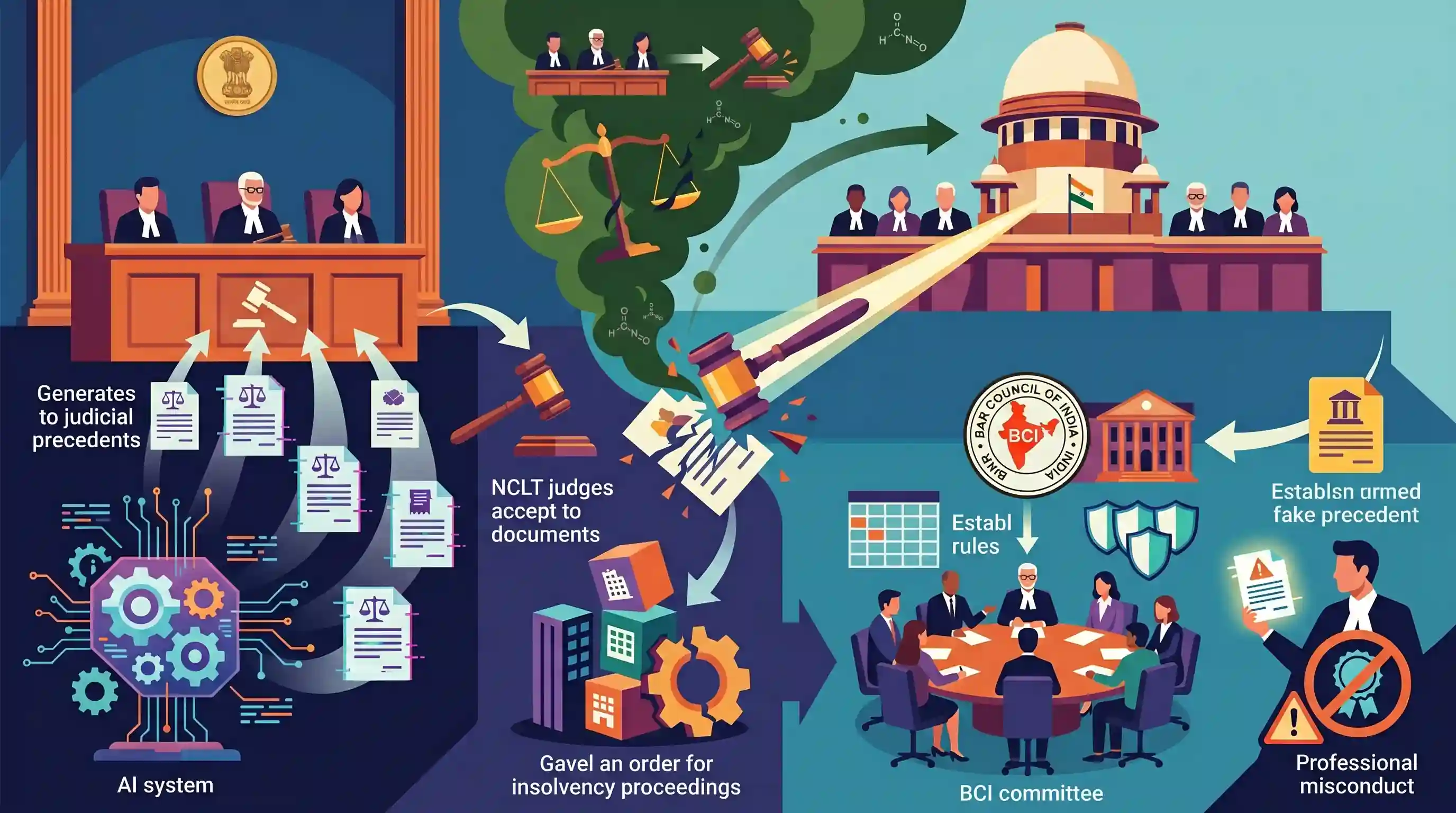
This landmark judgment establishes a critical legal precedent against the unregulated use of generative AI in quasi-judicial and judicial decision-making. It underscores the profound risks of 'AI hallucinations' in legal adjudication, establishes new professional misconduct standards for lawyers, and outlines the imperative for regulatory frameworks governing technology in public-interest systems like the judiciary.
Summary
The Supreme Court of India set aside a National Company Law Tribunal (NCLT) order admitting insolvency proceedings because the tribunal relied on six AI-hallucinated, non-existent judicial precedents. The division bench of Justices P S Narasimha and Alok Aradhe equated the unchecked use of AI in adjudication to the release of 'methyl isocyanate' in the realm of justice, warning of its insidious and catastrophic threat to judicial integrity. Consequently, the SC directed the Bar Council of India (BCI) to set up a committee to study the risks of AI in litigation, declaring that quoting unverified AI-generated citations constitutes professional misconduct.
Key Points
- The Supreme Court of India set aside an order passed by the National Company Law Tribunal (NCLT) because it relied on six AI-hallucinated (fake or non-existent) judicial precedents to reject objections against insolvency proceedings.
- Of the six citations relied upon by the NCLT, three did not exist at all (including a purported 2019 case, ICICI Bank Ltd v Urban Infrastructure Real Estate Ltd), while the other three either did not contain the quoted passages or corresponded to entirely different cases.
- The financial creditor (Jammu & Kashmir Bank) clarified that its counsel had not cited these cases, indicating the NCLT sourced them through its 'own research'—likely using an AI tool without verifying the outputs. The NCLAT also upheld the order without independently verifying them.
- Justices P S Narasimha and Alok Aradhe warned that AI-generated fake precedents act like 'the release of methyl isocyanate in the province of law and justice: invisible, insidious, and catastrophic.' They ruled that a decision built on fabricated case law 'is no decision at all' and must be set aside if even an iota of hallucinated material is used.
- The Supreme Court directed the Bar Council of India (BCI) to constitute a committee to examine the risks of AI in litigation, declaring that citing AI-generated authorities without verification constitutes professional misconduct.
- This is the second major instance of AI hallucination in Indian courts noted by the SC, following a February 2026 case (Gummadi Usha Rani v Sure Mallikarjuna Rao) where an Andhra Pradesh trial court relied on four fake AI-generated judgments.
- The underlying dispute involved Jammu & Kashmir Bank invoking Section 7 of the Insolvency and Bankruptcy Code (IBC) against corporate guarantor Essel Infraprojects Ltd for a Rs 200 crore loan default. Essel argued its liability was transferred under a court-approved demerger.
Important Terms
Insolvency and Bankruptcy Code

A consolidated legal framework enacted in 2016 to resolve insolvency and bankruptcy of corporate entities, partnerships, and individuals in a time-bound manner, shifting control from debtor-in-possession to creditor-in-control.
UPSC context
GS Paper III (Economy). Tests knowledge of NPA resolution, debt restructuring, and ease of doing business reforms.
National Company Law Tribunal
A specialized quasi-judicial body constituted under Section 408 of the Companies Act, 2013 to adjudicate corporate disputes, restructuring, and insolvency cases as the primary Adjudicating Authority under the IBC.
UPSC context
GS Paper II (Quasi-judicial bodies). Tests understanding of corporate dispute resolution, specialized adjudication, and tribunalization.
National Company Law Appellate Tribunal
A statutory appellate body established under Section 410 of the Companies Act, 2013 to hear appeals against decisions made by the NCLT, the Insolvency and Bankruptcy Board of India, and the Competition Commission of India.
UPSC context
GS Paper II (Tribunals). Tests knowledge of judicial hierarchy, appellate remedies in economic regulation, and administrative law.
Bar Council of India
A statutory body established under the Advocates Act, 1961, responsible for regulating legal education, prescribing professional conduct standards for advocates, and exercising disciplinary jurisdiction over the legal profession.
UPSC context
GS Paper II (Statutory Bodies) and GS Paper IV (Ethics). Tests regulation of legal profession and code of professional conduct.
Prelims Trap
The Bar Council of India, established under the Legal Services Authorities Act, 1987, regulates the conduct of both advocates and quasi-judicial members.
BCI is a statutory body under the Advocates Act, 1961, not the 1987 Act. It regulates advocates, whereas judicial/quasi-judicial members are governed by service rules.
Static Concepts Connected
What is the statutory role of the Bar Council of India?
- Statutory Origin: Established under Section 4 of the Advocates Act, 1961, as a representative regulatory body for Indian lawyers.
- Standard Setting: Prescribes standards of professional conduct, etiquette, and disciplinary procedures for advocates.
- Education Standards: Sets standards for legal education and grants recognition to universities offering law degrees.
What are the Supreme Court's key AI-driven administrative portals?
- SUPACE Portal: Assists judges with automated legal research, facts extraction, and case processing without replacing human judicial reasoning.
- SUVAS Software: An AI-powered translation tool designed to translate Supreme Court judgments and legal documents into scheduled regional languages.
- Human-in-the-Loop: Strictly maintains that AI tools are only assistive, requiring mandatory human verification for all outputs.
Cross-Topic Patterns
AI integration vs Article 21
Unverified algorithmic decision-making in tribunals risks violating the 'procedure established by law' under Article 21 by introducing arbitrary, non-existent precedents.
Tribunals and judicial review
The SC’s intervention under Article 136 underscores that quasi-judicial bodies (Article 323B) remain strictly subordinate to constitutional court oversight for procedural errors.

SC's stance on AI hallucinations likely to trigger GS2/GS4 questions on the ethical limits of algorithmic decision-making in governance.
Linked PYQs · 3
Linked PYQs · 3
- 2023MainsGS3
Introduce the concept of Artificial Intelligence (AI). How does Al help clinical diagnosis? Do you perceive any threat to privacy of the individual in the use of Al in healthcare?
- 2019MainsGS2
“The Central Administrative Tribunal which was established for redressal of grievances and complaints by or against central government employees, nowadays is exercising its powers as an independent judicial authority.” Explain.
- 2024MainsGS2
e-governance is not just about the routine application of digital technology in service delivery process. It is as much about multifarious interactions for ensuring transparency and accountability. In this context evaluate the role of the 'Interactive Service Model' of e-governance.
