Election Commission Special Summary Revision and Electoral Purity
Source:Indian Express ↗
Why It Matters
Maintaining accurate electoral rolls is the bedrock of free and fair elections. The article highlights how emerging technologies like AI can be weaponized to create fake identities (voter fraud), while simultaneously illustrating how regulatory bodies like the ECI must adopt advanced analytics to counter these threats, directly linking to UPSC GS-2 (Elections) and GS-3 (Science & Tech/Cybersecurity).
Summary
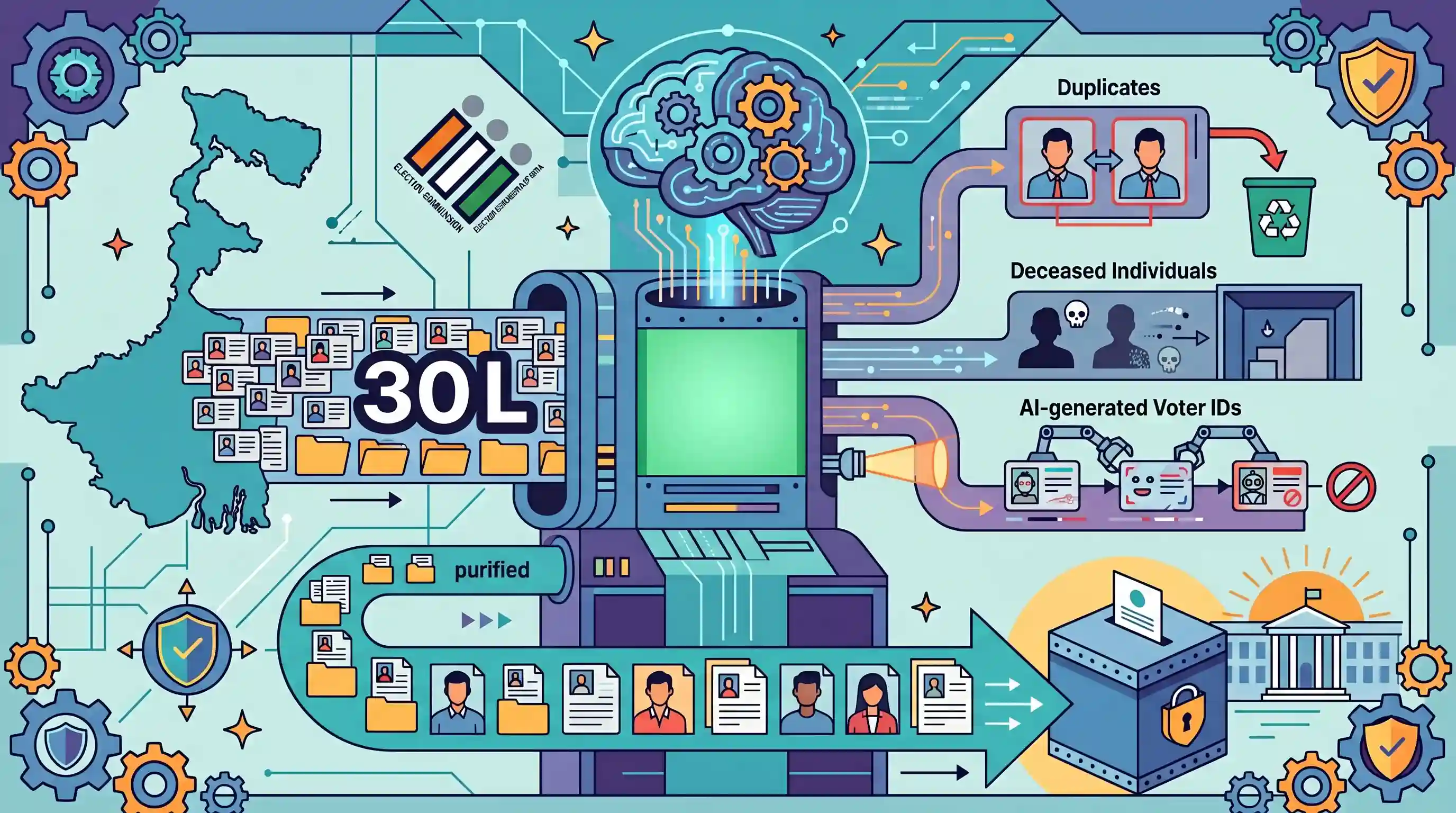
The Election Commission of India is intensifying its Special Summary Revision (SSR) in West Bengal by placing 30 lakh names under 'super checking' to cleanse the electoral roll. The process targets the emerging threat of AI-generated voter IDs, duplicate names, and deceased individuals persisting on voter lists. By utilizing AI and advanced data analytics, the ECI aims to counter technological manipulation and ensure the integrity of the democratic process. This development brings to the forefront both the governance challenges and institutional countermeasures surrounding the purity of electoral rolls and the evolving role of AI in electoral fraud.
Key Points
- The Election Commission of India (ECI) is conducting a 'super checking' of around 30 lakh names on the West Bengal electoral roll during the Special Summary Revision (SSR).
- Authorities are leveraging AI and deep data analytics to identify duplicate entries and weed out 'AI-generated fake voter IDs'.
- The verification drive was triggered by instances of deceased individuals remaining on electoral lists and allegedly 'appearing' for hearings.
- The purification of electoral rolls highlights the intersection of modern technology with electoral integrity, showcasing both the vulnerabilities posed by AI-generated fakes and the utility of data analytics in governance.
Important Terms
Election Commission of India (ECI)

A permanent constitutional body established under Article 324, responsible for the superintendence, direction, and control of all elections to Parliament and State Legislatures.
UPSC context
GS Paper II (Constitutional Bodies); fundamental for questions on democratic governance and electoral integrity.
Representation of the People Act (RPA)
The statutory framework governing Indian elections; RPA 1950 focuses on constituency delimitation and electoral rolls, while RPA 1951 governs the actual conduct of elections.
UPSC context
GS Paper II (Salient features of RPA); a core syllabus item for electoral processes.
Special Intensive Revision (SIR)
A comprehensive, time-bound verification exercise by the ECI involving door-to-door enumeration or scrutiny to update and cleanse voter lists before major elections.
UPSC context
GS Paper II (Electoral Reforms); critical for understanding measures to ensure universal adult suffrage.
Super Checking
A multi-layered verification system where senior officials (DEOs/Roll Observers) audit the work of field functionaries to ensure document accuracy and transparency in voter list revision.
UPSC context
GS Paper II (Governance/Electoral Administration); pertains to accountability and error-reduction in state-level election machinery.
Electoral Roll Purification
The institutional process of removing duplicates, deceased voters, and ineligible entries from the electoral roll to maintain the purity and fidelity of the voting register.
UPSC context
GS Paper II (Electoral Reforms); relevant to topics on free and fair elections and technology in governance.
Prelims Trap
The preparation and revision of electoral rolls are governed by the Representation of the People Act, 1951.
RPA 1950 governs the preparation of electoral rolls and voter qualifications. RPA 1951 deals exclusively with the actual conduct of elections, disputes, and corrupt practices.
Static Concepts Connected
What are the core provisions of the Representation of the People Act, 1950?
- Seat Allocation: Determines the allocation of seats for the Lok Sabha and State Legislative Assemblies.
- Electoral Rolls: Outlines the statutory procedures for the preparation, revision, and continuous maintenance of electoral rolls.
- Voter Qualifications: Sets the conditions and qualifications for citizens to be registered as voters in an electoral roll.
What is the scope of Article 324 regarding the ECI's authority over electoral rolls?
- Complete Control: Vests the absolute superintendence, direction, and control of the preparation of electoral rolls solely in the Election Commission.
- Plenary Powers: Grants the ECI residual powers to issue necessary orders to maintain roll purity where existing parliamentary statutes are silent.
Cross-Topic Patterns
AI utility vs AI threats in elections
The ECI uses AI-driven tools like ERONET to neutralize the cybersecurity threat of AI-generated synthetic identities, showcasing a duel of technology in democratic governance.
Balancing Article 326 and Article 324
UPSC frequently tests the statutory/constitutional nature of voting (Article 326). Electoral roll purification ties this right directly to ECI's Article 324 mandate to prevent fraud.

A hybrid Prelims question linking ECI's plenary powers (Article 324) with ERONET's AI-based duplicate voter detection is highly probable.
Linked PYQs · 4
Linked PYQs · 4
- 2017MainsGS2
To enhance the quality of democracy in India the Election Commission of India has proposed electoral reforms in 2016. What are the suggested reforms and how far are they significant to make democracy successful?
- 2024MainsGS2
Examine the need for electoral reforms as suggested by various committees with particular reference to "one nation one election" principle.
- 2023MainsGS3
Introduce the concept of Artificial Intelligence (AI). How does Al help clinical diagnosis? Do you perceive any threat to privacy of the individual in the use of Al in healthcare?
- 2017PrelimsGS1
Right to vote and to be elected in India is a
