Artificial intelligence infrastructure gaps and global governance
Source:The Hindu ↗
Why It Matters
The transition from a 'digital divide' to an 'inference gap' highlights structural vulnerabilities in India's technology ecosystem. It underscores the dual challenge of building indigenous AI infrastructure (GS3) while strategically positioning India as a regulatory leader for the Global South (GS2) against great power tech rivalries.
Summary
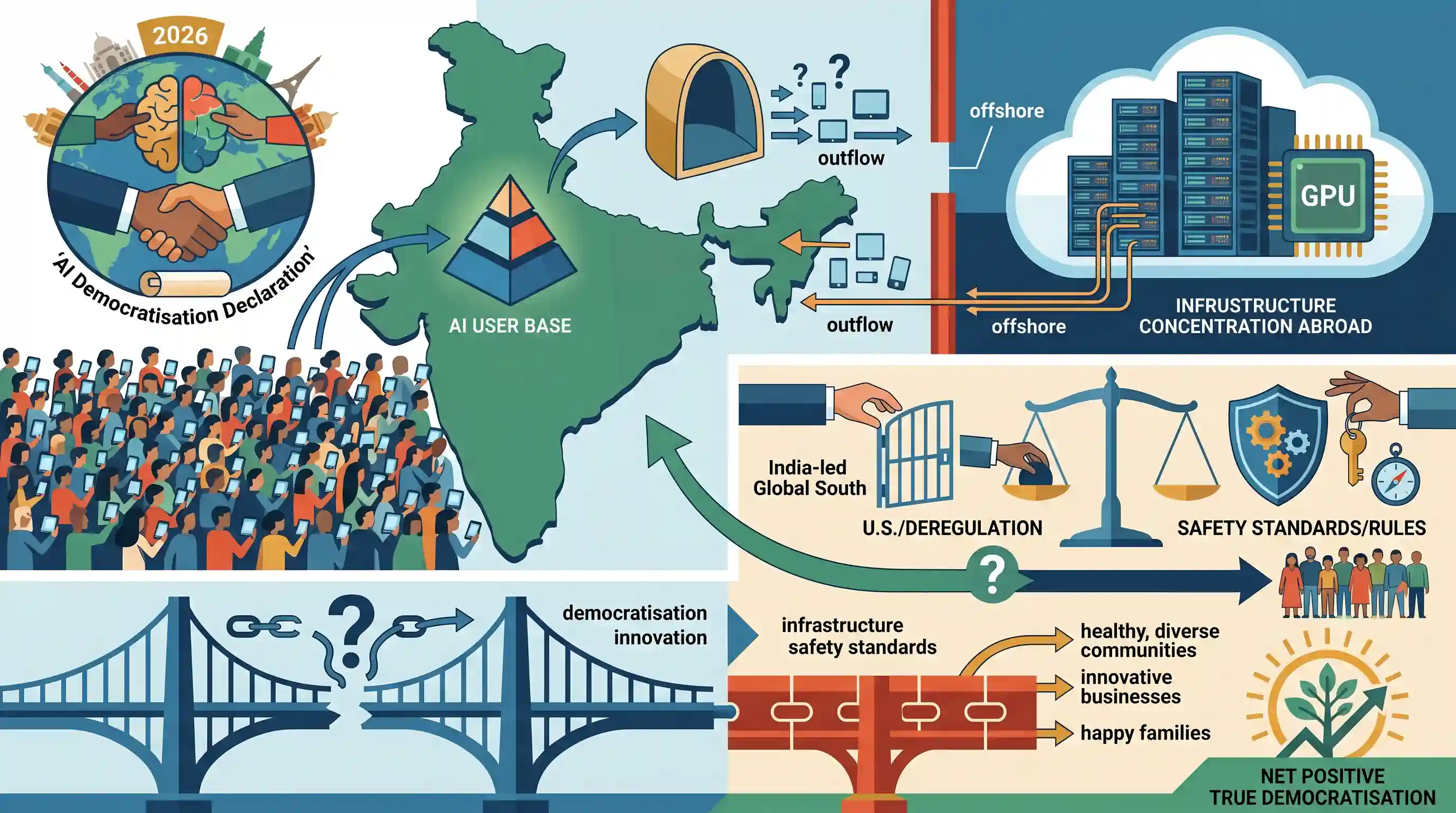
The editorial reviews the India AI Impact Summit 2026, where 89 countries signed a declaration on AI democratisation. While India boasts a massive AI user base, it risks becoming merely an AI deployment hub because the necessary core infrastructure—such as GPUs and data centers—remains concentrated abroad. The article criticises India's alignment with the U.S.'s deregulated approach to AI governance, arguing that India should instead use its leverage to lead the Global South in establishing robust safety standards. Ultimately, it emphasizes that true democratisation requires closing the 'inference gap' to ensure AI serves as a net positive for society.
Key Points
- 89 countries signed a declaration at the India AI Impact Summit 2026 in New Delhi, committing to share knowledge on AI democratisation.
- Despite a massive user base, India faces a risk of becoming merely an AI deployment hub because core infrastructure and capital (like costly GPUs and data centers) reside abroad.
- A national strategy overly reliant on model deployment rather than training and fine-tuning may yield smaller economic advantages than the IT sector era.
- The editorial critiques India for aligning with the U.S.'s hands-off approach to AI governance, urging it instead to lead the Global South in building safety standards.
- To ensure AI acts as a net public good, policymakers must focus on closing the emerging 'inference gap' just as they tackle the digital divide.
Important Terms
New Delhi Declaration on AI Impact 2026

The non-binding agreement signed by 89+ nations at the 2026 Summit, promoting equitable AI access and the principle of "Sarvajan Hitaya, Sarvajan Sukhaya" (Welfare for all).
UPSC context
GS-II (International Relations) & GS-III (S&T). Tests knowledge of global tech treaties and India's leadership in digital diplomacy.
Inference Gap
The disparity between high-compute model training and the ongoing, resource-intensive 'inference' (deployment) phase, where infrastructure-poor regions struggle to run AI models efficiently or affordably.
UPSC context
GS-III (Science & Tech). Crucial for understanding infrastructure challenges and digital sovereignty in emerging technology deployment.
GPU (Graphics Processing Unit) Concentration
Specialized hardware essential for AI training and deployment; its concentration in a few advanced nations creates a 'compute divide' that hinders local AI development.
UPSC context
GS-III (Indigenization of Technology). Relates to semiconductor missions, hardware self-reliance, and global supply chain security.
AI Democratisation
A policy framework advocating for broad, affordable access to AI tools, datasets, and compute resources to prevent tech monopolies and ensure inclusive growth.
UPSC context
GS-II (Global Groupings). Focuses on India's role as a bridge between tech powers and developing nations.
IndiaAI Mission
A ₹10,370 crore flagship initiative aimed at building sovereign compute capacity (100k+ GPUs), supporting startups, and fostering indigenous AI innovation in India.
UPSC context
GS-III (S&T Policy). Central to questions on national strategies for emerging technologies and digital infrastructure.
AI Governance Models
The divergent approaches to regulating AI; India currently favors a flexible, principles-based (voluntary) model over the EU's binding, risk-based legislative framework.
UPSC context
GS-IV (Ethics) & GS-II (Polity). Involves regulatory philosophies and the ethical trade-off between innovation and safety.
Prelims Trap
"The 'inference gap' in AI refers to the severe shortage of regional language training data."
It actually describes the ongoing computational and energy costs required to run (infer) AI models, creating a new digital divide for resource-constrained users.
Static Concepts Connected
Why are GPUs preferred over CPUs for training large AI models?
- Parallel Processing: GPUs can handle thousands of operations simultaneously, which is essential for the heavy matrix multiplications required in neural networks.
- Core Architecture: While CPUs have a few powerful cores optimized for sequential tasks, GPUs feature thousands of smaller, highly efficient cores.
- High Throughput: GPUs prioritize processing massive volumes of data at once (throughput), making them vastly superior for machine learning workloads.
What are the core pillars of the IndiaAI Mission?
- Compute Capacity: Establishing a scalable AI computing ecosystem via public-private partnerships, including subsidizing and deploying thousands of GPUs.
- Innovation Centre: Developing indigenous foundational models, particularly large language models (LLMs), suited for India's extreme linguistic diversity.
- Datasets Platform: Creating a unified, accessible platform to provide startups and researchers with non-personal, high-quality datasets.
Cross-Topic Patterns
From DPI to Sovereign AI Compute
India's AI strategy mirrors its Digital Public Infrastructure success (UPI, Aadhaar) by treating foundational AI compute as a public good to prevent foreign monopolization.
Voice of the Global South in Tech
The 89-nation declaration solidifies India's G20 legacy, pushing a development-centric AI governance model that contrasts sharply with the U.S. market-led and EU rights-based approaches.
AI's massive energy and carbon footprint
Running thousands of GPUs creates massive electricity and cooling demands. The 'inference gap' links directly to GS Paper 3 topics on grid capacity and India's net-zero transition.

Expect a Mains Q contrasting India's 'Sovereign AI' model with EU/US frameworks, emphasizing the 'inference gap' and compute dependency.
Linked PYQs · 3
Linked PYQs · 3
- 2023MainsGS3
Introduce the concept of Artificial Intelligence (AI). How does Al help clinical diagnosis? Do you perceive any threat to privacy of the individual in the use of Al in healthcare?
- 2023MainsGS3
What is the status of digitalization in the Indian economy? Examine the problems faced in this regard and suggest improvements.
- 2019MainsGS2
‘The long-sustained image of India as a leader of the oppressed and marginalised nations has disappeared on account of its new found role in the emerging global order.’ Elaborate.
