India AI Impact Summit and the Strategic Tech Gap
Source:The Hindu ↗
Why It Matters
The article critically analyzes India's positioning in the global AI landscape, balancing its massive user base with stark deficits in foundational AI infrastructure like GPUs and data centres. It highlights the crucial distinction between simply consuming AI models versus developing them, while calling for India to play a more assertive role in formulating global AI regulations to protect emerging economies from great power monopolies.
Summary
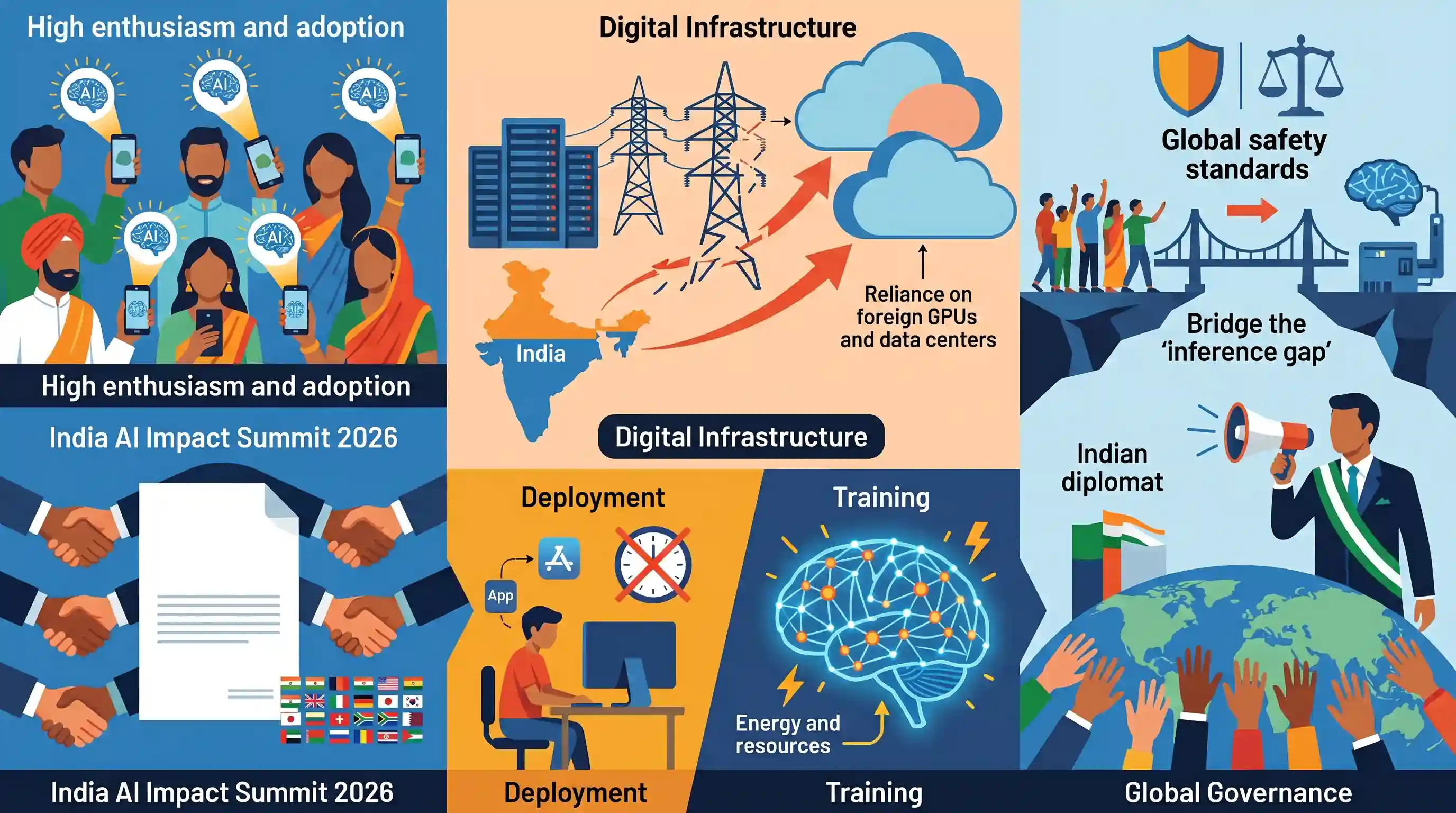
The editorial discusses the implications of the India AI Impact Summit 2026, where 89 countries signed a declaration promoting AI democratization. While highlighting the immense enthusiasm among Indians for AI, it underscores the structural challenges India faces, such as heavy reliance on foreign infrastructure (GPUs, data centres) and insufficient electrical capacity. The article warns against a strategy that merely focuses on deploying AI models rather than training them, noting that the low-cost labour advantage of the ITeS era will not apply to AI. Furthermore, it criticizes India's passive stance on international AI governance, urging the nation to actively advocate for global safety standards to protect the Global South and to bridge the emerging \'inference gap\'.
Key Points
- The India AI Impact Summit 2026 in New Delhi saw 89 countries commit to sharing knowledge for the democratization of artificial intelligence.
- India faces significant hurdles in AI adoption due to its reliance on foreign capital and computing infrastructure, specifically data centres and graphics processing units (GPUs), alongside necessary electrical capacity upgrades.
- A national strategy overly reliant on the deployment of AI models, rather than their training or fine-tuning, reduces India's competitive edge compared to the earlier IT-enabled services (ITeS) boom.
- The editorial critiques India for enabling a U.S.-led \'hands-off\' approach to AI governance, rather than advocating for stringent safety standards and tools for Large Language Models (LLMs).
- To demonstrate true Global South leadership, India must advocate for equitable AI governance, protect vulnerable nations from technological great-power rivalries, and work to close the domestic \'inference gap\' as it bridges the digital divide.
Important Terms
India AI Impact Summit 2026

A landmark global forum held in New Delhi (Feb 2026) where 89 nations endorsed a declaration to promote inclusive, responsible, and democratized Artificial Intelligence.
UPSC context
GS Paper II (International Relations) & III (Science & Tech); tests India’s leadership in global tech governance and the Global South.
New Delhi Declaration on AI Impact
The 2026 summit’s outcome document outlining seven pillars (Chakras) for global AI cooperation, focusing on equitable resource access, social empowerment, and energy-efficient systems.
UPSC context
GS Paper II; represents a multilateral consensus on ethical AI and digital sovereignty led by India.
IndiaAI Mission
A ₹10,372 crore national initiative to build India’s AI ecosystem through GPU-based compute infrastructure, indigenous foundational models (e.g., Bhashini), and open datasets (AI Kosh).
UPSC context
GS Paper III (IT & Computers); tests knowledge of domestic policy frameworks for achieving technological self-reliance.
Inference Gap
The disparity between nations that can afford the computing power to run advanced AI models (inference) versus those constrained by poor hardware or connectivity.
UPSC context
GS Paper III (Digital Divide); tests understanding of emerging socio-economic inequalities caused by high-end technology requirements.
Graphics Processing Unit (GPU)
Specialized hardware required for the massive parallel processing used in training and running AI models; currently a point of structural dependency for India.
UPSC context
GS Paper III (S&T); crucial for understanding the hardware-software bottleneck in India’s AI ambitions.
AI Democratization
The strategic push to make AI compute, data, and models accessible and affordable as "Global Public Goods" rather than exclusive tools for tech superpowers.
UPSC context
GS Paper II & III; a key theme in India’s digital diplomacy and its "AI for All" vision.
Prelims Trap
The India AI Impact Summit 2026 declaration acts as a legally binding UN treaty on AI governance.
Summits like this typically produce non-binding political declarations (similar to the Bletchley Declaration). There is currently no overarching, legally binding UN treaty on global AI governance.
Static Concepts Connected
Why are GPUs critical for AI, and what is the 'inference gap'?
- Parallel Processing: GPUs handle thousands of operations simultaneously, which is essential for processing the massive matrix math required by complex neural networks.
- Training vs Inference: Training builds the AI model; inference applies it to user queries. The 'inference gap' refers to structural inequalities in computing power access to actually run these models.
What are the key global initiatives for AI governance?
- EU AI Act: The world's first comprehensive, legally binding regulatory framework that classifies AI systems according to their risk level.
- Bletchley Declaration: A multilateral political agreement focusing specifically on identifying and mitigating catastrophic risks from advanced 'frontier AI' models.
- GPAI: The Global Partnership on AI is an international multi-stakeholder initiative to guide responsible AI development. India is a founding member and active participant.
Cross-Topic Patterns
AI compute demand & Energy Security
AI's extreme power requirements for data centres and cooling conflict with India's net-zero emission targets, making grid modernization and renewable energy capacity vital for tech sovereignty.
Demographic Dividend vs AI Capital
India's historic IT boom relied on a low-cost labour advantage. The AI era requires massive capital for GPUs and infrastructure, threatening to neutralize India's traditional demographic edge.
Global South Tech Diplomacy
India leverages digital platforms (like DPI) for Global South leadership. The AI 'inference gap' shifts this diplomacy from software sharing to demanding equitable hardware access and safety standards.

Expect a 2026 Mains question linking India's sovereign compute capacity (GPUs/energy) to its AI ambitions and Global South tech diplomacy.
Linked PYQs · 4
Linked PYQs · 4
- 2023MainsGS3
Introduce the concept of Artificial Intelligence (AI). How does Al help clinical diagnosis? Do you perceive any threat to privacy of the individual in the use of Al in healthcare?
- 2023MainsGS3
What is the status of digitalization in the Indian economy? Examine the problems faced in this regard and suggest improvements.
- 2025MainsGS2
India-Africa digital partnership is achieving mutual respect, co-development and long-term institutional partnerships. Elaborate.
- 2025MainsGS2
e-governance projects have a built-in bias towards technology and back-end integration than user-centric designs. Examine.
