AI And Emerging Technologies In Democratic Governance And Parliament
Source:The Hindu ↗
Why It Matters
This provides a high-level governance perspective on balancing the adoption of emerging technologies (like AI) for legislative efficiency (e-governance/paperless Parliament) against the threats of cybercrime and misinformation. It directly addresses GS2 (E-governance), GS3 (Cybercrimes/Technology), and GS4 (Ethics in AI/Social Media).
Summary
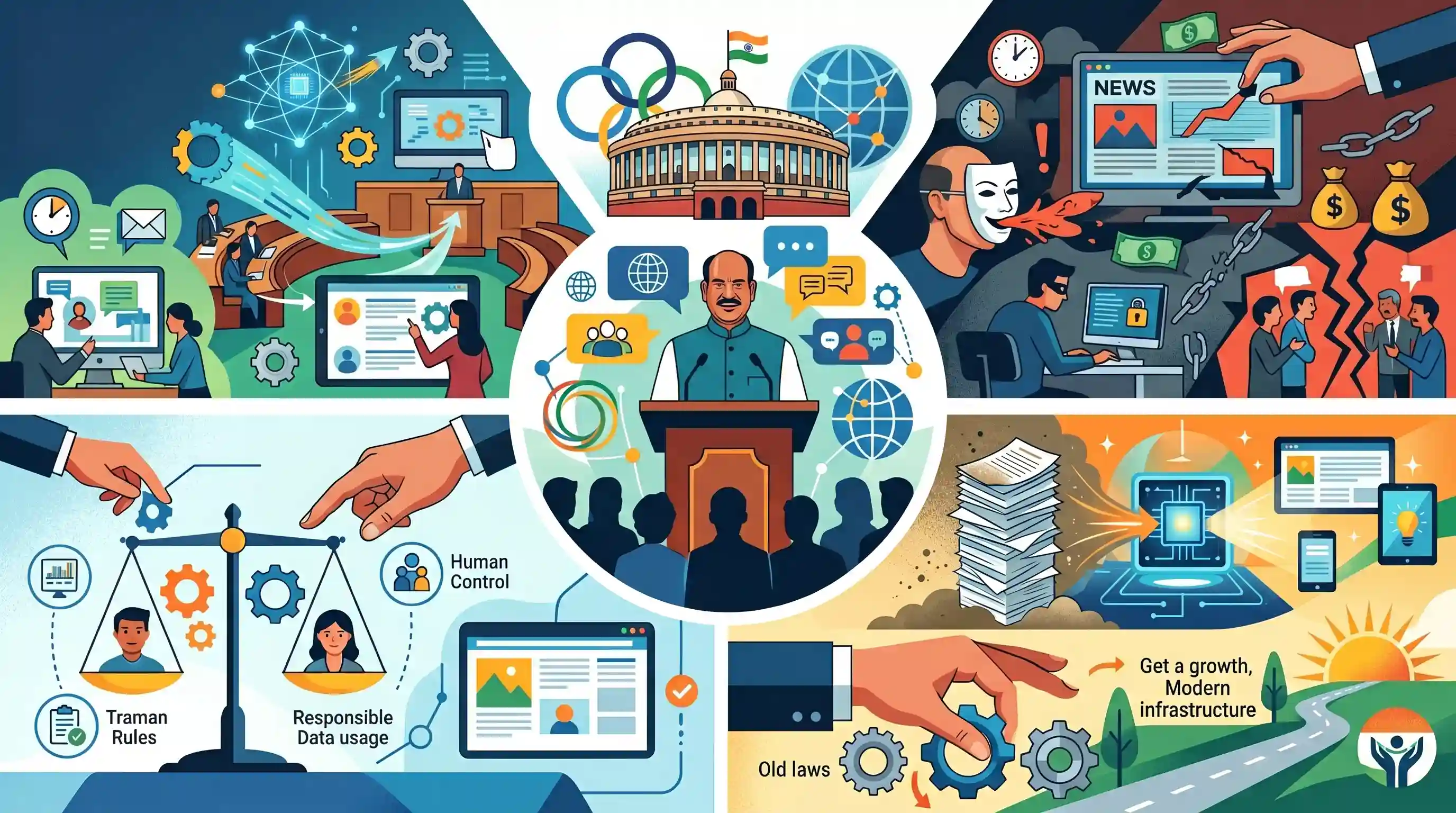
Lok Sabha Speaker Om Birla, addressing the Conference of Speakers and Presiding Officers of Commonwealth in New Delhi, emphasized that AI and emerging technologies have enhanced the efficiency of democratic processes. However, he warned of the risks associated with their misuse, including misinformation, cybercrime, and social polarization. Highlighting the need for ethical AI and accountable social media, he also shared that India is working on a unified digital platform to make legislative institutions paperless and has repealed obsolete laws to drive the country towards self-reliance and development.
Key Points
- Lok Sabha Speaker Om Birla highlighted that Artificial Intelligence (AI) and emerging technologies have significantly increased the efficiency and responsiveness of democratic institutions.
- He cautioned that without an ethical framework, these technologies could be misused for misinformation, cybercrimes, and causing social polarization.
- India is creating a unified digital platform to connect all legislative institutions across the country, aiming to make legislative processes completely paperless.
- Birla emphasized the repeal of obsolete laws to streamline governance and help India become self-reliant.
Important Terms
Lok Sabha Speaker

The presiding officer of India's Lower House, elected under Article 93 to conduct proceedings, maintain order, and represent the House's dignity and privileges.
UPSC context
GS Paper II (Polity). Central to parliamentary functioning, neutral conduct, and constitutional powers like certifying Money Bills.
Commonwealth of Nations
A voluntary association of 56 sovereign states, mostly former British colonies, cooperating to promote democracy, human rights, and sustainable development.
UPSC context
GS Paper II (International Relations). Important for India's multilateral diplomacy and engagement with the Global South.
CSPOC
An independent biennial forum for Speakers and Presiding Officers of Commonwealth parliaments to share best practices and strengthen democratic institutions.
UPSC context
GS Paper II (Governance). Relevant for international parliamentary diplomacy and India's leadership in democratic forums.
Digital Sansad
A unified digital platform for India's Parliament designed to make legislative processes paperless, transparent, and more accessible to members and citizens.
UPSC context
GS Paper II (E-governance). Key initiative for improving legislative efficiency and citizen engagement through technology.
Ethical AI
A framework for developing AI systems that prioritize transparency, accountability, and fairness while mitigating risks like misinformation and algorithmic bias.
UPSC context
GS Paper II & III (Technology/Ethics). Crucial for analyzing the impact of emerging tech on democratic stability and security.
Prelims Trap
"The National e-Vidhan Application (NeVA) is a platform exclusively designed to digitize proceedings of the Lok Sabha and Rajya Sabha."
NeVA operates under a 'One Nation, One Application' vision to digitize and integrate ALL legislative houses, including State Assemblies and Councils, not just Parliament.
Static Concepts Connected
What are the core pillars of the National e-Vidhan Application (NeVA)?
- One Nation Vision: Integrates all legislative bodies (Parliament and States) onto a single centralized, cloud-based platform.
- Paperless Legislature: Aims to eliminate paper usage by digitizing questions, bills, committee reports, and notices.
- Nodal Ministry: Spearheaded and funded under the Digital India Programme by the Ministry of Parliamentary Affairs.
What are the key ethical concerns of AI deployment in public governance?
- Algorithmic Bias: Risk of machine learning models perpetuating historical societal prejudices in public service delivery or policing.
- Accountability Gap: Determining liability when AI-driven governance decisions (e.g., welfare exclusions) cause harm or critical errors.
- Data Privacy: Balancing the requirement of vast datasets for AI model training with citizens' fundamental right to privacy.
Cross-Topic Patterns
E-Governance vs. Internal Security
Digitizing legislatures improves governance efficiency (GS2), but AI-driven deepfakes and cyber threats simultaneously challenge electoral integrity and internal security (GS3).
Decriminalization & Trust Governance
Repealing obsolete laws links the Jan Vishwas Act's corporate decriminalization (GS3) with administrative streamlining and minimum government goals (GS2).

Expect a GS2/GS3 linked question in 2026 assessing AI's dual impact on democracy: e-Vidhan efficiency vs. deepfake election interference.
Linked PYQs · 5
Linked PYQs · 5
- 2023MainsGS2
e-governance, as a critical tool of governance, has ushered in effectiveness, transparency and accountability in governments. What inadequacies hamper the enhancement of these features ?
- 2024MainsGS2
e-governance is not just about the routine application of digital technology in service delivery process. It is as much about multifarious interactions for ensuring transparency and accountability. In this context evaluate the role of the 'Interactive Service Model' of e-governance.
- 2023MainsGS3
Introduce the concept of Artificial Intelligence (AI). How does Al help clinical diagnosis? Do you perceive any threat to privacy of the individual in the use of Al in healthcare?
- 2020MainsGS3
Discuss different types of cyber crimes and measures required to be taken to fight the menace.
- 2024MainsGS4
The application of Artificial Intelligence as a dependable source of input for administrative rational decision-making is a debatable issue. Critically examine the statement from the ethical point of view.
