Artificial intelligence and digital sovereignty challenges in India
Source:Indian Express ↗
Why It Matters
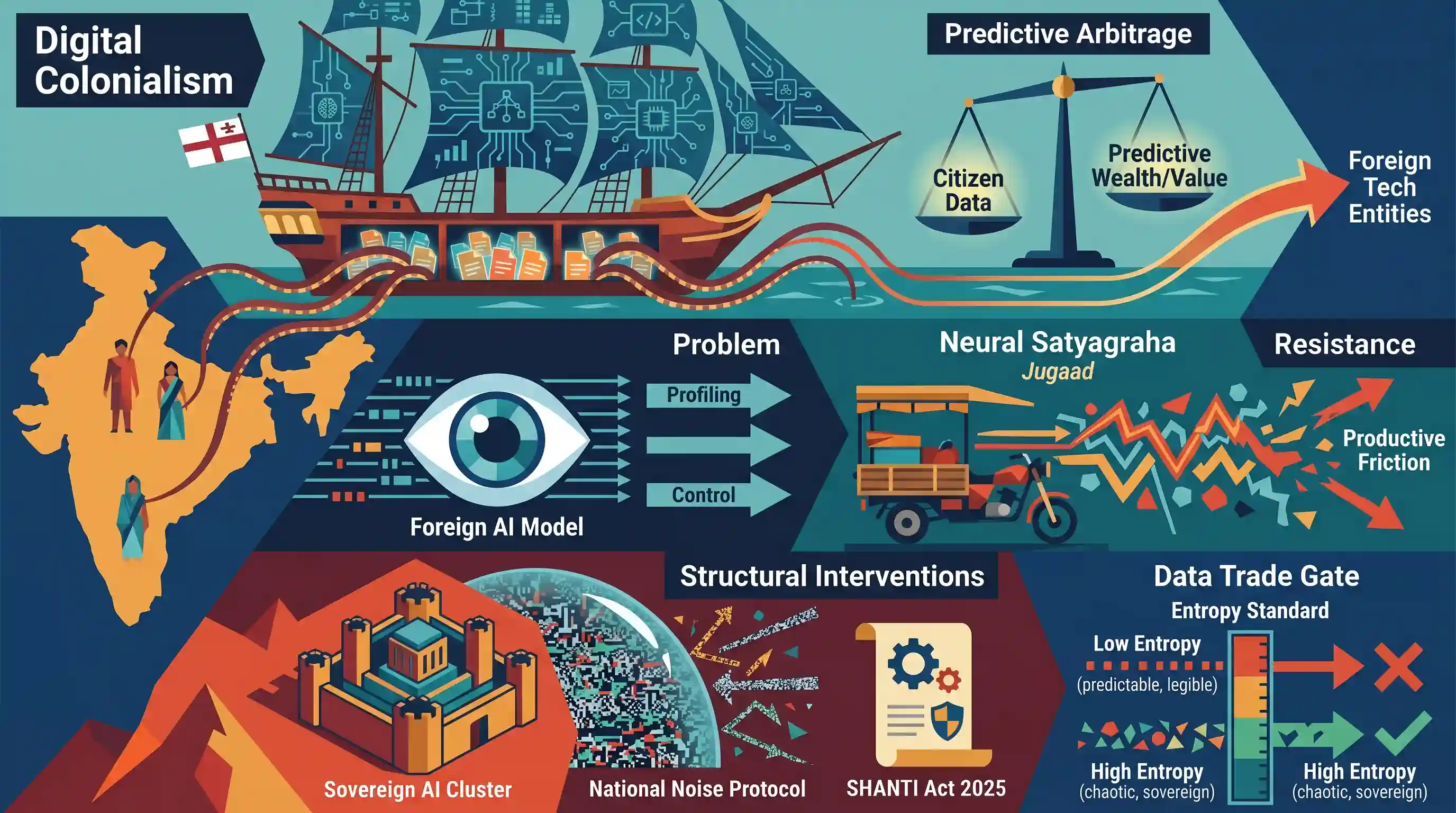
As AI reshapes global economies, data sovereignty has become a critical facet of national security. The concepts of 'predictive arbitrage' and 'digital colonialism' offer a sophisticated lens for GS3 S&T and Economy questions, challenging the blind pursuit of hyper-efficiency and advocating for sovereign control over digital footprints.
Summary
The article presents a critical view of global Artificial Intelligence as a form of digital colonialism, likening it to the East India Company. It argues that foreign AI models extract immense wealth from India through 'predictive arbitrage' by exploiting citizen data. To counter this, the author proposes 'Neural Satyagraha,' leveraging the Indian concept of 'jugaad' (strategic irrationality) to disrupt algorithmic profiling. It advocates for structural interventions such as a 'National Noise Protocol' backed by sovereign AI clusters, the SHANTI Act 2025, and an 'Entropy Standard' for data trade. The piece highlights that 'productive friction'—which makes data harder to predict—is a necessary defense mechanism to ensure technological sovereignty and protect against cognitive exploitation by global tech entities.
Key Points
- Global AI models operate similarly to a digital East India Company, algorithmically colonising India by extracting behavioral data for 'predictive arbitrage' and draining significant economic value.
- The article proposes 'Neural Satyagraha'—using indigenous 'jugaad' or strategic irrationality to resist algorithmic profiling and protect cognitive sovereignty.
- A 'National Noise Protocol' under the IndiaAI Mission and SHANTI Act 2025 is suggested to inject deliberate noise into data streams, providing 'obfuscation as a service' to shield citizens.
- An 'Entropy Standard' for data trade is recommended to value data based on its unpredictability, thus resisting purely extractive hyper-efficient global models.
- The complex socio-economic realities of Tier-2/3 cities create 'productive friction' that AI struggles to model, leading to better human tech job growth compared to hyper-efficient metros.
Important Terms
IndiaAI Mission

A ₹10,372 crore national initiative to establish sovereign AI infrastructure, including 10,000+ GPUs, foundational models, and a datasets platform to ensure technological self-reliance.
UPSC context
GS-3 (S&T, Economy): Relates to digital sovereignty, indigenous innovation, and the 'Make AI in India' mandate.
SHANTI Act 2025
Legislation replacing the Atomic Energy Act 1962 to modernize India's nuclear framework, enabling private participation and providing reliable baseload power for data-intensive technologies like AI.
UPSC context
GS-3 (Energy, Infrastructure): Crucial for understanding the energy-technology nexus and recent legislative overhauls in nuclear governance.
National Noise Protocol
A proposed strategy to protect data sovereignty by intentionally injecting 'noise' or 'synthetic irrationality' into data streams to disrupt profiling by foreign algorithmic models.
UPSC context
GS-3 (Cybersecurity, Internal Security): Tests awareness of non-traditional data defense mechanisms and privacy-preserving techniques.
Neural Satyagraha
A defensive doctrine advocating for 'strategic complexity' and non-cooperation with exploitative global predictive structures to safeguard a nation's cognitive and economic sovereignty.
UPSC context
GS-4 (Ethics, Technology): A conceptual tool for discussing ethical resistance to digital exploitation and algorithmic bias.
Digital Colonialism
Modern extraction of data and wealth from developing nations by global tech entities, using predictive algorithms to manipulate markets and erode technological autonomy.
UPSC context
GS-2/GS-3 (International Relations, Tech Governance): Core concept for examining power dynamics between Global South nations and Big Tech.
Predictive Arbitrage
The economic practice where global AI models profit by predicting and influencing consumer behavior using data harvested without providing equitable value to the source nation.
UPSC context
GS-3 (Economy, S&T): Relevant for discussions on data-driven economic disparities and digital market regulation.
Prelims Trap
"The SHANTI Act 2025 and National Noise Protocol are global UN frameworks for AI governance."
These are conceptual domestic regulatory interventions proposed in the article to counter predictive arbitrage, not enacted international treaties or UN frameworks.
Static Concepts Connected
How does India govern Non-Personal Data (NPD) to prevent monopolies?
- Gopalakrishnan Committee: Recommended a framework to harness NPD for domestic economic value and prevent exclusive tech-monopolies.
- Classification: Divided NPD into Public (government collected), Community (raw data of user groups), and Private (privately collected) data.
- Mandatory Sharing: Suggested mechanisms for mandatory sharing of important NPD to spur domestic innovation and AI training.
What are the core pillars of India's 'Sovereign AI' push?
- Compute Infrastructure: Building domestic capacity, including procuring 10,000+ GPUs under the IndiaAI Mission.
- Indigenous Datasets: Developing platforms like AI Kosh to provide high-quality, localized, and culturally nuanced datasets.
- Domestic Models: Creating indigenous multimodal AI (like BharatGen) that respect domestic legal frameworks and cultural nuances.
Cross-Topic Patterns
Digital Colonialism & WTO e-commerce
The concept of 'predictive arbitrage' reinforces India's defensive stance at the WTO against binding commitments on unrestricted cross-border data flows.
Tier-2/3 Demographics & E-Gov Friction
AI's failure to model unstructured Tier-2/3 Indian socio-economic realities highlights why e-governance requires localized, human-centric design, not just algorithmic efficiency.

Expect a 2026 GS-3 Mains question linking 'Sovereign AI' and 'Digital Colonialism' to India's data governance and the IndiaAI Mission.
Linked PYQs · 4
Linked PYQs · 4
- 2023MainsGS3
Introduce the concept of Artificial Intelligence (AI). How does Al help clinical diagnosis? Do you perceive any threat to privacy of the individual in the use of Al in healthcare?
- 2023MainsGS3
What is the status of digitalization in the Indian economy? Examine the problems faced in this regard and suggest improvements.
- 2018MainsGS3
Data security has assumed significant importance in the digitized world due to rising cyber crimes. The Justice B. N. Srikrishna Committee Report addresses issues related to data security. What, in your view, are the strengths and weaknesses of the Report relating to protection of personal data in cyber space?
- 2025MainsGS2
e-governance projects have a built-in bias towards technology and back-end integration than user-centric designs. Examine.
