Artificial Intelligence Cybersecurity Threats to India
Source:Indian Express ↗
ఇది ఎందుకు ముఖ్యం
With India undergoing rapid digital transformation, understanding the intersection of AI and cyber security is crucial for safeguarding critical infrastructure, data privacy, and national security against next-generation threats.
సారాంశం
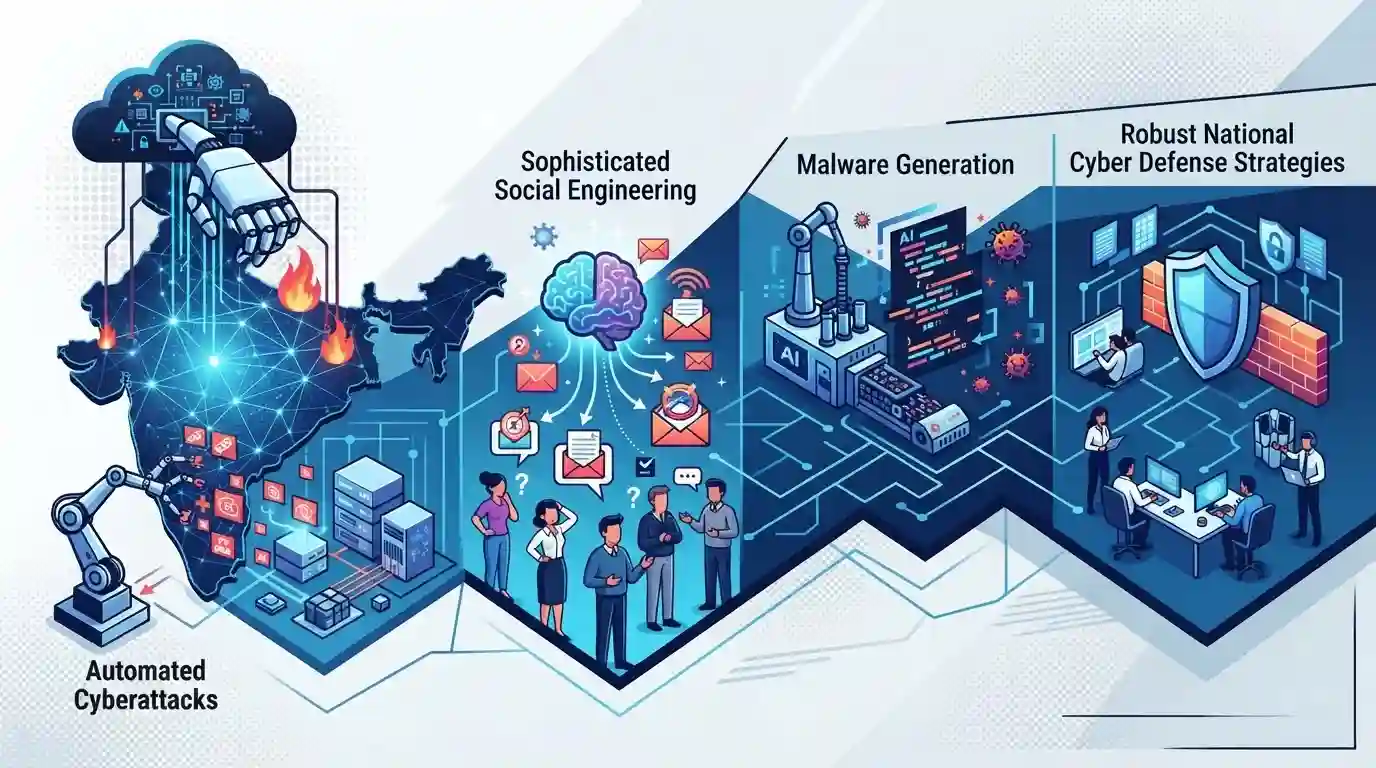
The article examines the escalating cybersecurity threats posed by the malicious use of Artificial Intelligence in India. It highlights how AI tools are leveraged for automated cyberattacks, sophisticated social engineering, and malware generation, underscoring the necessity for robust national cyber defense strategies.
ముఖ్య అంశాలు
- AI is increasingly being weaponized by cybercriminals to execute sophisticated, automated, and large-scale attacks.
- Threats include AI-generated phishing, deepfakes for social engineering, automated vulnerability exploitation, and malware mutation.
- India faces significant cyber security vulnerabilities due to rapid digitalization and expanding critical infrastructure, requiring robust defense mechanisms.
- There is an urgent need to integrate AI-driven defense systems and update national cyber security frameworks to counter these emerging threats.
ముఖ్యమైన పదాలు
CERT-In

India's national nodal agency operating under the Ministry of Electronics and Information Technology, mandated to collect, analyze, and disseminate cyber threat information, issue alerts, and coordinate emergency incident responses.
UPSC context
GS Paper III (Internal Security - Cyber Security). Tests knowledge of institutional frameworks for responding to cyber threats and securing national critical infrastructure.
National Cyber Security Strategy
A comprehensive policy framework formulated to secure India's cyberspace, enhance network resilience, protect critical information infrastructure, and counter escalating digital and AI-driven cyber threats.
UPSC context
GS Paper III (Internal Security - Cyber Security). Evaluates preparedness, strategic vision, and policy measures against evolving state and non-state cyber actors.
అనుసంధానమైన స్థిర భావనలు
What are the key institutional mechanisms and mandates of CERT-In in India's cybersecurity architecture?
- Nodal Agency: Nodal Agency: Operates under the Ministry of Electronics and Information Technology (MeitY) as the national agency for incident response.
- Core Mandate: Core Mandate: Collecting, analyzing, and disseminating information on cyber incidents, along with issuing emergency security alerts and advisories.
- Incident Reporting: Incident Reporting: Mandates organizations to report cyber incidents within 6 hours of noticing them to facilitate rapid containment.
అంతర-అంశ నమూనాలు
AI Cyber Threats + Democratic Integrity
AI-driven misinformation and deepfakes blur the line between traditional internal security threats and democratic integrity, heavily impacting electoral processes.
Critical Infrastructure + Tech Governance
The weaponization of AI by non-state actors requires deep public-private partnerships, linking technology governance with critical infrastructure protection.

AI-driven cyber threats + CERT-In directives likely to feature in Prelims as a statement-based question on digital security frameworks.
అనుసంధాన PYQలు · 2
అనుసంధాన PYQలు · 2
- 2022MainsGS3
What are the different elements of cyber security ? Keeping in view the challenges in cyber security, examine the extent to which India has successfully developed a comprehensive National Cyber Security Strategy.
- 2021MainsGS3
Keeping in view India's internal security, analyse the impact of cross-border cyber attacks. Also discuss defensive measures against these sophisticated attacks.
