Artificial Intelligence Weaponization Escalates Cybersecurity Threats
Source:Indian Express ↗
हे का महत्त्वाचे आहे
It addresses the intersection of emerging technologies like Artificial Intelligence and national security threats, which is a core and high-yield theme in GS Paper 3 (Internal Security and Cyber Threats).
सारांश
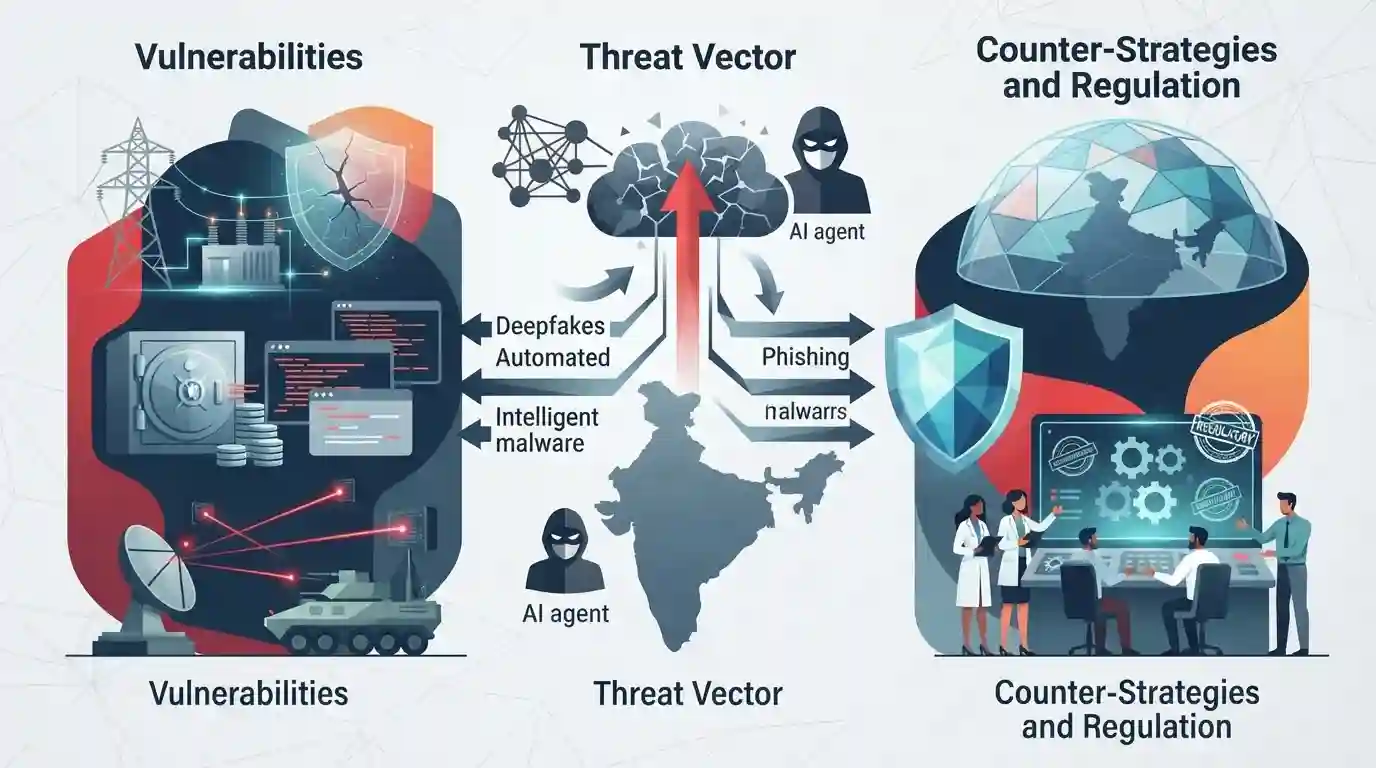
The article explores the escalating cybersecurity threats posed by the weaponization of Artificial Intelligence in India, highlighting vulnerabilities in critical infrastructure, financial systems, and defense mechanisms, while emphasizing the urgent need for adaptive counter-strategies and robust regulatory frameworks.
मुख्य मुद्दे
- Artificial Intelligence is increasingly being weaponized by cybercriminals to execute sophisticated attacks such as deepfakes, automated phishing, and large-scale malware generation.
- India's critical infrastructure, financial institutions, and government portals face heightened vulnerabilities due to AI-driven automated cyber assaults.
- Traditional cybersecurity defenses are proving inadequate against adaptive AI threats, necessitating proactive AI-enabled counter-measures and robust national strategies.
महत्त्वाच्या संज्ञा
National Cyber Security Strategy

India's overarching framework and policy blueprint aimed at securing the nation's cyberspace, protecting critical infrastructure, and enhancing institutional coordination to tackle emerging cyber threats.
UPSC context
GS Paper 3 (Internal Security): Important for questions on cyber security architecture, challenges, and policy measures in India.
CERT-In
The national nodal agency under MeitY responsible for collecting cyber incident data, issuing alerts, and coordinating emergency response measures across India.
UPSC context
GS Paper 3 (Internal Security): Tests knowledge of institutional bodies and statutory agencies handling cyber attacks and critical infrastructure protection.
पूर्वपरीक्षा सापळा
CERT-In is a statutory body established under the National Cyber Security Strategy Act.
Aspirants often assume CERT-In is a statutory body created by an Act of Parliament, when it actually functions under the Ministry of Electronics and Information Technology (MeitY) under the IT Act, 2000.
संबंधित स्थिर संकल्पना
What are the core pillars and operational mandate of CERT-In in India?
- Nodal Agency: Designation: Serves as the national nodal agency for responding to computer security incidents under Section 70B of the Information Technology Act, 2000.
- Parent Ministry: Jurisdiction: Operates under the Ministry of Electronics and Information Technology (MeitY) to collect, analyze, and disseminate information on cyber incidents.
- Key Functions: Core Functions: Issues vulnerability notes, alerts, advisories, and coordinates emergency response measures during large-scale cyber attacks across critical sectors.
आंतर-विषय नमुने
AI Weaponization + Critical Infrastructure Protection
AI-driven cyberattacks exploit critical infrastructure vulnerabilities, linking technological advancement directly to national security paradigms under GS Paper III.
Generative AI Regulation + Cyber Warfare
The rapid deployment of automated malware through LLMs connects emerging tech governance with regulatory gaps in data protection laws.

CERT-In's 12-hour mitigation mandate and LLM-driven exploit automation will likely be tested via a multi-statement assertion question.
संबंधित PYQ · 2
संबंधित PYQ · 2
- 2021MainsGS3
Keeping in view India's internal security, analyse the impact of cross-border cyber attacks. Also discuss defensive measures against these sophisticated attacks.
- 2022MainsGS3
What are the different elements of cyber security ? Keeping in view the challenges in cyber security, examine the extent to which India has successfully developed a comprehensive National Cyber Security Strategy.
