United Nations Warns Artificial Intelligence Threatens Global Jobs
Source:Indian Express ↗
Why It Matters
The UNCTAD report emphasizes a crucial intersection of Science & Technology and Economy for UPSC aspirants: AI threatens the traditional export-oriented, low-wage development model relied upon by developing nations. The monopolization of AI by Big Tech also highlights the critical need for inclusive global governance and digital public infrastructure to prevent extreme global inequality.
Summary
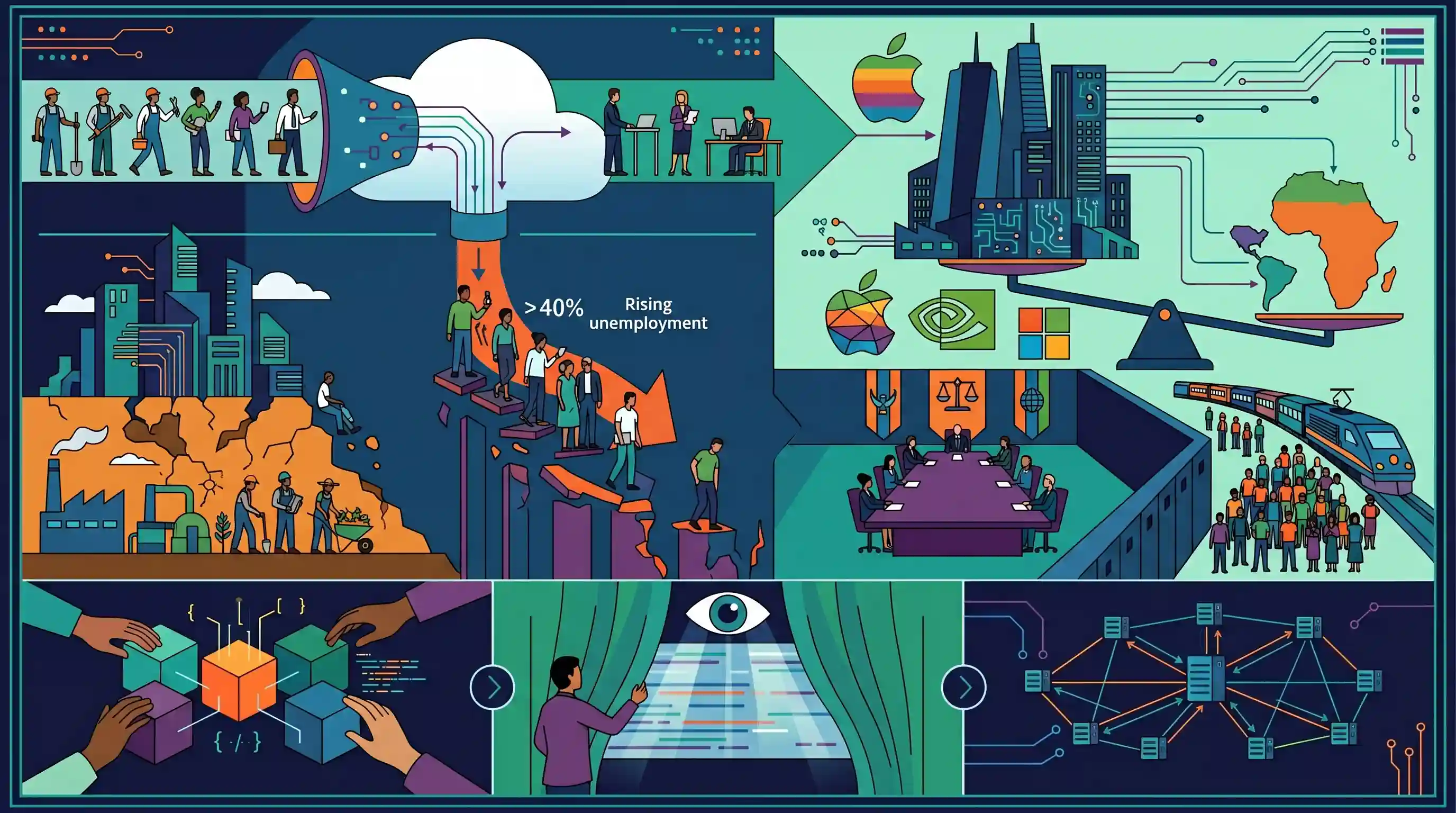
A recent report by the UN Trade and Development (UNCTAD) warns that Generative Artificial Intelligence could disrupt over 40% of the global workforce. The report highlights that developing nations face a unique structural threat as AI-driven automation could erode their traditional economic advantage of offering low-cost labor. Compounding this risk is the intense concentration of AI infrastructure and R&D in a handful of massive tech corporations based primarily in the US and China. The combined market capitalization of giants like Apple, Nvidia, and Microsoft now dwarfs the GDP of the entire African continent. With 118 countries completely unrepresented in global AI governance forums, the Global South is at risk of being left behind. To democratize the technology and mitigate deep structural inequality, UNCTAD recommends developing open-source AI ecosystems, mandating public disclosure of AI developments, and building shared AI infrastructure.
Key Points
- A new UNCTAD report cautions that Generative AI could disrupt over 40% of jobs globally, disproportionately impacting both white-collar and traditional low-skill sectors.
- Developing economies face the severe risk of losing their 'low-cost labor' advantage as AI enables cost-efficient automation, challenging traditional export-driven development models.
- AI development is highly monopolised, with nearly all R&D concentrated within about 100 companies, predominantly based in the US and China.
- A significant governance gap exists, as 118 countries (largely in the Global South) are excluded from critical global AI governance and standards-setting discussions.
- UNCTAD proposes interventions like an AI public disclosure mechanism, establishing shared AI infrastructure, and promoting open-source AI models to ensure equitable benefits.
Important Terms
UNCTAD

The UN's primary body for trade, investment, and development issues. It assists developing countries in accessing technology and global markets fairly to ensure inclusive growth.
UPSC context
GS Paper II (International Institutions) and GS Paper III (Economy). Relevant for understanding global trade governance and digital economy challenges.
AI public disclosure mechanism
A proposed accountability framework by UNCTAD, similar to ESG standards, requiring companies to openly share AI methodologies, data sources, and safety safeguards to ensure ethical development.
UPSC context
GS Paper III (Science & Technology/AI Governance). Focuses on transparency, ethics, and regulatory frameworks for emerging technologies.
Open-source AI models
AI systems with publicly accessible source code and datasets, allowing anyone to inspect, modify, and enhance them. UNCTAD recommends these to democratize AI access for the Global South.
UPSC context
GS Paper III (Science & Technology). Relates to digital sovereignty, technology transfer, and reducing the monopoly of Big Tech.
Digital Divide
The gap between individuals, companies, and nations that have access to modern information and communication technology and those that do not, often exacerbated by AI concentration.
UPSC context
GS Paper I (Society) and GS Paper III (Economy/Technology). Key concept for questions on inequality and social justice in the digital age.
Frontier Technologies
A broad category of technologies—including AI, robotics, and biotechnology—that are at the leading edge of innovation and have the potential to reshape economies and societies.
UPSC context
GS Paper III (S&T). Relevant for industrial policy, Industry 4.0, and India's position in global technology value chains.
Global South
A collective term for developing and least-developed nations, primarily in Africa, Asia, and Latin America, which UNCTAD warns are being excluded from global AI governance.
UPSC context
GS Paper II (International Relations). Central to discussions on multilateralism, climate justice, and equitable technological growth.
Prelims Trap
"AI-driven automation primarily impacts advanced economies, preserving the low-cost labor advantage of developing nations."
UNCTAD warns the exact opposite: AI specifically threatens developing nations by erasing their traditional economic advantage of offering low-cost labor.
Static Concepts Connected
What is UNCTAD and what are its primary flagship reports?
- Mandate: Established in 1964, it is a permanent intergovernmental body promoting the integration of developing countries into the world economy.
- Headquarters: Geneva, Switzerland. It is part of the United Nations Secretariat.
- Key Reports: Trade and Development Report, World Investment Report, and the Technology and Innovation Report.
What is 'Jobless Growth' in the context of developing economies?
- Definition: An economic phenomenon where macro-economic growth (GDP expansion) occurs without a commensurate expansion in employment opportunities.
- Drivers: Reliance on capital-intensive technology, premature leapfrogging to automated service sectors (like AI-driven BPOs), and inflexible labor markets.
- Demographic Risk: It threatens to convert a nation's 'demographic dividend' into a demographic disaster, widening inequality and sparking social unrest.
Cross-Topic Patterns
AI Governance & India's GPAI Leadership
While UNCTAD notes 118 countries are excluded from AI governance, India has leveraged platforms like the Global Partnership on Artificial Intelligence (GPAI) to advocate for Global South inclusion and equitable tech.
Premature Deindustrialization & Automation
AI accelerates 'premature deindustrialization', where developing economies lose their manufacturing labor arbitrage to automation before achieving high-income status, heavily disrupting traditional export-led growth models.

GenAI disrupting the Global South's 'low-cost labor' arbitrage is a prime candidate for a GS3 Mains question on jobless growth.
Linked PYQs · 3
Linked PYQs · 3
- 2023MainsGS3
Introduce the concept of Artificial Intelligence (AI). How does Al help clinical diagnosis? Do you perceive any threat to privacy of the individual in the use of Al in healthcare?
- 2022MainsGS3
Economic growth in the recent past has been led by increase in labour productivity." Explain this statement. Suggest the growth pattern that will lead to creation of more jobs without compromising labour productivity.
- 2015MainsGS3
What are the areas of prohibitive labour that can be sustainably managed by robots ? Discuss the initiatives that can propel research in premier research institutes for substantive and gainful innovation.
