Study Highlights Limitations of AI Chatbots in Healthcare
Source:The Hindu ↗
Why It Matters
The article underscores the practical and ethical limitations of generative AI in healthcare. It is highly relevant for GS-3 (Science and Technology) and GS-4 (Ethics), illustrating that high technical capability in AI does not guarantee safe clinical outcomes due to human-computer communication gaps and the absence of professional medical judgment.
Summary
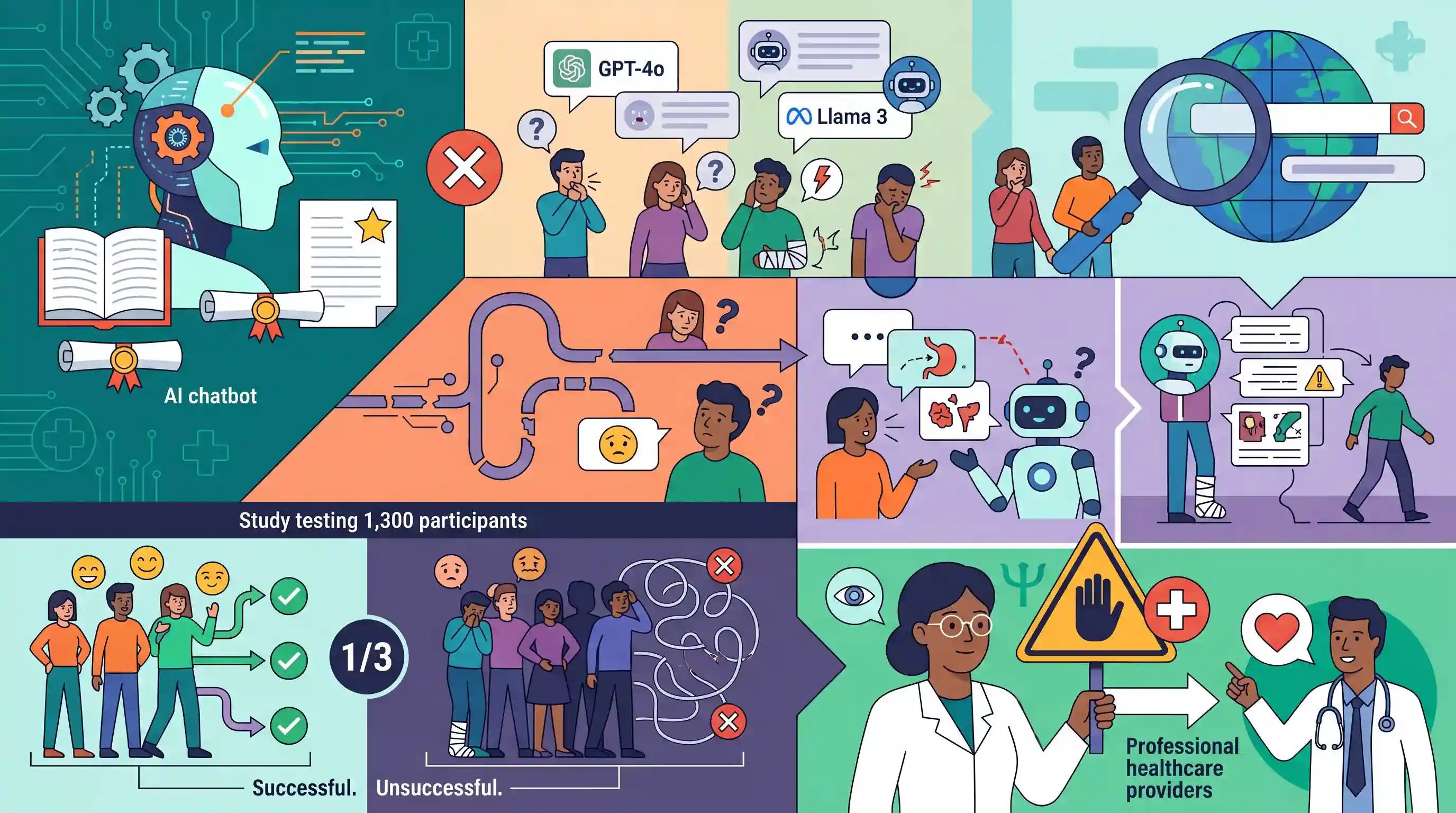
A study published in Nature Medicine indicates that AI chatbots, despite excelling in medical licensing exams, fail to provide better real-world health advice than traditional internet searches. Testing models like GPT-4o and Llama 3 on 1,300 UK participants, researchers found that users identified their health issues accurately only a third of the time. The discrepancy between benchmark success and real-world failure is attributed to a "communication breakdown," where users either provide incomplete symptom data or misinterpret the AI's guidance. With AI use for medical queries rising, bioethicists warn of the significant dangers of relying on chatbots over professional healthcare providers.
Key Points
- Despite passing medical exams, AI chatbots (like GPT-4o and Llama 3) perform no better than traditional internet search engines in diagnosing health issues.
- A UK study of 1,300 participants revealed that AI users accurately identified their health problems only ~33% of the time and took correct action ~45% of the time.
- Researchers blame a 'communication breakdown' for the poor results: real users often fail to provide complete symptoms or misinterpret the chatbot's advice.
- With one in six US adults using AI for health info monthly, bioethicists warn of severe medical risks like wrong diagnoses and delayed urgent care.
Important Terms
National Health Service (NHS)

The United Kingdom's publicly funded universal healthcare system, providing comprehensive medical services free at the point of delivery based on clinical need rather than ability to pay.
UPSC context
GS2: Issues relating to Health. It serves as a global benchmark for universal healthcare and single-payer health infrastructure.
Digital Health
The use of information and communication technologies (ICT)—such as AI, telemedicine, and mobile apps—to manage health risks, improve clinical outcomes, and promote wellness.
UPSC context
GS3: Science & Tech. Tests knowledge of technological applications in daily life and government initiatives like Ayushman Bharat Digital Mission.
Bioethics
A branch of ethics examining moral dilemmas in biology and medicine, focusing on principles like patient autonomy, beneficence (doing good), and non-maleficence (avoiding harm).
UPSC context
GS4: Ethics. Crucial for discussing the moral implications of emerging technologies like AI, gene editing, and medical research.
Large Language Models (LLMs)
Advanced AI systems (e.g., GPT-4) trained on massive datasets to interpret and generate human-like text by identifying complex language patterns.
UPSC context
GS3: Developments in IT and AI. Evaluates understanding of foundational AI architectures and their socio-economic repercussions.
Generative AI
A type of artificial intelligence capable of creating new content—such as text, images, or audio—by learning from existing data.
UPSC context
GS3: Science & Tech. tests awareness of "disruptive" technologies and the balance between innovation and regulatory oversight.
Nature Medicine
A premier monthly peer-reviewed journal that publishes high-impact research in biomedical science, often influencing global medical standards and policy.
UPSC context
GS3: S&T. Highlights the importance of peer-reviewed scientific literature in validating technological breakthroughs and research integrity.
Prelims Trap
Generative AI models have higher real-world diagnostic accuracy than search engines because they clear medical licensing exams.
Chatbots excel in standardized exams but fail in real-world scenarios due to communication breakdowns. They remain unregulated for primary clinical diagnosis.
Static Concepts Connected
What is 'Automation Bias' in Artificial Intelligence and Healthcare?
- Definition: The human tendency to blindly trust automated decision-making systems and ignore contradictory information, even when the AI is incorrect or hallucinating.
- Clinical Risk: Leads to misdiagnosis, delayed emergency care, and medical negligence if patients rely on unregulated chatbots rather than consulting registered professionals.
What are India's frameworks for digital health and telemedicine?
- ABDM Platform: The Ayushman Bharat Digital Mission (ABDM) creates interoperable digital health records but relies strictly on verified human healthcare facilities.
- Telemedicine Guidelines: Notified in 2020, they mandate that only Registered Medical Practitioners (RMPs) can provide remote consultation, barring autonomous AI from independent diagnosis.
Cross-Topic Patterns
Health AI and the DPDP Act
Feeding medical symptoms to commercial AI models triggers the Digital Personal Data Protection Act, highlighting the clash between open-source LLMs and sensitive personal data processing.
Digital divide in rural public health
Relying on AI for primary care exacerbates inequalities; rural populations lacking digital literacy are highly vulnerable to the 'communication breakdown' identified in AI diagnostics.

Expect a 2026 GS-3 question on the limitations of Generative AI, specifically targeting automation bias and the lack of real-world efficacy.
Linked PYQs · 3
Linked PYQs · 3
- 2023MainsGS3
Introduce the concept of Artificial Intelligence (AI). How does Al help clinical diagnosis? Do you perceive any threat to privacy of the individual in the use of Al in healthcare?
- 2022MainsGS4
Online methodology is being used for day-to-day meetings, institutional approvals in the administration and for teaching and learning in education sector to the extent telemedicine in the health sector is getting popular with the approvals of the competent authority. No doubt, it has advantages and disadvantages for both the beneficiaries and the system at large. Describe and discuss the ethical issues involved in the use of online method particularly to the vulnerable section of the society.
- 2024MainsGS4
The application of Artificial Intelligence as a dependable source of input for administrative rational decision-making is a debatable issue. Critically examine the statement from the ethical point of view.
