AI Data Centres Growth Environmental Challenges and Local Backlash
Source:Indian Express ↗
Why It Matters
Crucial for GS3 (Infrastructure, Economy, Environment). It highlights the critical trade-offs between rapid digital/AI expansion and sustainable resource management (water and energy security) in India.
Summary
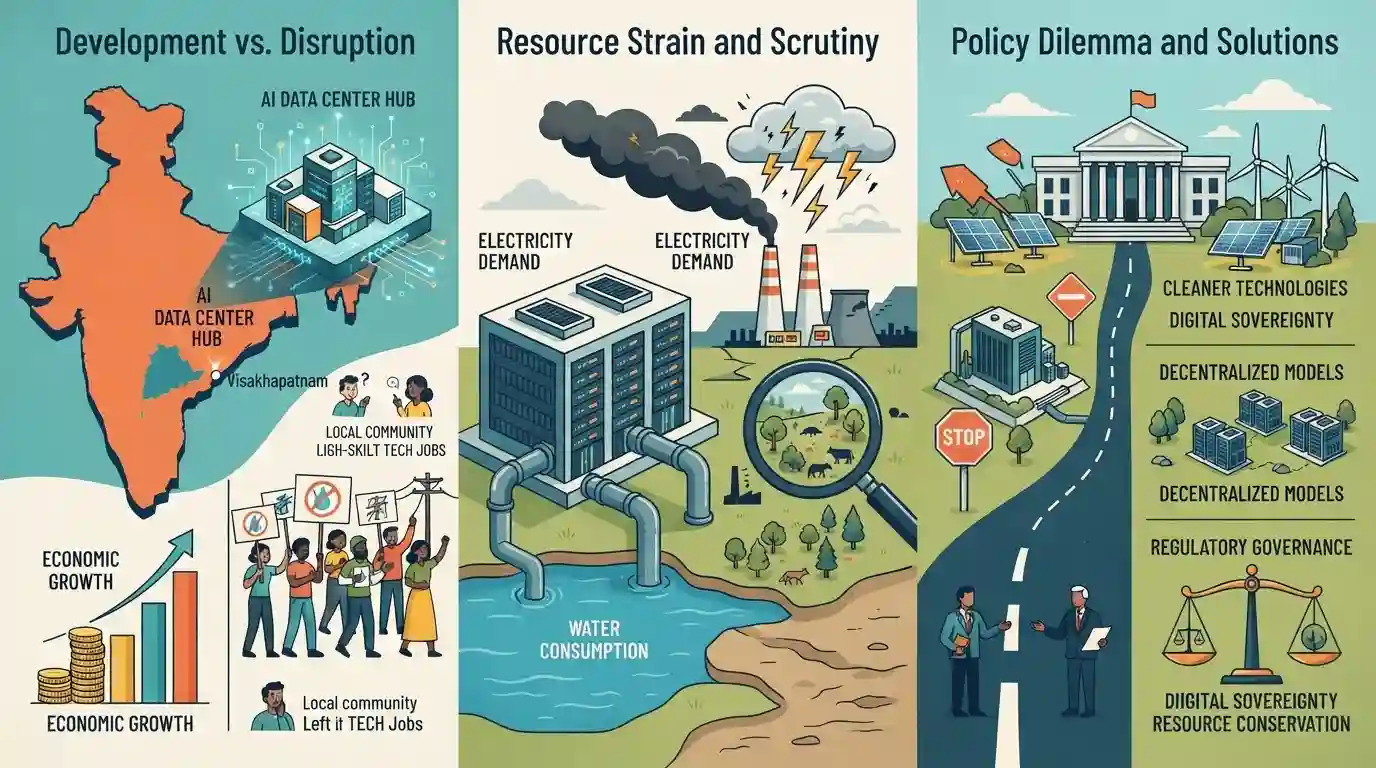
The article examines the rising public backlash and geopolitical-environmental scrutiny surrounding the boom of artificial intelligence (AI) data centres in India and globally. While facilities like the upcoming Adani-Google campus in Visakhapatnam promise economic growth and digital infrastructure, they face stiff resistance from local communities, environmentalists, and civil society due to intensive water consumption, heavy electricity footprints near sensitive ecological zones, and mismatched local employment gains. Experts highlight the policy dilemma between pursuing digital sovereignty and managing localized resource strains, calling for cleaner technologies, decentralized models, and better regulatory governance.
Key Points
- The explosive growth of artificial intelligence (AI) has dramatically increased the demand for massive data centres, which consume gargantuan amounts of electricity and water.
- In India, mega projects like the proposed Adani-Google AI data centre campus in Visakhapatnam face local opposition and legal challenges over ecological concerns, water usage in sensitive catchment areas, and limited local employment benefits.
- Globally and nationally, data centres act as "double-edged swords," driving digital infrastructure investments while threatening local grid stability, straining municipal water resources, and raising concerns about distributive justice (NIMBY phenomenon—costs borne locally, benefits dispersed globally).
- Experts suggest mitigating strategies including shifting toward smaller task-specific AI models, decentralised compute networks, strict green mandates, and robust national policy frameworks rather than a regulatory race to the bottom among states.
Prelims Trap
All mega data centre projects in India require mandatory prior clearance under the EIA Notification 2006 due to their massive carbon footprints.
Data centres are not automatically categorized under Schedule I of the EIA Notification 2006, meaning many bypass mandatory central environmental clearance despite intensive local footprints.
Static Concepts Connected
What are the key environmental and regulatory governance challenges posed by mega data centres in India?
- EIA Exemption Gaps: Data centres are typically not listed under Schedule I of the EIA Notification 2006, often bypassing mandatory public consultations despite heavy resource footprints.
- Water Stress & CGWA: Cooling systems in mega data centres consume millions of litres of water daily, aggravating municipal shortages and violating sustainable groundwater extraction norms set by the CGWA.
- Grid & Energy Load: Massive power draw threatens local DISCOM financial health and grid stability, conflicting with state renewable purchase obligations (RPOs) and India's decarbonisation roadmap.
Cross-Topic Patterns
Digital Infrastructure vs. Net Zero Goals
Data centre electricity and cooling loads threaten India's peak power management and push DISCOMs toward carbon lock-in, directly challenging our 2070 Net Zero trajectory.
Data Centres & Environmental Federalism
Rapid groundwater depletion by mega-campuses in coastal and water-stressed zones tests the limits of cooperative federalism and EIA frameworks under the EPA, 1986.

AI data centre resource footprints (water/energy) vs Net Zero targets will feature in mains paper III (Infrastructure/Environment).
Linked PYQs · 3
Linked PYQs · 3
- 2025MainsGS3
Examine the factors responsible for depleting groundwater in India. What are the steps taken by the government to mitigate such depletion of groundwater?
- 2023MainsGS3
What is the status of digitalization in the Indian economy? Examine the problems faced in this regard and suggest improvements.
- 2021MainsGS3
“Investment in infrastructure is essential for more rapid and inclusive economic growth.” Discuss in the light of India's experience.
