Artificial Intelligence and Modern National Security
Source:The Hindu ↗
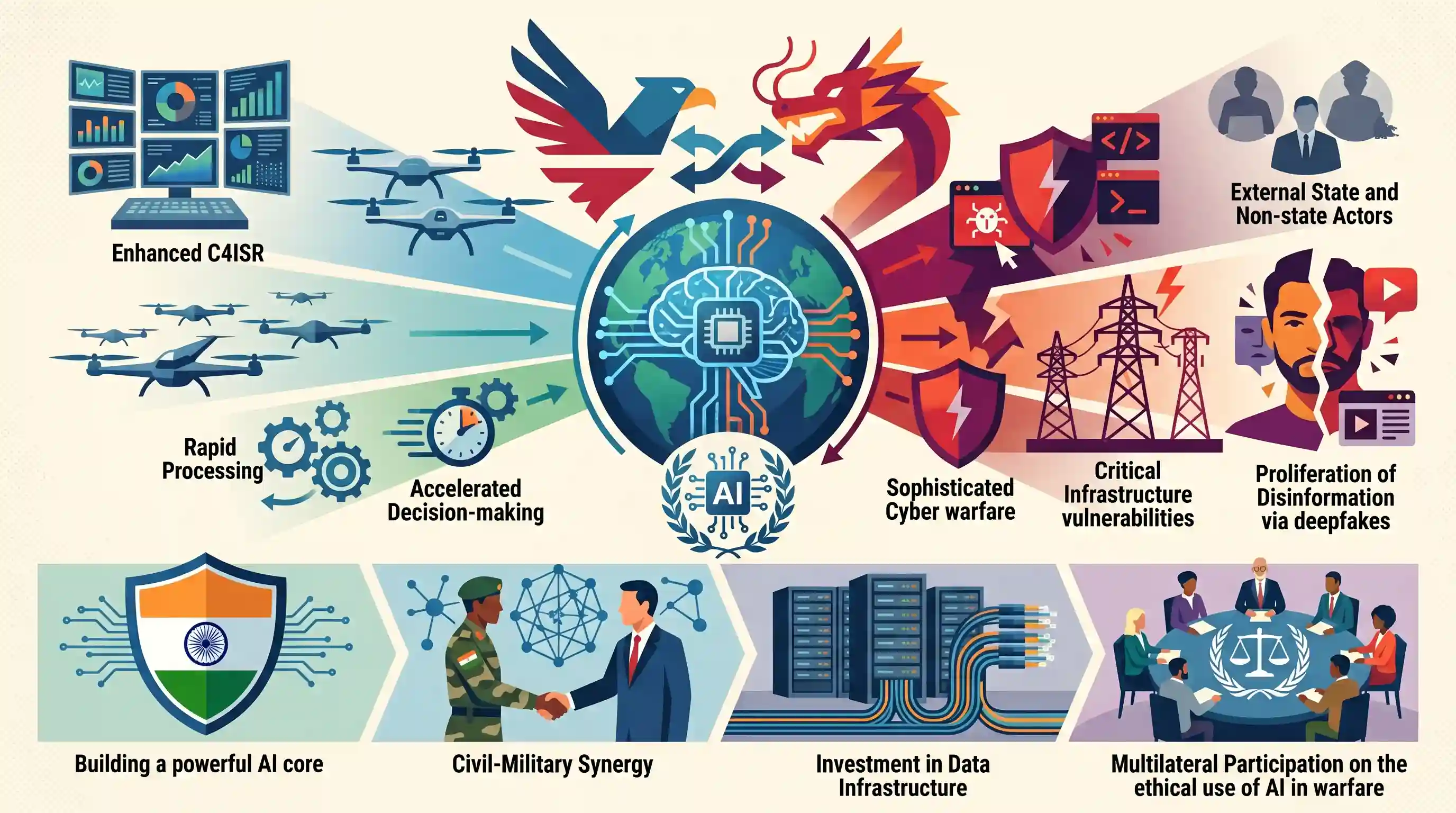
Why It Matters
The militarization of Artificial Intelligence is a core frontier in modern defense strategy and geopolitics. For UPSC aspirants, understanding the dual-use nature of AI is crucial for both Science & Technology and Internal Security (GS Paper 3), as well as evaluating India's strategic posture in International Relations (GS Paper 2).
Summary
The article explores the profound intersection of Artificial Intelligence (AI) and national security, framing AI as a critical determinant of future geopolitical power. It highlights the military advantages of AI, such as enhanced C4ISR capabilities, autonomous drones, and accelerated decision-making. However, it also warns against the multifaceted threats AI poses, including sophisticated cyber warfare, critical infrastructure vulnerabilities, and the proliferation of disinformation via deepfakes. Contextualizing this within the broader US-China tech rivalry, the author emphasizes that India must prioritize indigenous AI development. This requires fostering civil-military synergy, investing in data infrastructure, and actively participating in multilateral forums to shape the ethical use of AI in warfare.
Key Points
- AI is transforming the nature of warfare by significantly reducing the OODA (Observe, Orient, Decide, Act) loop, enabling predictive logistics, and facilitating the deployment of autonomous weapon systems.
- The dual-use nature of AI introduces severe internal security challenges, including AI-driven cyberattacks, deepfakes, and cognitive warfare aimed at manipulating public perception.
- A global 'tech arms race' is underway, primarily driven by the US and China, which risks leaving developing nations strategically vulnerable if they do not build indigenous technological capabilities.
- For India, achieving self-reliance in military AI requires strengthening civil-military fusion, boosting R&D investments, and establishing robust ethical guardrails for AI deployment.
- There is an urgent need for global governance frameworks and treaties to regulate the use of Artificial Intelligence in military applications to prevent unintended escalations.
Important Terms
Lethal Autonomous Weapons Systems (LAWS)

Military systems that can independently identify, select, and engage targets using algorithms without human intervention. They raise significant ethical, legal, and accountability concerns in international humanitarian law.
UPSC context
GS Paper 3: Security and Science & Tech. Tests understanding of ethical warfare and international regulatory challenges.
Defence AI Council (DAIC)
A high-level body established in 2019 under the Ministry of Defence, chaired by the Raksha Mantri, to provide strategic direction and oversight for AI adoption in Indian military operations.
UPSC context
GS Paper 3: Security. Relevant for institutional frameworks for defense modernization and indigenous technology adoption.
C4ISR
An acronym for Command, Control, Communications, Computers, Intelligence, Surveillance, and Reconnaissance; it represents integrated systems that provide military commanders with situational awareness and decision-making speed.
UPSC context
GS Paper 3: Security. Tests knowledge of modern warfare technology and the 'nervous system' of military command structures.
National Strategy for Artificial Intelligence
A 2018 NITI Aayog roadmap themed '#AIforAll' that prioritizes AI for social inclusion (agriculture, healthcare, education) and economic growth while addressing ethical and privacy challenges.
UPSC context
GS Paper 3: Science & Tech and Economy. Tests policy awareness of India's digital and technological transformation.
Deepfakes
AI-generated synthetic media where a person's likeness or voice is convincingly replaced, often used to spread disinformation, incite social unrest, or compromise electoral integrity.
UPSC context
GS Paper 3: Internal Security. Tests awareness of challenges posed by communication networks and non-state actors using technology.
Defence AI Project Agency (DAIPA)
The implementation arm of the DAIC, tasked with executing AI projects, setting benchmarks for technology development, and fostering partnerships between the military, industry, and academia.
UPSC context
GS Paper 3: Security. Important for understanding the practical execution of defense indigenization and technology policy.
Prelims Trap
Lethal Autonomous Weapons Systems (LAWS) are currently banned worldwide under a legally binding UN treaty.
There is no binding international treaty banning LAWS. Discussions occur under the UN Convention on Certain Conventional Weapons (CCW), but it remains a normative debate.
Static Concepts Connected
What is the mandate of the Defence AI Council (DAIC)?
- Setup: Created by the Ministry of Defence to provide strategic direction for the adoption of AI in defence.
- Leadership: It is chaired by the Defence Minister (Raksha Mantri).
- Core Role: To drive civil-military fusion, approve AI projects, and enable startup-academia partnerships for indigenous capability development.
What are OODA loops and C4ISR in military terminology?
- OODA Loop: Observe, Orient, Decide, Act. It is a decision-making cycle crucial for battlefield agility and tactical superiority.
- C4ISR: Command, Control, Communications, Computers, Intelligence, Surveillance, and Reconnaissance. It represents the nervous system of military operations.
- AI Impact: AI fundamentally alters warfare by compressing OODA loops to seconds and automating vast data processing in C4ISR networks.
Cross-Topic Patterns
AI deepfakes and democratic stability
The internal security threat of cognitive warfare directly links to GS2 concerns about electoral integrity, posing challenges for the ECI in regulating synthetic media and deepfakes.
Civil-Military Fusion via iDEX
India's military AI push mirrors the broader defence indigenization strategy, leveraging platforms like iDEX to integrate civilian startup innovation into the defence manufacturing ecosystem.
Multilateral vacuum in emerging tech
Similar to space militarization, the lack of a governing AI weapons treaty exposes the limitations of current UN disarmament mechanisms like the Convention on Certain Conventional Weapons (CCW).

Expect a GS3 Mains question combining deepfakes, cognitive warfare, and the role of non-state actors in undermining internal security.
Linked PYQs · 4
Linked PYQs · 4
- 2023MainsGS3
Introduce the concept of Artificial Intelligence (AI). How does Al help clinical diagnosis? Do you perceive any threat to privacy of the individual in the use of Al in healthcare?
- 2021MainsGS3
Keeping in view India's internal security, analyse the impact of cross-border cyber attacks. Also discuss defensive measures against these sophisticated attacks.
- 2023MainsGS3
The use of unmanned aerial vehicles (UAVs) by our adversaries across the borders to ferry arms/ammunitions, drugs, etc., is a serious threat to the internal security. Comment on the measures being taken to tackle this threat.
- 2020PrelimsGS1
With the present state of development, Artificial Intelligence can effectively do which of the following? 1. Bring down electricity consumption in industrial units 2. Create meaningful short stories and songs 3. Disease diagnosis 4. Text-to-Speech Conversion 5. Wireless transmission of electrical energy Select the correct answer using the code given below:
