Comparative Analysis of Artificial Intelligence and Human Brain
Source:The Hindu ↗
Why It Matters
Provides foundational clarity on the operational differences between artificial neural networks and biological brains, addressing both the technological constraints of current AI and the environmental impact of its massive energy requirements. This conceptual clarity is essential for GS3 Science and Technology.
Summary
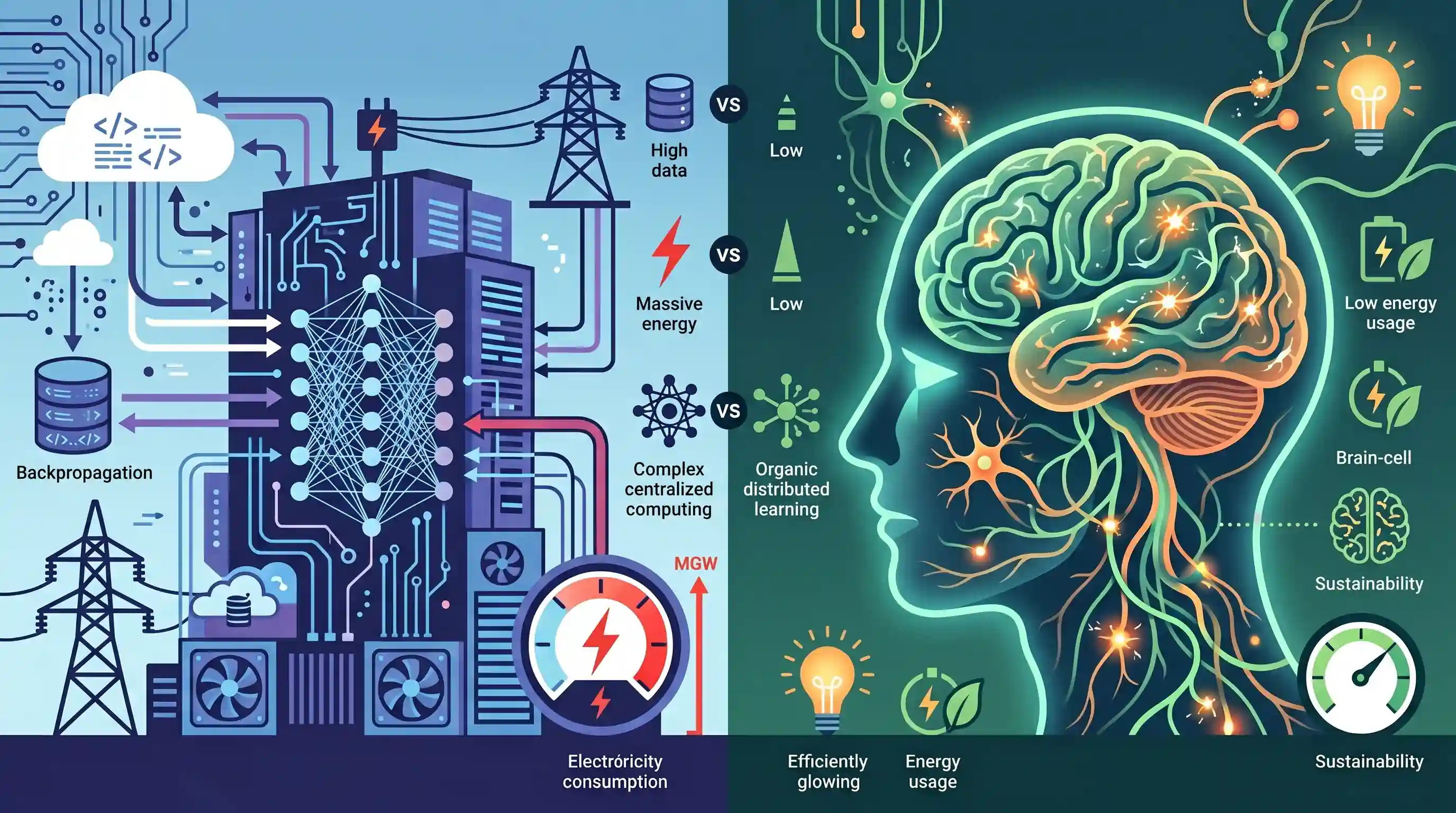
The article provides a comparative analysis of modern Artificial Intelligence (particularly Large Language Models) and the human brain. While advanced AI systems are reaching the physical 'scale' of the brain by utilizing trillions of parameters (analogous to synapses), their underlying 'design' and learning mechanisms differ fundamentally. Biological brains operate on highly parallel, sparse networks that facilitate continuous learning with extreme energy efficiency, utilizing only about 20 watts of power. In contrast, artificial neural networks rely on backpropagation, require massive training datasets, struggle with catastrophic forgetting, and run in centralized data centers that consume megawatts of electricity. Understanding these profound structural and functional differences highlights the limitations of current AI architectures and underscores the potential need for neuromorphic computing to create sustainable, genuinely intelligent systems.
Key Points
- Scale Convergence: Advanced Large Language Models (LLMs) now possess trillions of parameters, mathematically analogous to the roughly 100 trillion synaptic connections in the human brain.
- Learning Mechanisms: Biological brains learn continuously through neuroplasticity without overwriting previous knowledge, whereas artificial neural networks rely on backpropagation and are prone to 'catastrophic forgetting' when introduced to new data.
- Energy Efficiency Disparity: The human brain is extraordinarily efficient, operating on approximately 20 watts of power. In contrast, AI training and inference require massive data centers consuming megawatts of electricity, raising environmental concerns.
- Structural Differences: Biological cognition relies on highly parallel, sparse processing across localized physical pathways, contrasting with the dense, matrix-multiplication operations running sequentially on current digital GPUs.
- Future of AI: Overcoming the energy and learning limitations of current AI models may necessitate a shift toward 'neuromorphic computing'—designing hardware that directly mimics the physical architecture of biological neurons.
Prelims Trap
"Current Large Language Models operate on neuromorphic computing architectures to achieve brain-like efficiency."
Current LLMs rely on traditional Von Neumann architectures (GPUs) and consume massive power. Neuromorphic computing is an emerging, distinct hardware paradigm.
Static Concepts Connected
What differentiates Neuromorphic Computing from traditional Von Neumann architecture?
- Von Neumann: Physically separates the CPU and memory, causing an energy-intensive data transfer bottleneck during computation.
- Neuromorphic: Integrates data processing and memory storage in the exact same physical location, mimicking biological synapses.
- Energy efficiency: Solves the memory bottleneck, approaching the brain's 20-watt efficiency for highly parallel, sparse processing tasks.
How does AI learning differ fundamentally from biological neuroplasticity?
- Backpropagation: AI learns via computationally intensive algorithms that adjust network weights by calculating output errors backwards.
- Catastrophic forgetting: AI models possess a flaw where they overwrite and lose previously learned information when trained anew.
- Neuroplasticity: Biological brains continuously learn and physically adapt neural pathways without abruptly erasing past foundational knowledge.
Cross-Topic Patterns
AI Data Centers vs Net Zero Targets
The massive power consumption of AI data centers directly intersects with India’s climate commitments and the push for green energy transitions under the Panchamrit goals.
Semiconductor Mission & Neuromorphic Hardware
As AI hits energy limits on traditional GPUs, the India Semiconductor Mission may need to prioritize R&D in next-generation neuromorphic chip designs for technological sovereignty.

Expect a Prelims question contrasting biological neuroplasticity and 20W efficiency against AI's backpropagation and catastrophic forgetting.
Linked PYQs · 3
Linked PYQs · 3
- 2023MainsGS3
Introduce the concept of Artificial Intelligence (AI). How does Al help clinical diagnosis? Do you perceive any threat to privacy of the individual in the use of Al in healthcare?
- 2020PrelimsGS1
With the present state of development, Artificial Intelligence can effectively do which of the following? 1. Bring down electricity consumption in industrial units 2. Create meaningful short stories and songs 3. Disease diagnosis 4. Text-to-Speech Conversion 5. Wireless transmission of electrical energy Select the correct answer using the code given below:
- 2025PrelimsGS1
Consider the following statements: I. It is expected that Majorana 1 chip will enable quantum computing. II. Majorana 1 chip has been introduced by Amazon Web Services (AWS). III. Deep learning is a subset of machine learning. Which of the statements given above are correct?
