Artificial Intelligence Monopoly and Regulatory Governance Challenges
Source:The Hindu ↗
Why It Matters
AI governance is a recurring and highly probable topic across multiple UPSC papers. The intersection of AI with tech monopolies directly links to GS2 (role of CCI), its technological and security implications link to GS3, and the ethical dilemmas of algorithmic decision-making align with GS4.
Summary
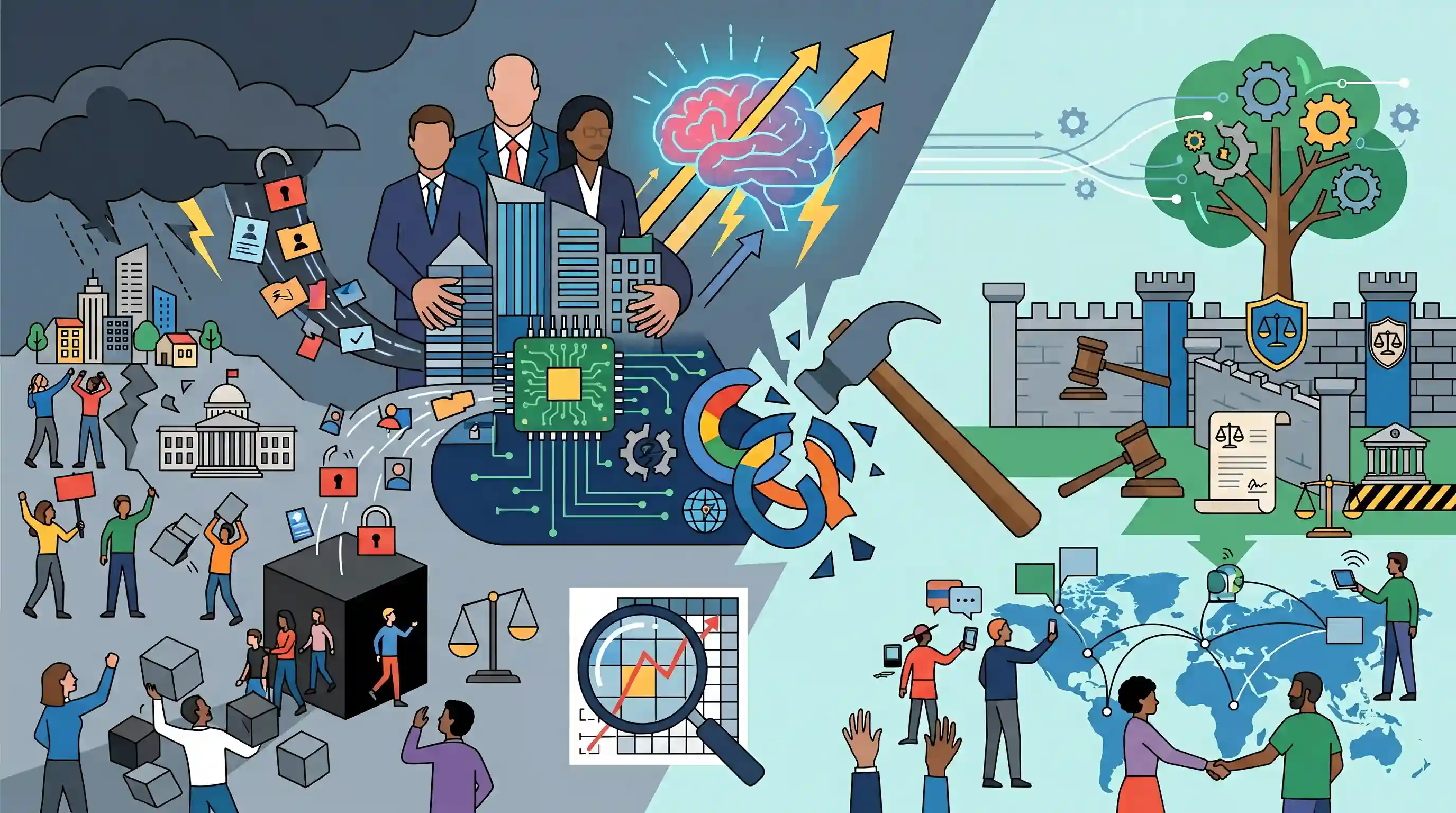
The article critically examines the rapid evolution of Artificial Intelligence and the concurrent monopolization of technological capabilities by a few global tech giants. It warns of a 'gathering storm' where the unchecked power of these corporations poses severe risks to societal stability, data privacy, and democratic integrity. Emphasizing the ethical dilemmas of algorithmic bias and opaque decision-making, the author advocates for stringent regulatory frameworks, anti-trust interventions, and international cooperation to govern AI development and prevent corporate overreach.
Key Points
- The rapid and largely unregulated advancement of Artificial Intelligence is driving an unprecedented concentration of power into the hands of a few major technology corporations.
- This unchecked power raises serious ethical and societal concerns, including algorithmic biases, opaque automated decision-making, and significant threats to individual data privacy.
- The potential for AI to be misused for generating deepfakes and mass misinformation poses a direct security and democratic challenge, representing the 'gathering storm'.
- There is an urgent need for proactive anti-trust measures, robust domestic regulations (like the proposed Digital India Act), and collaborative global governance to ensure AI serves the public interest responsibly.
Important Terms
EU AI Act

The world's first comprehensive legal framework for AI, adopting a risk-based approach (Prohibited, High-risk, Limited-risk, Minimal-risk) to ensure technology is safe, transparent, and respects fundamental rights.
UPSC context
GS Paper II (Governance) and III (S&T). Tests knowledge of global regulatory benchmarks and ethical technology governance.
Digital India Act (Proposed)
A proposed comprehensive overhaul of India's IT Act, 2000, intended to regulate the modern digital ecosystem, focusing on user safety, open internet, and the ethical use of emerging technologies like AI.
UPSC context
GS Paper II (Legislative reforms) and III (IT). Key for questions on modernizing digital laws and balancing innovation with safety.
Bletchley Declaration
A 2023 international agreement signed by 28 nations (including India) focusing on the shared risks of 'frontier AI'—highly capable foundation models that pose significant safety and security concerns.
UPSC context
GS Paper II (International Relations) and III (S&T). Relevant for global cooperation on managing disruptive emerging technologies.
Competition Commission of India (CCI)
A statutory body under the Competition Act, 2002, tasked with preventing anti-competitive practices and ensuring fair market competition; it currently monitors Big Tech's dominance and AI's impact on markets.
UPSC context
GS Paper II (Statutory Bodies) and III (Economy). Tests understanding of regulatory mechanisms against monopolies and digital gatekeeping.
Big Tech
Refers to dominant global technology firms (e.g., Google, Meta, Microsoft) that wield immense power through data monopolies, massive market capitalization, and significant influence over global AI development and societal norms.
UPSC context
GS Paper III (S&T/Economy). Explores challenges like data colonialism, market concentration, and corporate overreach in the digital age.
Prelims Trap
The Bletchley Declaration is a legally binding UN treaty designed to globally regulate Artificial Intelligence development.
The Bletchley Declaration is a voluntary, non-binding international agreement among participating nations (including India) to manage AI safety risks. It is not a UN treaty.
Static Concepts Connected
How does the Indian framework protect against AI-driven surveillance and data profiling?
- Puttaswamy Judgement: Recognized privacy as a fundamental right under Article 21, protecting against arbitrary state and corporate data profiling.
- Data Protection Act: The DPDP Act 2023 mandates explicit consent and purpose limitation, though it grants certain exemptions to state instrumentalities.
- Proportionality Test: Any AI surveillance must be backed by law, necessary, and proportionate to the legitimate aim.
How does the Competition Commission of India regulate digital monopolies and algorithmic collusion?
- Market Dominance: Probes abuses like discriminatory pricing or deep discounting by major tech platforms under the Competition Act, 2002.
- Algorithmic Collusion: Investigates instances where pricing algorithms are used by competitors to subtly fix prices without explicit human communication.
- Merger Control: Evaluates big tech acquisitions that could stifle innovation or create insurmountable data barriers for new entrants.
Cross-Topic Patterns
Tech Monopoly + Economic Sovereignty
The dominance of foreign tech giants directly links GS-3 technology with GS-3 economy, threatening India's digital market sovereignty and prompting localized data storage mandates.
Deepfakes + Cognitive Warfare
AI-generated misinformation bridges GS-3 Science & Tech with GS-3 Internal Security, specifically regarding the role of social networking sites in cognitive warfare.
Algorithmic Bias + GS-4 Ethics
Biased AI models trained on skewed datasets offer a prime case study for GS-4 ethical dilemmas concerning algorithmic fairness, corporate accountability, and inclusive tech design.

Expect a Mains GS-3 question interlinking AI deepfakes with internal security threats, demanding specific regulatory countermeasures.
Linked PYQs · 4
Linked PYQs · 4
- 2023MainsGS3
Introduce the concept of Artificial Intelligence (AI). How does Al help clinical diagnosis? Do you perceive any threat to privacy of the individual in the use of Al in healthcare?
- 2024MainsGS4
The application of Artificial Intelligence as a dependable source of input for administrative rational decision-making is a debatable issue. Critically examine the statement from the ethical point of view.
- 2023MainsGS2
Discuss the role of the Competition Commission of India in containing the abuse of dominant position by the Multi-National Corporations in India. Refer to the recent decisions.
- 2024MainsGS3
Social media and encrypting messaging services pose a serious security challenge. What measures have been adopted at various levels to address the security implications of social media? Also suggest any other remedies to address the problem.
