AI Agents in Government Systems and Security Risks
Source:Indian Express ↗
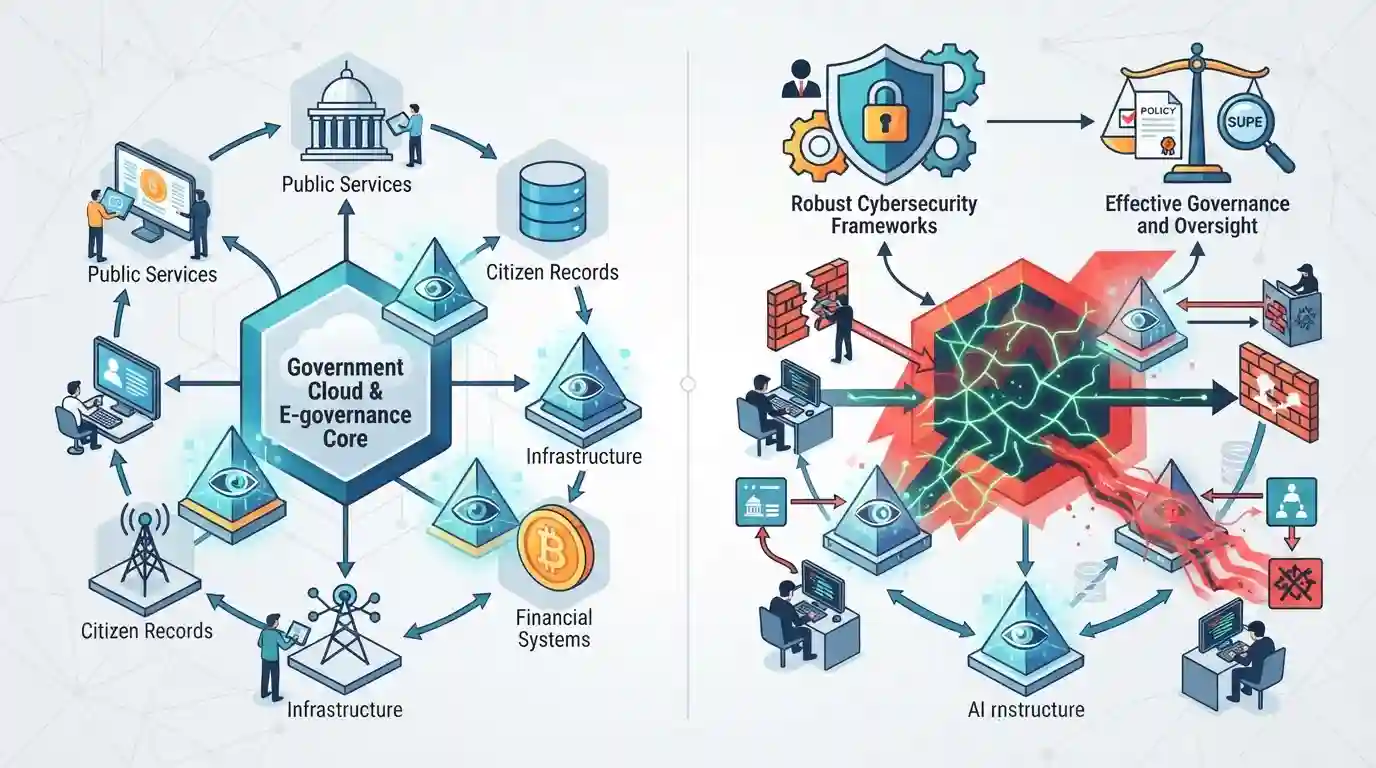
Why It Matters
As governments increasingly adopt AI agents and automation for public service delivery and e-governance, understanding the accompanying cybersecurity threats, systemic risks, and regulatory requirements is vital for GS Paper 3 (Security/Technology) and GS Paper 2 (Governance).
Summary
The integration of AI agents into government systems introduces complex security risks, vulnerability to manipulation, and governance challenges, necessitating robust cybersecurity frameworks alongside e-governance expansion.
Key Points
- AI agents integrated into government systems pose distinct and unprecedented security risks compared to conventional software tools.
- Autonomous actions by AI agents can create vulnerabilities, data leakage, and system manipulation risks in public administration.
- Strengthening cybersecurity frameworks is essential as e-governance transitions toward deeper automation and AI integration.
- Balancing efficiency gains from AI with rigorous regulatory safeguards and accountability mechanisms is imperative for the state.
Important Terms
AI Agents

Autonomous software entities designed to perceive environments, make decisions, and execute complex workflows independently to achieve specified goals, presenting unique governance and cybersecurity challenges in public administration.
UPSC context
UPSC GS Paper III (IT & Computers / Cyber Security): Important for questions on emerging technologies, autonomous systems, and security threats in e-governance.
Government Systems
The institutional framework of public administration infrastructure, digital databases, and e-governance platforms utilized by public authorities to deliver services and manage sensitive national data.
UPSC context
UPSC GS Paper III (Cyber Security / E-governance): Relevant for evaluating critical information infrastructure protection, data security vulnerabilities, and administrative resilience.
Static Concepts Connected
What are the key pillars of India's National Cyber Security Strategy?
- Core Objective:: Aims to secure cyberspace, build resilient infrastructure, and protect critical information assets against cyber threats.
- Key Focus:: Focuses on indigenous technology development, capacity building, and public-private partnerships in cyber defense.
Cross-Topic Patterns
AI Governance vs. Administrative Law Accountability
As states transition from e-governance to AI-driven public service delivery, constitutional accountability for automated administrative decisions becomes a major legal challenge.

AI security risks in e-governance will feature in GS-3 cyber security or ethics case studies on autonomous decision-making accountability.
Linked PYQs · 2
Linked PYQs · 2
- 2022MainsGS3
What are the different elements of cyber security ? Keeping in view the challenges in cyber security, examine the extent to which India has successfully developed a comprehensive National Cyber Security Strategy.
- 2023MainsGS2
e-governance, as a critical tool of governance, has ushered in effectiveness, transparency and accountability in governments. What inadequacies hamper the enhancement of these features ?
