Pilot Associations Defend Flight Crew Following Air India Crash
Source:The Hindu ↗
Why It Matters
The article highlights critical issues surrounding aviation safety, the protocols of accident investigation, and the institutional frameworks governing the civil aviation sector. For UPSC aspirants, it provides a practical context for GS3 (infrastructure and disaster management) and GS2 (the functioning and transparency of statutory bodies like the AAIB and DGCA). It also touches upon ethical aspects (GS4) regarding corporate accountability and media speculation during crises.
Summary
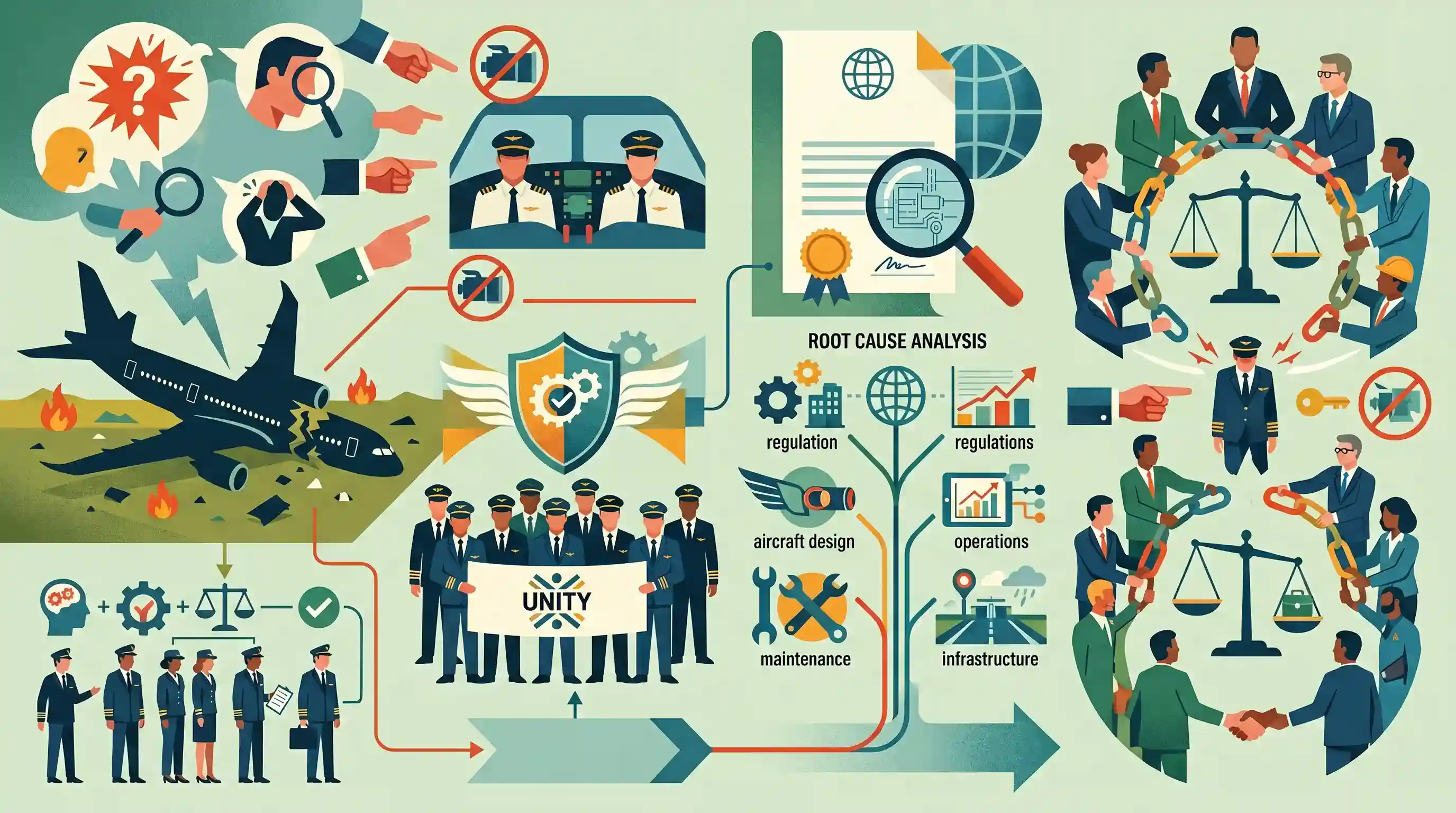
Following the tragic crash of Air India flight AI-171 (a Boeing 787-8), pilot unions ICPA and ALPA have strongly defended the flight crew against premature speculations of 'pilot error' or 'pilot suicide'. In response to an AAIB preliminary report indicating a simultaneous fuel cutoff to both engines, the unions highlighted the rigorous psychological and professional screening pilots undergo. They have called for a transparent, objective, and comprehensive investigation to determine the root cause, emphasizing the need for accountability across all stakeholders rather than scapegoating the deceased crew.
Key Points
- The Indian Commercial Pilots' Association (ICPA) and Airline Pilots' Association of India (ALPA) defended the crew of the crashed Air India flight AI-171, rejecting insinuations of 'pilot suicide' or 'pilot error'.
- A preliminary report by the Aircraft Accident Investigation Bureau (AAIB) found that fuel supply to both engines of the Boeing 787-8 was cut off within a second of each other shortly after takeoff.
- Pilot unions emphasized that commercial pilots undergo rigorous physiological and psychological assessments, cautioning against premature speculations and 'trial by media'.
- The unions demanded a fair, fact-based investigation emphasizing transparency and accountability from all stakeholders, including the airline and manufacturers.
- There is also reference to a serviceability bulletin regarding the replacement of fuel control switch gates on the aircraft type.
Important Terms
Aircraft Accident Investigation Bureau (AAIB)

A specialized division of India's Ministry of Civil Aviation responsible for investigating aviation accidents and serious incidents to improve safety rather than assign legal blame.
UPSC context
GS-3 (Infrastructure/Disaster Management). Tests knowledge of specialized safety regulators and compliance with international ICAO safety standards.
International Federation of Airline Pilots' Association (IFALPA)
The global voice of pilots, representing over 100,000 professionals across 100 countries. It provides technical input to ICAO and advocates for global aviation safety standards.
UPSC context
GS-2 (International Bodies). Tests understanding of how global non-state actors influence international norms and domestic aviation policies.
Indian Commercial Pilots' Association (ICPA)
A prominent trade union representing Air India pilots. It focuses on labor rights, pilot welfare, and safety advocacy during industrial disputes and accident investigations.
UPSC context
GS-2 (Pressure Groups and Trade Unions). Relevant for topics involving labor advocacy and professional standards in critical infrastructure.
Airline Pilots' Association of India (ALPA)
A national professional body that unites Indian pilots and represents them at IFALPA. It promotes aviation safety, professional growth, and collective pilot welfare in India.
UPSC context
GS-3 (Infrastructure/Aviation Safety). Highlights the role of professional associations in maintaining safety benchmarks and advocating for pilot mental health.
Directorate General of Civil Aviation (DGCA)
The principal regulatory body for civil aviation in India, responsible for safety oversight, licensing, and formulating airworthiness standards to ensure secure air transport.
UPSC context
GS-3 (Infrastructure). A core regulatory body often tested regarding its role in aviation governance and safety enforcement.
Prelims Trap
"The Directorate General of Civil Aviation (DGCA) conducts independent aviation accident investigations."
The AAIB was established in 2012 specifically to separate accident investigation from the DGCA, ensuring independent inquiries free from regulatory conflicts of interest.
Static Concepts Connected
What is the Aircraft Accident Investigation Bureau (AAIB) mandate?
- Institutional Independence: Separated from the DGCA in 2012 to conduct unbiased safety inquiries, functioning independently to avoid conflicts of interest.
- Statutory Mandate: Investigates accidents and serious incidents involving civil aircraft over 2,250 kg All-Up Weight (AUW) or turbojet-powered aircraft.
- Core Objective: Aims solely to identify root causes to prevent future accidents, not to apportion blame or establish criminal liability.
How does the Chicago Convention govern aviation disaster investigations?
- Annex 13 Framework: The 1944 Chicago Convention established ICAO; its Annex 13 sets the international standards for aircraft accident and incident investigation.
- Jurisdictional Lead: Under ICAO protocols, the 'State of Occurrence' (where the accident happens) has the primary responsibility to lead the investigation.
- Participating Rights: States of aircraft registry, design, and manufacture are granted participating rights in the investigation, ensuring a holistic technical review.
Cross-Topic Patterns
Independent safety regulators
The AAIB's separation from DGCA mirrors the Commission of Railway Safety (CRS), which operates under the Ministry of Civil Aviation—not Railways—to ensure unbiased accident probes without institutional conflict of interest.
ICAO and Territorial Sovereignty
The Chicago Convention's rule empowering the 'State of Occurrence' to investigate reinforces territorial sovereignty principles, a concept frequently tested alongside international maritime (UNCLOS) and airspace laws.

Expect a 2026 Prelims statement contrasting the investigative mandate of AAIB with the regulatory role of DGCA to test institutional independence.
Linked PYQs · 3
Linked PYQs · 3
- 2015MainsGS2
For achieving the desired objectives, it is necessary to ensure that the regulatory institutions remain independent and autonomous. Discuss in the light of the experiences in recent past.
- 2013MainsGS3
How important are vulnerability and risk assessment for pre-disaster management ? As an administrator, what are key areas that you would focus on in a Disaster Management System.
- 2023MainsGS2
e-governance, as a critical tool of governance, has ushered in effectiveness, transparency and accountability in governments. What inadequacies hamper the enhancement of these features ?
