Ahmedabad University Sets Up Manufacturing and Economy Institute
Source:Indian Express ↗
Why It Matters
This development is a prime example for UPSC aspirants to cite when discussing industry-academia linkages, the challenges of the manufacturing sector, and strategies for employment generation (labor-intensive vs. technology-driven). It underscores institutional steps taken to achieve the National Manufacturing Policy's goal of a 25% GDP share.
Summary
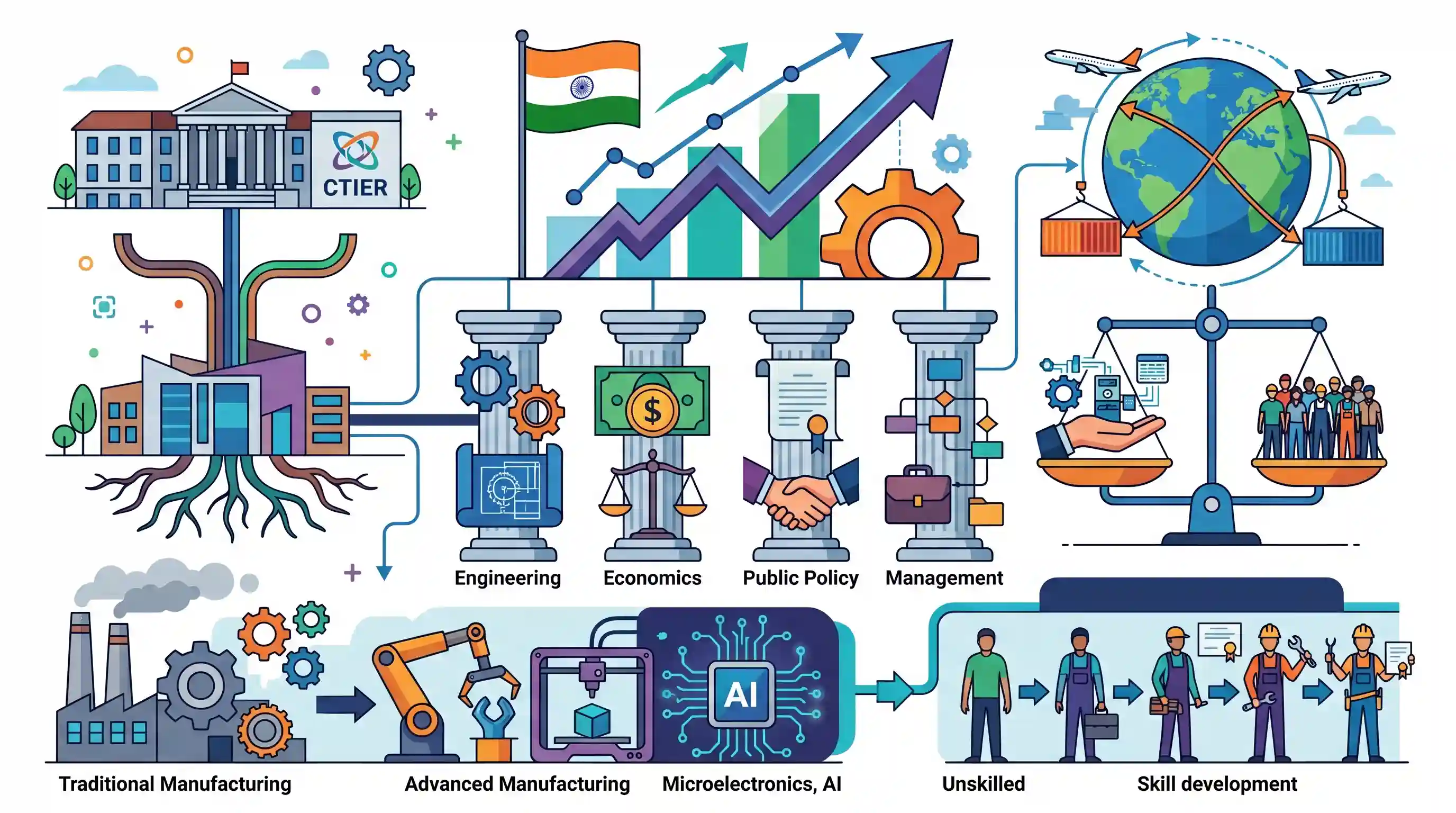
Ahmedabad University has announced the establishment of the Institute of Manufacturing and Economy in partnership with the Centre for Technology, Innovation and Economic Research (CTIER). The institute aims to foster robust industry-academia collaboration by treating manufacturing as a cross-disciplinary challenge involving engineering, economics, public policy, and management. By focusing on emerging technologies like AI, 3D printing, and microelectronics, alongside traditional supply chain issues, it seeks to improve workforce readiness and translational research. The initiative is strategically aligned with India's need to boost manufacturing from 15% to 25% of its GDP and integrate Indian firms into global markets amid recent Free Trade Agreements, all while balancing capital-intensive innovation with labor-intensive job creation.
Key Points
- Ahmedabad University launched the Institute of Manufacturing and Economy in collaboration with CTIER to foster cross-disciplinary solutions for India's manufacturing challenges.
- The institute will focus on bridging academia and industry through executive education, SME manufacturing clinics, policy research, and startups in advanced fields like AI, microelectronics, and 3D printing.
- A core objective is supporting India's macroeconomic goal of increasing the manufacturing sector's contribution to GDP from 15% to 25%.
- The initiative aims to address the dual challenge of adopting technology-intensive innovation (Industry 4.0) while sustaining high-productivity, labor-intensive manufacturing for job creation.
- It highlights the need for supply chain coordination and workforce readiness as Indian firms face intensified global competition due to recent Free Trade Agreements (FTAs).
Important Terms
Free Trade Agreements (FTAs)

Formal treaties between two or more countries to reduce or eliminate trade barriers, such as tariffs and quotas, on goods and services.
UPSC context
GS II (International Relations) and GS III (Economy); tests understanding of trade policy, market access, and global supply chains.
Industry 4.0
The Fourth Industrial Revolution, characterized by the fusion of digital, physical, and biological systems through technologies like AI, IoT, robotics, and 3D printing.
UPSC context
GS III (Science & Tech and Economy); critical for questions on manufacturing competitiveness and the future of work.
Make in India
A major national initiative launched in 2014 to transform India into a global manufacturing hub by encouraging domestic and foreign investment.
UPSC context
GS III (Economy - Industrial Policy); fundamental for discussing economic growth, employment, and import substitution.
Ahmedabad University
A private, non-profit research university in Gujarat focused on interdisciplinary learning, now hosting a cross-disciplinary institute to address manufacturing and economic challenges.
UPSC context
Current Affairs; highlights the role of private research institutions in national industrial development.
Centre for Technology, Innovation and Economic Research (CTIER)
A premier Indian think tank established in 2015 to promote technical capability and innovation as core drivers of economic development and policy.
UPSC context
GS III (Economy/S&T Policy); relevant for institutional frameworks that support India's R&D and innovation ecosystem.
Industry-Academia Linkage
The collaborative relationship between higher education institutions and the private sector to bridge the skill gap, commercialize research, and foster innovation.
UPSC context
GS II (Education) and GS III (Employment); tests solutions to the 'employability gap' and R&D translation.
Global Value Chains (GVCs)
The full sequence of activities (design, production, marketing, distribution) performed by firms across different countries to bring a product to the final consumer.
UPSC context
GS III (Economy); essential for understanding trade integration, 'China Plus One' strategy, and export-led growth.
Prelims Trap
"The National Manufacturing Policy aims to increase the manufacturing sector's share to 35% of India's GDP."
The target is to reach 25% of GDP (up from the stagnant ~15-16%), along with creating 100 million jobs. UPSC often exaggerates these percentage targets.
Static Concepts Connected
What are the macro objectives of the National Manufacturing Policy?
- Output Target: Increase the manufacturing sector's share to 25% of India's GDP.
- Employment Generation: Create 100 million additional jobs in manufacturing to absorb the demographic dividend.
- Global Competitiveness: Enhance technological depth, value addition, and integrate domestic MSMEs into global value chains.
What are the core components of the Fourth Industrial Revolution (Industry 4.0)?
- Cyber-physical systems: Integration of computation, networking, and physical manufacturing processes for smart factory automation.
- Additive Manufacturing: Utilizing 3D printing for rapid prototyping, mass customization, and reducing supply chain bottlenecks.
- IoT & AI: Real-time data processing for predictive machine maintenance and efficient supply chain coordination.
Cross-Topic Patterns
Private R&D and Industry-Academia Gap
India's R&D expenditure is heavily government-driven. Institutionalizing manufacturing clinics directly targets the Economic Survey's push to boost private sector translational research and technology adoption.
FTAs vs. MSME Competitiveness
As India operationalizes new FTAs, domestic MSMEs face intensified global competition. Bridging engineering and economics through academia helps modernize supply chains to survive import influxes.

Expect a Mains question on the dual challenge of adopting capital-intensive Industry 4.0 while sustaining labor-intensive job creation.
Linked PYQs · 4
Linked PYQs · 4
- 2023MainsGS3
Faster economic growth requires increased share of the manufacturing sector in GDP, particularly of MSMEs. Comment on the present policies of the Government in this regard.
- 2017MainsGS3
Account for the failure of manufacturing sector in achieving the goal of labour-intensive exports. Suggest measures for more labour-intensive rather than capital-intensive exports.
- 2023MainsGS2
Skill development programmes have succeeded in increasing human resources supply to various sectors. In the context of the statement analyse the linkages between education, skill and employment.
- 2015MainsGS2
The quality of higher education in India requires major improvements to make it internationally competitive. Do you think that the entry of foreign educational institutions would help improve the quality of higher and technical education in the country? Discuss.
