अहमदाबाद को स्वदेशी मेड इन इंडिया ड्राइवरलेस मेट्रो ट्रेनें मिलीं
स्रोत:इंडियन एक्सप्रेस ↗
क्यों मायने रखता है
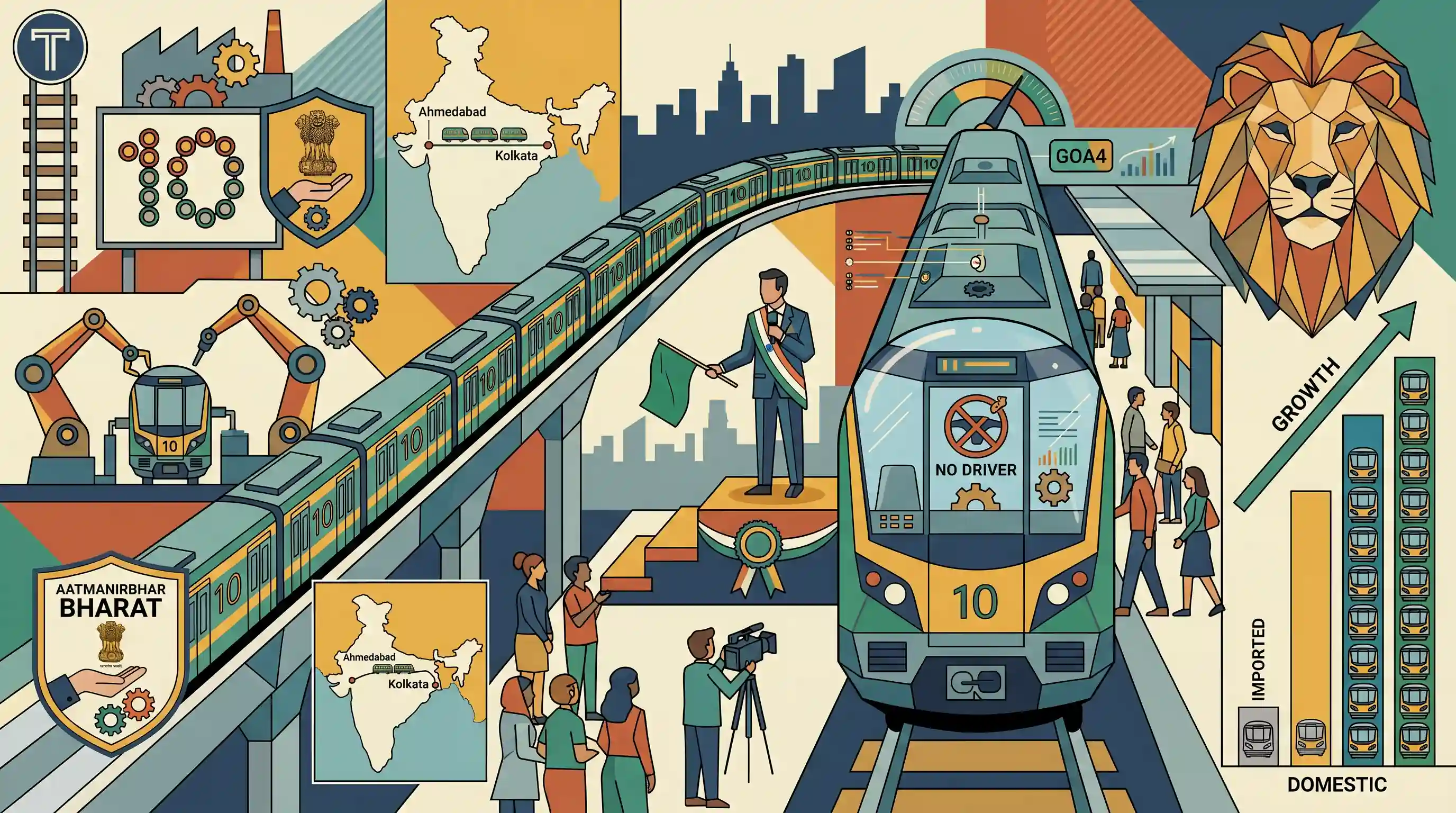
तकनीकी रूप से उन्नत, ड्राइवरलेस मेट्रो ट्रेनों का स्वदेशी उत्पादन भारत के विनिर्माण क्षेत्र और 'Make in India' पहल के लिए एक ठोस सफलता की कहानी है। UPSC अभ्यर्थियों के लिए, यह बुनियादी ढांचा विकास, अत्याधुनिक परिवहन तकनीक में आत्मनिर्भरता और शहरी गतिशीलता में सुधार के एक ठोस उदाहरण के रूप में कार्य करता है।
सारांश
Ahmedabad is set to receive 10 fully indigenous, 'Made in India' Metro trains manufactured by Titagarh Rail Systems at their facility near Kolkata. The first train, flagged off by Gujarat Chief Minister Bhupendra Patel, will run on the Ahmedabad Metro Phase-2 line. The train is highly advanced, featuring a Grade of Automation 4 (GOA4) system that allows for driverless, completely automated operation. This development underscores India's advancing domestic manufacturing capabilities in high-tech urban mass transit systems, aligning strongly with the 'Make in India' and 'Aatmanirbhar Bharat' initiatives.
मुख्य बिंदु
- अहमदाबाद में गुजरात मेट्रो रेल कॉर्पोरेशन (GMRC) के चरण-2 प्रोजेक्ट के लिए पहली पूरी तरह से स्वदेशी 'मेक इन इंडिया' मेट्रो ट्रेन का निर्माण टीटागढ़ रेल सिस्टम्स (Titagarh Rail Systems) द्वारा किया गया है।
- The state-of-the-art Metro is equipped with a Grade of Automation 4 (GOA4) system, enabling fully automated, driverless operations.
- ऐसी दस ट्रेनों की डिलीवरी निर्धारित है, जो शहरी मास रैपिड ट्रांजिट सिस्टम के निर्माण में बढ़ती घरेलू क्षमताओं को प्रदर्शित करती हैं।
- The project highlights the success of 'Make in India' and 'Aatmanirbhar Bharat' in high-tech manufacturing, an area previously reliant on foreign imports or joint ventures.
महत्वपूर्ण शब्द
मेक इन इंडिया

2014 में शुरू किया गया राष्ट्रीय कार्यक्रम, जिसका उद्देश्य निवेश को सुविधाजनक बनाकर, नवाचार को बढ़ावा देकर और 27 क्षेत्रों में विश्व स्तरीय विनिर्माण बुनियादी ढांचे (manufacturing infrastructure) का निर्माण करके भारत को एक वैश्विक विनिर्माण केंद्र (global manufacturing hub) के रूप में परिवर्तित करना है।
UPSC context
GS III (Economy/Industry); relevant for industrial policy, FDI, and the 'Vocal for Local' initiative.
आत्मनिर्भर भारत
2020 की एक पहल जिसका लक्ष्य पाँच स्तंभों—अर्थव्यवस्था, इन्फ्रास्ट्रक्चर, सिस्टम, जीवंत जनसांख्यिकी और मांग—पर आधारित एक 'आत्मनिर्भर भारत' बनाना है, जो आयात निर्भरता को कम करने और घरेलू उत्पादन को बढ़ाने का प्रयास करती है।
UPSC context
GS III (Economic Development); essential for policy analysis of indigenous supply chains and technology self-sufficiency.
Grade of Automation 4 (GOA4)
The highest level of automated train operation (Unattended Train Operation) where the system is fully responsible for driving and emergency management without any on-board staff.
UPSC context
GS III (S&T/Infrastructure); showcases indigenisation of advanced urban transit systems and high-tech urban mobility solutions.
Titagarh Rail Systems (TRSL)
रेलवे वैगन, यात्री कोच और मेट्रो ट्रेनों का एक प्रमुख भारतीय निजी क्षेत्र का निर्माता, जो रेल तकनीक के स्वदेशीकरण और 'Make in India' में महत्वपूर्ण भूमिका निभा रहा है।
UPSC context
जीएस III (अवसंरचना); हाई-टेक विनिर्माण और परिवहन अवसंरचना में निजी क्षेत्र की भागीदारी का उदाहरण।
गुजरात मेट्रो रेल कॉर्पोरेशन (GMRC)
A 50:50 Special Purpose Vehicle (SPV) jointly owned by the Government of India and Government of Gujarat, tasked with implementing urban metro projects in the state.
UPSC context
GS II/III (Governance/Infrastructure); reflects cooperative federalism and urban transport planning for sustainable cities.
प्रारंभिक ट्रैप
"GoA4 metro trains require a human attendant onboard strictly for emergency interventions."
GoA4 signifies Unattended Train Operation (UTO). All functions, including emergencies, are managed by centralized control rooms without any onboard staff.
संबंधित अवधारणाएँ
मेट्रो रेल नीति 2017 के तहत केंद्रीय सहायता के लिए मुख्य अधिदेश क्या हैं?
- PPP Mandate: केंद्रीय वित्तीय सहायता प्राप्त करने के लिए सार्वजनिक-निजी भागीदारी (PPP) घटक को शामिल करना एक अनिवार्य पूर्व-शर्त है।
- UMTA Formation: States must establish a statutory body to oversee integrated urban transport planning.
- गतिशीलता एकीकरण: Projects require a Comprehensive Mobility Plan (CMP) to ensure seamless integration with buses, non-motorized transport, and last-mile connectivity.
How do Grades of Automation (GoA) classify driverless train technologies?
- GoA 2: Semi-automated. The train runs automatically, but a human driver operates doors and handles emergencies.
- GoA 3: Driverless operation. Running and doors are automated, but a train attendant is present strictly for emergencies.
- GoA 4: Unattended Train Operation (UTO). Completely automated without any onboard staff required for standard or emergency operations.
अंतर-विषय पैटर्न
Metro Policy + Urban Governance Reforms
अर्बन मेट्रोपॉलिटन ट्रांसपोर्ट अथॉरिटी (UMTA) का अधिदेश बुनियादी ढांचा वित्तपोषण को सीधे शहरी शासन सुधारों और व्यापक गतिशीलता योजना से जोड़ता है, जो 74वें संशोधन की विकेंद्रीकरण की भावना को प्रतिबिंबित करता है।
रोलिंग स्टॉक + आत्मनिर्भर आपूर्ति श्रृंखला
टीटागढ़ का स्वदेशी विनिर्माण शुरुआती आयात-निर्भरता (जैसे दिल्ली मेट्रो के शुरुआती कोच) से घरेलू आपूर्ति श्रृंखला की ओर बदलाव को रेखांकित करता है, जो भारी विनिर्माण में 'Make in India' और PLI के व्यापक उद्देश्यों को प्रतिबिंबित करता है।

Metro Rail Policy 2017's conditions (PPP mandate, UMTA, 75% local procurement) paired with GoA4 tech could form a tricky 2026 Prelims MCQ.
संबद्ध PYQ · 3
संबद्ध PYQ · 3
- 2015MainsGS3
Success of 'Make in India' programme depends on the success of 'Skill India' programme and radical labour reforms." Discuss with logical arguments.
- 2023MainsGS3
Faster economic growth requires increased share of the manufacturing sector in GDP, particularly of MSMEs. Comment on the present policies of the Government in this regard.
- 2022MainsGS3
Why is Public Private Partnership (PPP) required in infrastructural projects ? Examine the role of PPP model in the redevelopment of Railway Stations in India.
