Ahmedabad Receives Indigenous Made In India Driverless Metro Trains
Source:Indian Express ↗
Why It Matters
The indigenous production of technologically advanced, driverless Metro trains is a tangible success story for India's manufacturing sector and the 'Make in India' initiative. For UPSC aspirants, it serves as a concrete example of infrastructure development, self-reliance in cutting-edge transport technology, and urban mobility improvements.
Summary
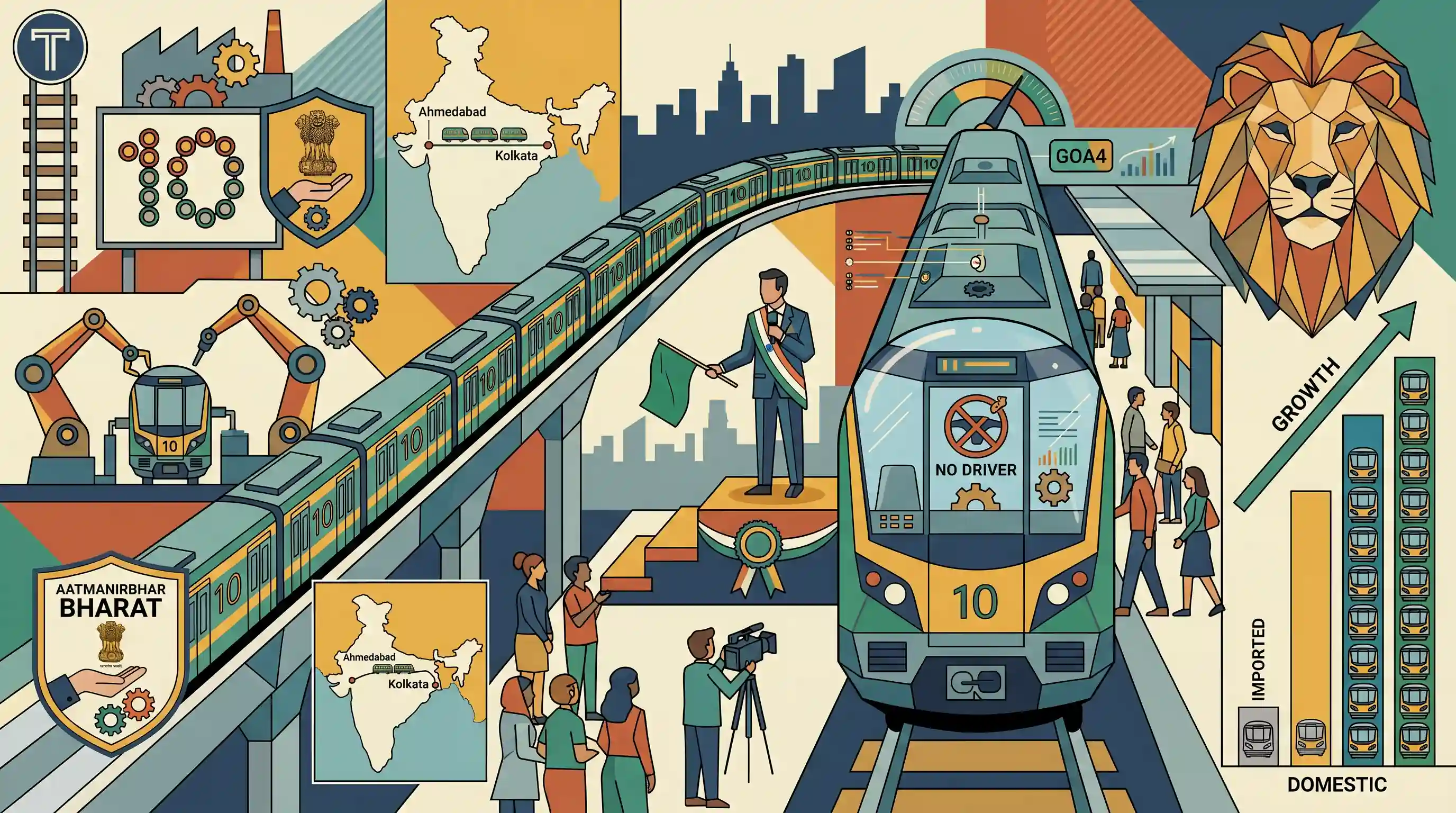
Ahmedabad is set to receive 10 fully indigenous, 'Made in India' Metro trains manufactured by Titagarh Rail Systems at their facility near Kolkata. The first train, flagged off by Gujarat Chief Minister Bhupendra Patel, will run on the Ahmedabad Metro Phase-2 line. The train is highly advanced, featuring a Grade of Automation 4 (GOA4) system that allows for driverless, completely automated operation. This development underscores India's advancing domestic manufacturing capabilities in high-tech urban mass transit systems, aligning strongly with the 'Make in India' and 'Aatmanirbhar Bharat' initiatives.
Key Points
- The first completely indigenous 'Make in India' Metro train was manufactured by Titagarh Rail Systems for the Gujarat Metro Rail Corporation (GMRC) Phase-2 project in Ahmedabad.
- The state-of-the-art Metro is equipped with a Grade of Automation 4 (GOA4) system, enabling fully automated, driverless operations.
- Ten such trains are scheduled for delivery, demonstrating growing domestic capabilities in manufacturing urban mass rapid transit systems.
- The project highlights the success of 'Make in India' and 'Aatmanirbhar Bharat' in high-tech manufacturing, an area previously reliant on foreign imports or joint ventures.
Important Terms
Make in India

National program launched in 2014 to transform India into a global manufacturing hub by facilitating investment, fostering innovation, and building best-in-class manufacturing infrastructure across 27 sectors.
UPSC context
GS III (Economy/Industry); relevant for industrial policy, FDI, and the 'Vocal for Local' initiative.
Aatmanirbhar Bharat
A 2020 initiative aiming for a 'Self-Reliant India' based on five pillars: Economy, Infrastructure, System, Vibrant Demography, and Demand, seeking to reduce import dependency and enhance domestic production.
UPSC context
GS III (Economic Development); essential for policy analysis of indigenous supply chains and technology self-sufficiency.
Grade of Automation 4 (GOA4)
The highest level of automated train operation (Unattended Train Operation) where the system is fully responsible for driving and emergency management without any on-board staff.
UPSC context
GS III (S&T/Infrastructure); showcases indigenisation of advanced urban transit systems and high-tech urban mobility solutions.
Titagarh Rail Systems (TRSL)
A leading Indian private-sector manufacturer of railway wagons, passenger coaches, and metro trains, playing a critical role in the indigenisation of rail technology and 'Make in India.'
UPSC context
GS III (Infrastructure); example of private sector participation in high-tech manufacturing and transport infrastructure.
Gujarat Metro Rail Corporation (GMRC)
A 50:50 Special Purpose Vehicle (SPV) jointly owned by the Government of India and Government of Gujarat, tasked with implementing urban metro projects in the state.
UPSC context
GS II/III (Governance/Infrastructure); reflects cooperative federalism and urban transport planning for sustainable cities.
Prelims Trap
"GoA4 metro trains require a human attendant onboard strictly for emergency interventions."
GoA4 signifies Unattended Train Operation (UTO). All functions, including emergencies, are managed by centralized control rooms without any onboard staff.
Static Concepts Connected
What are the key mandates for Central assistance under the Metro Rail Policy 2017?
- PPP Mandate: Including a Public-Private Partnership (PPP) component is a mandatory prerequisite to receive central financial assistance.
- UMTA Formation: States must establish a statutory body to oversee integrated urban transport planning.
- Mobility Integration: Projects require a Comprehensive Mobility Plan (CMP) to ensure seamless integration with buses, non-motorized transport, and last-mile connectivity.
How do Grades of Automation (GoA) classify driverless train technologies?
- GoA 2: Semi-automated. The train runs automatically, but a human driver operates doors and handles emergencies.
- GoA 3: Driverless operation. Running and doors are automated, but a train attendant is present strictly for emergencies.
- GoA 4: Unattended Train Operation (UTO). Completely automated without any onboard staff required for standard or emergency operations.
Cross-Topic Patterns
Metro Policy + Urban Governance Reforms
The mandate for an Urban Metropolitan Transport Authority (UMTA) links infrastructure financing directly to urban governance reforms and comprehensive mobility planning, echoing the decentralization ethos of the 74th Amendment.
Rolling Stock + Aatmanirbhar Supply Chains
Titagarh's indigenous manufacturing highlights the transition from early import-dependence (like initial Delhi Metro coaches) to domestic supply chains, mirroring broader 'Make in India' and PLI objectives in heavy manufacturing.

Metro Rail Policy 2017's conditions (PPP mandate, UMTA, 75% local procurement) paired with GoA4 tech could form a tricky 2026 Prelims MCQ.
Linked PYQs · 3
Linked PYQs · 3
- 2015MainsGS3
Success of 'Make in India' programme depends on the success of 'Skill India' programme and radical labour reforms." Discuss with logical arguments.
- 2023MainsGS3
Faster economic growth requires increased share of the manufacturing sector in GDP, particularly of MSMEs. Comment on the present policies of the Government in this regard.
- 2022MainsGS3
Why is Public Private Partnership (PPP) required in infrastructural projects ? Examine the role of PPP model in the redevelopment of Railway Stations in India.
