Gujarat Expands Green Cover Across Forest and Non Forest Land
Source:times-of-india ↗
Why It Matters
Schemes related to forest conservation, green cover expansion, and state-specific environmental initiatives like 'Maha Van Kavach' are highly relevant for GPSC Class 1-2 Prelims. Understanding the regional distribution of these plantations, major ranges, and the concept of high-density consolidated planting helps in answering direct geographical and ecological questions.
Summary
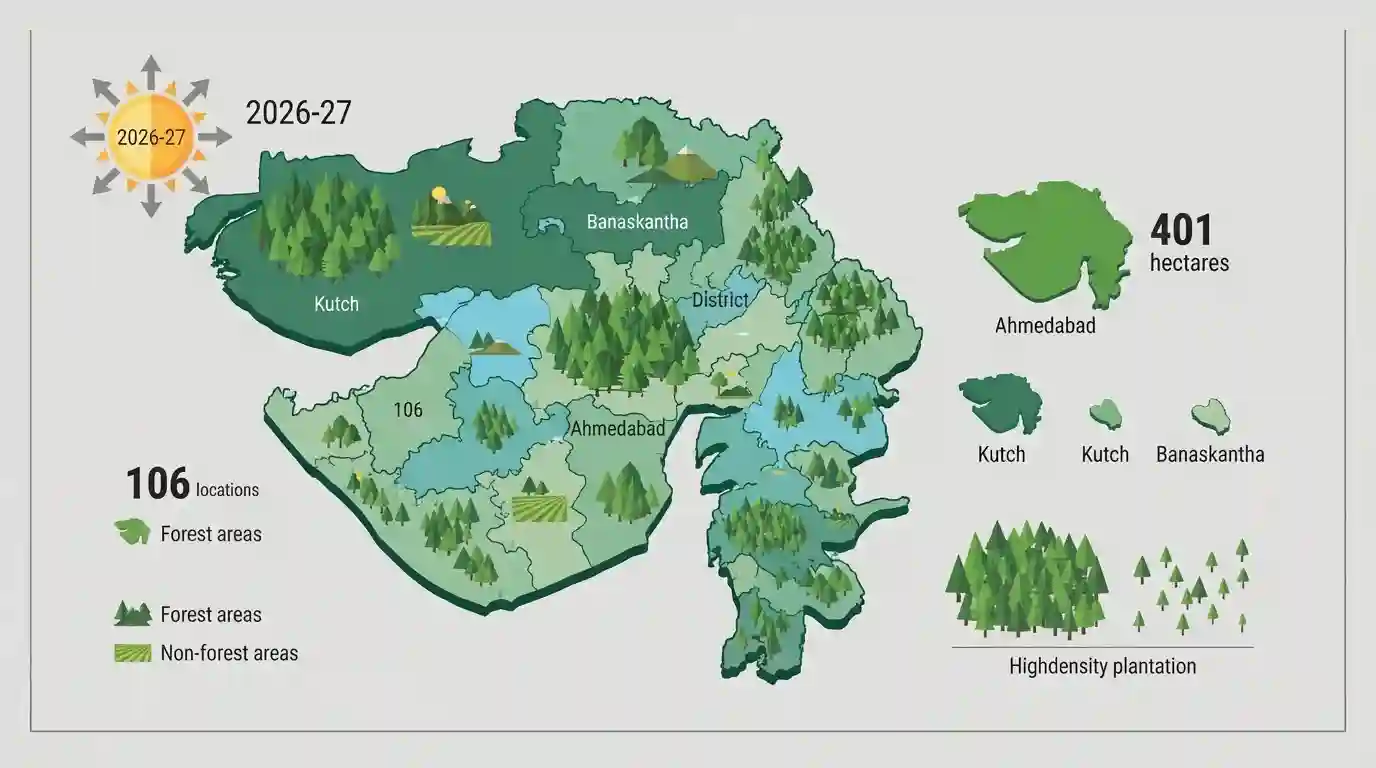
During 2026-27, the Gujarat Forest Department has expanded its green cover by developing concentrated, high-density plantations across 1,526 hectares at 106 locations under the 'Maha Van Kavach' initiative. Ahmedabad district leads with the largest share of 401 hectares, followed by Kutch (195 hectares) and Banaskantha (120 hectares). The project covers both forest and non-forest areas across diverse ecological zones to create extensive green patches rather than dispersed plantings.
Key Points
- Under the 'Maha Van Kavach' initiative, Gujarat has carried out high-density plantations across 1,526 hectares at 106 locations during 2026-27.
- The individual plantation sites range from 10 hectares to 100 hectares, aiming to develop concentrated, large green patches rather than scattered forest activities. These sites span both forest and non-forest lands across diverse ecological zones.
- Ahmedabad district leads the state-wide program, accounting for the highest share of 401 hectares across the Daskroi, Sanand, and Bavla ranges. Key sites include a 100-hectare plantation at Godhavi in Sanand, Zanp block-1 (48 hectares), Vinchhiya (45 hectares), and Dumali (30 hectares).
- Kutch is the second major focus division with 195 hectares covered across Kutch East and West (specifically Nakhatrana, Dayapar, Bhuj, Rapar, Bhachau, and Mundra ranges).
- Other prominent district-wise distributions include Banaskantha (120 hectares, with 50 hectares at Dawas in Dantiwada), Sabarkantha (85 hectares), Narmada & Valsad (90 hectares each), Vyara (75 hectares), Dahod (73 hectares), Patan (60 hectares), Surat (65 hectares), Chhota Udepur (42 hectares), and Dang (60 hectares in Dang North, 30 hectares in Dang South).
Important Terms
Maha Van Kavach Initiative

An indigenous afforestation initiative of the Gujarat Forest Department based on the 'Van Kavach' model, adapting the Japanese Miyawaki method to create concentrated, high-density native forest patches on degraded lands.
UPSC context
GPSC GS Paper-V (Environment & Geography), testing state-specific afforestation schemes and ecological conservation strategies.
Miyawaki Afforestation Method
A high-density, rapid-growth afforestation technique developed by Japanese botanist Akira Miyawaki, involving dense planting of diverse native species to establish mature forest canopies within a few decades.
UPSC context
GPSC GS Paper-V (Environment), testing innovative global conservation methodologies, biodiversity restoration, and climate mitigation.
National Forest Policy 1988
India's primary framework for forest management, aiming to maintain 33% forest and tree cover while emphasizing environmental stability, ecological balance, community participation, and safeguarding tribal livelihood rights.
UPSC context
GPSC GS Paper-V (Geography and Environment), testing national conservation mandates and sustainable resource management policies.
Social Forestry
The management and protection of forests and afforestation on barren lands outside traditional forest areas to aid environmental, social, and rural development while meeting local resource demands.
UPSC context
GPSC GS Paper-V (Geography of Gujarat & Environment), testing agro-forestry schemes and community participation.
Gujarat Forest Department
The nodal state agency responsible for the conservation of wildlife, management of state forests, and implementation of afforestation, social forestry, and biodiversity schemes in Gujarat.
UPSC context
GPSC GS Paper-V (Geography & Environment), testing state administrative machinery and localized conservation projects.
Prelims Trap
The tribal-dominated Dang district registered the highest land allocation under the 2026-27 Maha Van Kavach high-density plantation drive.
Aspirants often assume heavily forested tribal districts like Dang or Narmada would lead any massive state-driven afforestation initiative, whereas the semi-urbanized/industrialized Ahmedabad district actually holds the largest share (401 hectares).
Static Concepts Connected
What is the Miyawaki Method and how does it compare to indigenous models?
- Core Concept: Developed by Japanese botanist Akira Miyawaki; involves planting multi-layered native saplings close together to create self-sustaining micro-forests within two to three years.
- Efficiency Advantage: Miyawaki forests grow 10 times faster, are 30 times denser, and boast 100 times more biodiversity than conventional monoculture plantations.
- Van Kavach Adaptation: Developed by Gujarat Forest Department as a localized, cost-effective alternative utilizing indigenous and drought-resistant species suited to the state's dry tracts.
What are the key constitutional and statutory frameworks for forestry in India?
- Constitutional Status: Forests were transferred from the State List to the Concurrent List (Entry 17A) via the 42nd Constitutional Amendment Act of 1976.
- Directive Principles & Duties: Article 48A (DPSP) mandates state protection of forests, while Article 51A(g) tasks citizens with the fundamental duty to protect the natural environment.
- Gujarat Forest Profile: As per the India State of Forest Report (ISFR), Gujarat has low natural forest cover (~7.4%) but stands exceptionally high in 'Tree Outside Forests' (TOF) metrics.
Cross-Topic Patterns
Urban Forestry + Heat Island Mitigation
High-density urban forestry under Maha Van Kavach in Ahmedabad directly combats the Urban Heat Island (UHI) effect by building micro-climate sinks in rapidly industrializing zones.
Constituency-led climate action
Structuring ecological targets around parliamentary boundaries (e.g., Gandhinagar's Green Lok Sabha initiative) signals a transition toward mainstreaming green governance in electoral politics.

GPSC will likely test 'Maha Van Kavach' by pitting its district-wise leaders (Ahmedabad vs Dang) against Miyawaki technical concepts.
Linked PYQs · 2
Linked PYQs · 2
- 2026GPSC_PRELIMSGS1
Consider the following statements regarding the objectives of Forest Policy, 2018: 1. Controlling animal grazing in forests. 2. Promoting government and private partnership where forests have been destroyed. 3. Promoting greenbelts in cities. Which of the above statement/s is/are correct?
- 2026GPSC_PRELIMSGS1
Consider the following pairs: Tree Species - Associated Forest Type 1. Rosewood (Dalbergia latifolia) - Tropical Wet Evergreen Forests 2. Teak (Tectona grandis) - Tropical Moist Deciduous Forests 3. Khejri (Prosopis cineraria) - Tropical Thorn Forests 4. Sundari (Heritiera fomes) - Littoral and Swamp Forests 5. Deodar (Cedrus deodara) - Mountainous Sub-Tropical Broad-leaves Forests Which of the above pairs are correctly matched?
