Ramol illegal firecracker factory blast arrests and crackdown
Source:etvbharat ↗
Why It Matters
The fatal explosion underscores the urgent challenges in regulatory compliance and enforcement within urban centers, emphasizing the risks of illegal explosive manufacturing and the need for robust municipal disaster management and fire safety protocols.
Summary
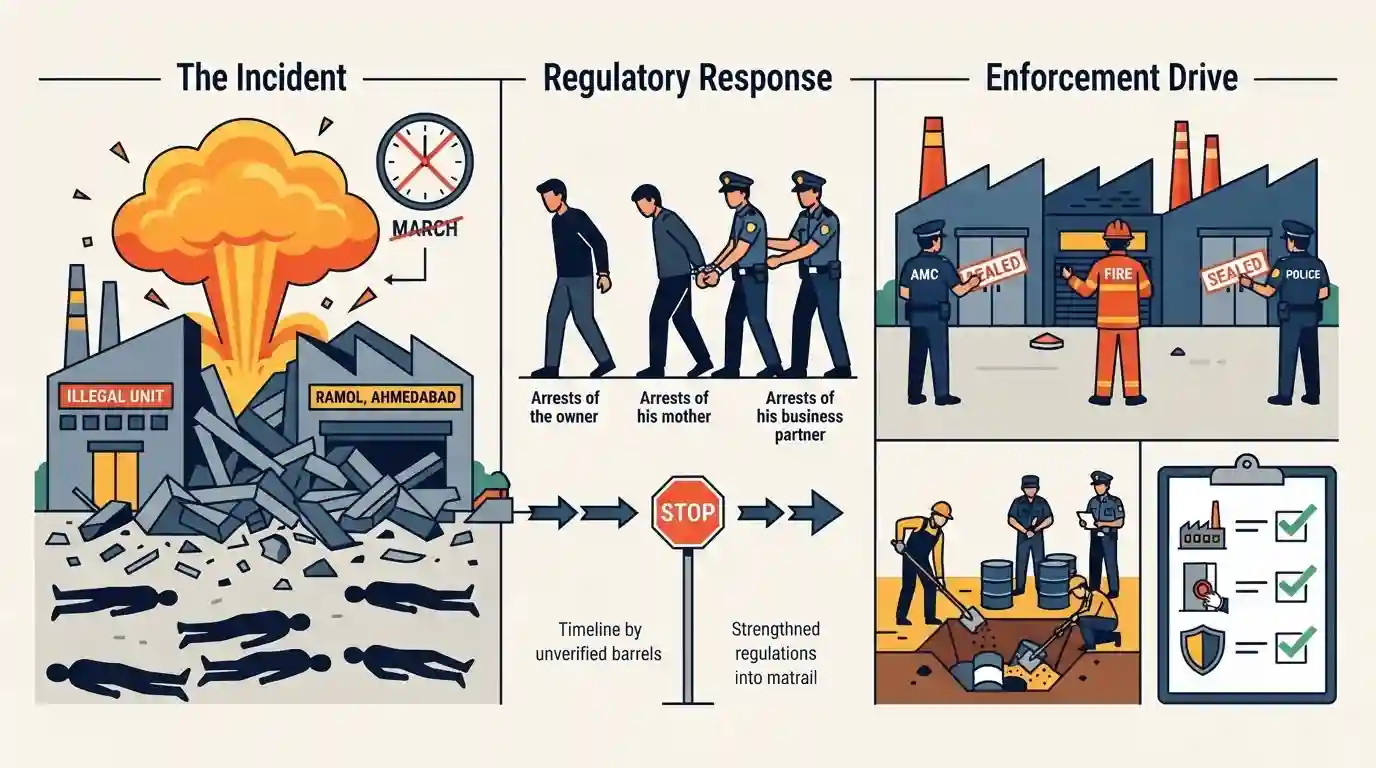
A massive blast at an illegal firecracker manufacturing unit in Ahmedabad's Ramol area resulted in the deaths of nine individuals. The factory was operating unlawfully after its license had expired and operations were officially ordered shut in March. In response to the tragedy, authorities arrested the owner, his mother, and his business partner. The Ahmedabad Municipal Corporation (AMC), alongside the fire department and police, subsequently launched an enforcement drive, shutting down other illegal firecracker units in the city and destroying unverified explosive materials. This incident highlights critical regulatory enforcement gaps in urban industrial safety and hazardous material management.
Key Points
- An explosion at an illegal firecracker manufacturing unit in Ahmedabad’s Ramol area killed 9 people and injured several others.
- The factory had been officially closed in March by municipal authorities for operating without a renewed license but was continuing production illegally.
- Ahmedabad police arrested the factory owner Mehul Dodia, his mother, and his business partner Sadiq Syed in connection with the fatal blast.
- Following the incident, joint crackdowns by the Ahmedabad Municipal Corporation, fire department, and police shut down other illegal firecracker operations in the Ramol and Vastral areas, destroying large quantities of confiscated materials.
Important Terms
Explosives Act, 1884

An Indian legislation regulating the manufacture, possession, use, sale, transport, import, and export of explosives, providing safety standards to mitigate hazards.
UPSC context
GS Paper 3 (Disaster Management) and GS Paper 2 (Regulatory Frameworks); tests statutory rules on public safety.
Explosive Substances Act, 1908
A penal statute criminalizing the malicious manufacture, possession, or use of explosives with intent to endanger life, cause harm, or damage property.
UPSC context
GS Paper 3 (Internal Security) and GS Paper 2 (Criminal Justice); tests penal provisions dealing with high-risk explosives.
Bharatiya Nyaya Sanhita (BNS), 2023
India's official criminal code, effective July 2024, which replaced the colonial Indian Penal Code (IPC) to simplify offenses, including culpable homicide and negligence.
UPSC context
GS Paper 2 (Judicial Reforms and Criminal Justice System); tests awareness of overhauled criminal laws.
Ahmedabad Municipal Corporation (AMC)
An urban local body in Gujarat responsible for local administration, civic infrastructure, fire services, and public safety under the 74th Constitutional Amendment.
UPSC context
GS Paper 2 (Urban Governance and Local Bodies); tests decentralization, municipal responsibilities, and civic safety.
Industrial Safety
The framework of safety measures, regulatory audits, and disaster prevention protocols implemented within factories to secure workers and mitigate chemical or explosive risks.
UPSC context
GS Paper 3 (Disaster Management); tests management of hazardous materials and prevention of man-made disasters.
Prelims Trap
"The manufacture and storage of firecrackers is regulated by the Ministry of Home Affairs."
PESO, the apex regulatory body for explosives and firecrackers, operates under the DPIIT (Ministry of Commerce and Industry), not the Ministry of Home Affairs or MoEFCC.
Static Concepts Connected
What is the legal framework governing hazardous industries and chemical disasters in India?
- Explosives Act, 1884: Regulates the manufacture, possession, use, and transport of explosives through the Petroleum and Explosives Safety Organisation (PESO).
- Factories Act, 1948: Defines 'hazardous processes' and mandates state-level Site Appraisal Committees to evaluate the establishment or expansion of such industrial units.
- Public Liability Insurance: Mandates insurance for hazardous industries to provide immediate relief to victims of accidents on a strict "no-fault" liability basis.
What are 'green crackers' and how do they differ from traditional firecrackers?
- Variants Developed: Formulated by CSIR-NEERI, the three categories are SWAS (Safe Water Releaser), STAR (Safe Thermite Cracker), and SAFAL (Safe Minimal Aluminium).
- Barium Free: They are completely free of barium nitrate, a toxic green-coloring metal salt banned by the Supreme Court of India.
- Emission Reduction: They are designed to reduce particulate matter (PM) emissions by 30-50% compared to conventional firecrackers.
Cross-Topic Patterns
ULB capacity in industrial safety
The persistent operation of illegal units highlights enforcement gaps by municipalities, linking urban governance (74th Amendment) directly to disaster resilience and local enforcement capacity.
Judicial mandates driving environmental tech
The Supreme Court's ban on barium nitrate drove CSIR-NEERI's innovation of green crackers, bridging judicial interventions on Article 21 (Right to Clean Air) with indigenous technological R&D.

PESO's nodal ministry (DPIIT) and the 'no-fault' liability under the Public Liability Insurance Act are prime targets for a 2026 Prelims Q.
Linked PYQs · 1
Linked PYQs · 1
- 2024GPSC_PRELIMSGS1
The National Environmental Policy Act required, all federal agencies to conduct prior before taking any major action.
