Ahmedabad Faces Climate Readiness Test for Mega Sporting Events
Source:Indian Express ↗
Why It Matters
The increasing frequency of heatwaves demands that climate resilience and disaster risk reduction be integrated into urban planning. The article provides a contemporary context—hosting global sporting events—to analyze the intersection of climate change, sustainable urbanization, and soft power.
Summary
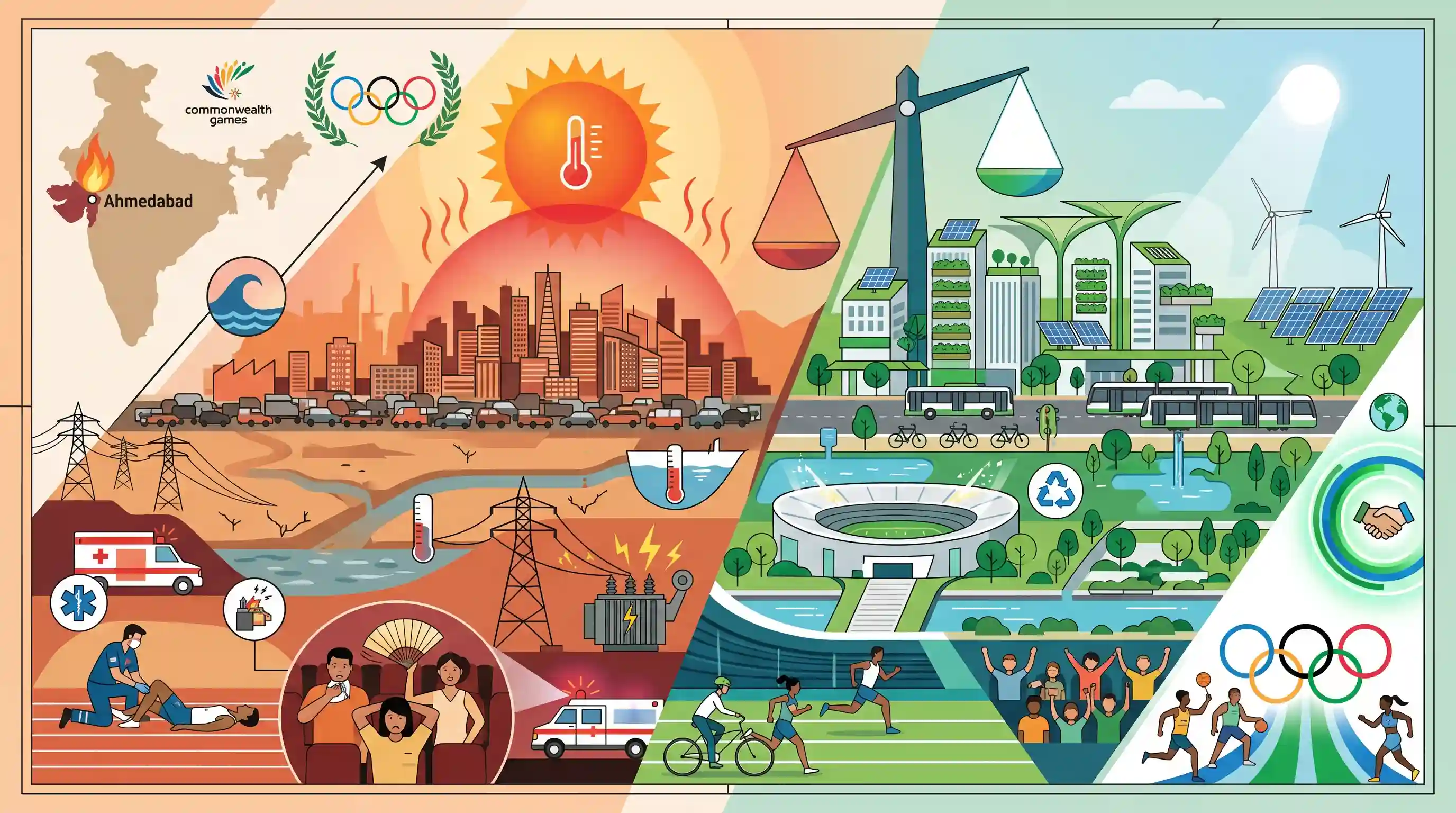
The article analyzes India's ambitions to host mega-sporting events, such as the 2030 Commonwealth Games and the 2036 Olympics, focusing on Ahmedabad as a prospective host city. It underscores that beyond infrastructure and financial capability, India must pass a critical 'climate readiness test.' Mega-events held in regions prone to extreme heatwaves and urban heat island effects face severe challenges regarding athlete safety, spectator comfort, and the immense strain on water and energy resources. Consequently, securing these bids necessitates building climate-resilient urban infrastructure and demonstrating a commitment to environmental sustainability, using the 2030 CWG as a proving ground for the larger 2036 Olympics.
Key Points
- India is considering bidding for the 2030 Commonwealth Games and the 2036 Olympic Games, with Ahmedabad being projected as a key host city.
- A major obstacle to hosting such mega-events is the climate vulnerability of Indian cities, particularly the high risks of extreme summer heat and heatwaves.
- Extreme temperatures severely threaten athlete health, spectator safety, and place immense stress on urban resources like electricity for cooling and freshwater supply.
- To be considered 'Olympics ready,' cities like Ahmedabad must urgently integrate climate resilience into their urban planning to mitigate the urban heat island effect.
- Successfully implementing sustainable and climate-resilient infrastructure for a preparatory event like the CWG is essential to demonstrate India's capability to the IOC for a future Olympics bid.
Important Terms
International Olympic Committee (IOC)

The supreme authority of the Olympic Movement, it sets the 'Host City Contract' requirements, now mandating sustainability, carbon neutrality, and long-term legacy for all future Olympic hosts.
UPSC context
Relevant for GS 2 (International Organizations) and GS 3 (Environment) regarding global standards for sustainable development.
Urban Heat Island (UHI) Effect
A phenomenon where urban areas experience significantly higher temperatures than rural surroundings due to heat-absorbing surfaces (concrete/asphalt) and lack of green cover.
UPSC context
Key GS 1/3 topic testing knowledge of urbanization challenges and climate adaptation in Indian megacities.
Climate-Resilient Infrastructure
Building systems (transport, water, power) designed to withstand and recover from climate-induced shocks, such as extreme heatwaves or urban flooding.
UPSC context
Critical for GS 3 (Infrastructure/Disaster Management) as India needs ~$11 trillion for resilient urban transition by 2050.
Olympic Agenda 2020+5
A strategic roadmap (2021–2025) emphasizing sustainability, digitalization, and financial resilience, requiring future Games to be 'climate positive' (removing more CO2 than emitted).
UPSC context
GS 3 (Environment/Infrastructure); highlights the global shift toward mandatory climate accountability in mega-projects.
Heat Action Plan (HAP)
A comprehensive framework to manage extreme heat risks through early warnings, public awareness, and medical preparedness; Ahmedabad’s 2013 plan was India’s first.
UPSC context
GS 3 (Disaster Management); tests specific policy interventions for climate-induced health crises.
Sardar Vallabhbhai Patel Sports Enclave (SVPSE)
A major multi-sport facility in Ahmedabad, Gujarat, designed to meet Olympic standards; it is central to India's bid for the 2036 Summer Olympics.
UPSC context
GS 3 (Infrastructure); an example of mega-scale sports infrastructure development for national soft power projection.
Prelims Trap
CDRI is a UN agency established at the 2019 UN Climate Action Summit to fund resilient infrastructure.
CDRI was launched by India, not the UN. It is an independent global coalition headquartered in New Delhi and acts as a knowledge-sharing platform, not a funding agency.
Static Concepts Connected
What causes the Urban Heat Island (UHI) effect in cities?
- Albedo reduction: Concrete and asphalt have low albedo, absorbing and retaining significantly more solar radiation compared to natural vegetation or water bodies.
- Anthropogenic heat: Emissions from vehicles, air conditioners, and industrial activities directly release waste heat into the urban microclimate.
- Urban canyon effect: Tall, closely spaced buildings block natural wind flows and trap long-wave thermal radiation, severely limiting nighttime cooling.
What are the key features of the Coalition for Disaster Resilient Infrastructure (CDRI)?
- Indian leadership: Spearheaded by the Indian Prime Minister at the 2019 UN Climate Action Summit, with its secretariat located in New Delhi.
- Core mandate: Promotes the resilience of new and existing infrastructure systems to climate and disaster risks in support of sustainable development.
- Non-funding nature: It functions as a global knowledge partnership and technical assistance platform rather than a direct financial institution or fund.
Cross-Topic Patterns
Urbanization vs. Extreme Heatwaves
The push for mega-events intersects with GS-1 urbanization challenges. Ahmedabad’s 2013 Heat Action Plan (HAP) serves as a model case study for mitigating urban heat island impacts during extreme summers.
Mega-events as Geopolitical Soft Power
India's pursuit of the 2036 Olympics aligns with its IR strategy to project global soft power, requiring massive resilient infrastructure investments comparable to its recent G20 presidency efforts.

Mains GS-3 2026 could feature a question linking urban heat island mitigation with the feasibility of hosting global mega-events in India.
Linked PYQs · 3
Linked PYQs · 3
- 2013MainsGS1
Bring out the causes for the formation of heat islands in the urban habitat of the world.
- 2024MainsGS3
What is disaster resilience? How is it determined? Describe various elements of a resilience framework. Also mention the global targets of Sendai Framework for Disaster Risk Reduction (2015–2030).
- 2024MainsGS3
Flooding in urban areas is an emerging climate-induced disaster. Discuss the causes of this disaster. Mention the features of two such major floods in the last two decades in India. Describe the policies and frameworks in India that aim at tackling such floods.
