Ahmedabad Municipal Corporation Mandates Kitchen CCTV Cameras
Source:organiser ↗
Why It Matters
Ensuring food safety is a fundamental aspect of public health administration. The article highlights the overlapping roles of statutory bodies like FSSAI and decentralized urban local bodies (Municipal Corporations under the 74th Amendment Act) in enforcing food quality standards, protecting consumer rights, and preventing health hazards.
Summary
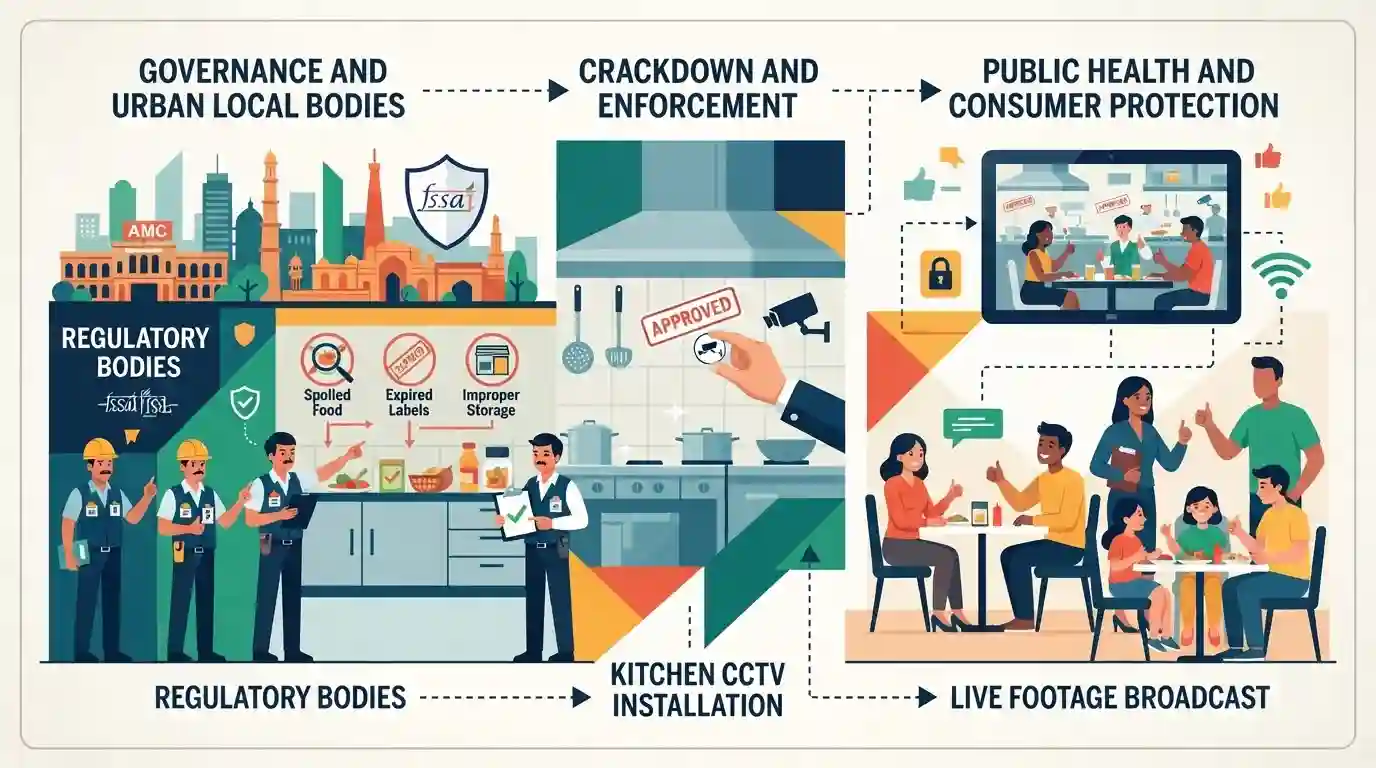
The Ahmedabad Municipal Corporation (AMC) has intensified its crackdown on poor food hygiene by advising restaurants to install kitchen CCTV cameras and broadcast live footage to patrons. This move aims to ensure compliance with the Food Safety and Standards Act and FSSAI guidelines. The drive follows widespread discoveries of unhygienic conditions, expired food, and adulteration during inspections across cities like Ahmedabad, Surat, and Bengaluru. The enforcement highlights the critical role of urban local bodies and statutory health authorities in monitoring public health and safeguarding consumers.
Key Points
- The Ahmedabad Municipal Corporation (AMC) advised over 11,000 restaurants to install CCTV cameras in kitchens and display live footage to customers to enhance transparency and hygiene.
- The initiative urges compliance with the Food Safety and Standards Act and FSSAI guidelines regarding food storage, pest control, and proper sanitation.
- During inspections, authorities uncovered severe violations such as the use of expired meat, adulterated ingredients, and unhygienic premises, leading to the sealing of several establishments.
- Tragic incidents, such as a child's death in Surat after consuming restaurant food, underscore the urgent need for stringent food safety enforcement by urban local bodies and regulatory authorities.
Important Terms
Food Safety and Standards Act

Enacted in 2006, this landmark legislation consolidated multiple food-related laws into a single framework to regulate food manufacturing, storage, distribution, and sale in India.
UPSC context
Highly relevant for GS Paper 2 (Statutory Frameworks and Public Health) regarding the legislative basis for consumer health protection.
74th Constitutional Amendment Act
Passed in 1992, this amendment constitutionalised Urban Local Bodies (Municipalities) in India, mandating regular elections, devolution of powers, and establishing a structured municipal system.
UPSC context
Crucial for GS Paper 2 (Polity and Governance) focusing on decentralized governance and the functioning of Urban Local Bodies.
Ahmedabad Municipal Corporation (AMC)
Established in 1950, it is the urban local body responsible for administering the civic infrastructure, public health, and basic services in the city of Ahmedabad.
UPSC context
Important for Gujarat PSC GS Paper 2 (State Governance and Urban Local Bodies) concerning local civic administration and enforcement.
Food Safety and Standards Authority of India (FSSAI)
A statutory body operating under the Ministry of Health and Family Welfare, responsible for setting science-based food standards and regulating food safety across India.
UPSC context
Key topic in GS Paper 2 (Statutory, Regulatory and Quasi-judicial Bodies) and GS Paper 3 (Food Security and Health).
Prelims Trap
FSSAI is a statutory body administered by the Ministry of Consumer Affairs, Food and Public Distribution.
FSSAI actually operates under the Ministry of Health & Family Welfare. Food distribution and food safety are distinct regulatory domains handled by different ministries.
Static Concepts Connected
What is the statutory backing and nodal ministry of the FSSAI?
- Statutory Status: FSSAI is an autonomous statutory body established under the Food Safety and Standards Act, 2006.
- Nodal Ministry: It is administered by the Ministry of Health & Family Welfare, NOT the Ministry of Consumer Affairs.
- Consolidation of Laws: The 2006 Act consolidated older food safety laws, officially replacing the Prevention of Food Adulteration Act, 1954.
How does the 74th Amendment empower Urban Local Bodies in public health?
- 12th Schedule: The 74th Constitutional Amendment Act (1992) added Part IX-A and the 12th Schedule to the Constitution.
- Public Health Mandate: Article 243W delineates 18 functional items for municipalities, explicitly including public health, sanitation conservancy, and solid waste management.
- State Devolution: State legislatures enact specific laws (e.g., Gujarat Provincial Municipal Corporations Act) to devolve these powers to local bodies.
Cross-Topic Patterns
Tech-enabled public health & Article 21
Using live-feed CCTVs for food safety links tech-governance (transparency) with Article 21 (Right to Health), showing how Urban Local Bodies innovate beyond traditional inspection models.
FSSAI mandates vs. Local ULB enforcement
While FSSAI establishes national food standards, on-ground execution relies heavily on State Food and Drug Administrations and Municipal Corporations, creating a fragmented multi-tiered compliance challenge.

A joint question testing FSSAI's nodal ministry (MoHFW) alongside the 12th Schedule powers (public health) of ULBs is highly probable.
Linked PYQs · 4
Linked PYQs · 4
- 2025GPSC_PRELIMSGS1
Which of the following Constitutional Amendments is related to local self-governance in India? 1. 61ˢᵗ Amendment Act, 1989 2. 69ᵗʰ Amendment Act, 1991 3. 73ʳᵈ Amendment Act, 1992 4. 74ᵗʰ Amendment Act, 1992 Select the correct answer using the codes given below:
- 2017GPSC_PRELIMSGS1
District planning Committees have been constituted as mandated by
- 2025GPSC_PRELIMSGS1
Consider the following statements regarding important Constitutional Amendments: Statements: 1. The 42ⁿᵈ Constitutional Amendment Act, 1976 is known as the 'Mini-Constitution' as it introduced significant changes, including the words Socialist, Secular and Integrity in the Preamble. 2. The 44ᵗʰ Constitutional Amendment Act, 1978 restored certain provisions of the Fundamental Rights that were curtailed during the emergency. 3. The 73ʳᵈ Constitutional Amendment Act, 1992 provided constitutional status to urban local bodies. Which of the statement/statements given above is/are correct?
- 2022GPSC_PRELIMSGS1
One of the following is not a correct statement in relation to the "One District One Focus Product (ODOFP)" Scheme:
