Ahmedabad mandates wider staircases for commercial buildings safety
Source:timesofindia ↗
આ શા માટે મહત્વનું છે
Highlights how municipal and state authorities continuously update urban development bylaws to plug regulatory loopholes and proactively enhance civic safety, particularly fire and disaster evacuation protocols in dense commercial zones.
સારાંશ
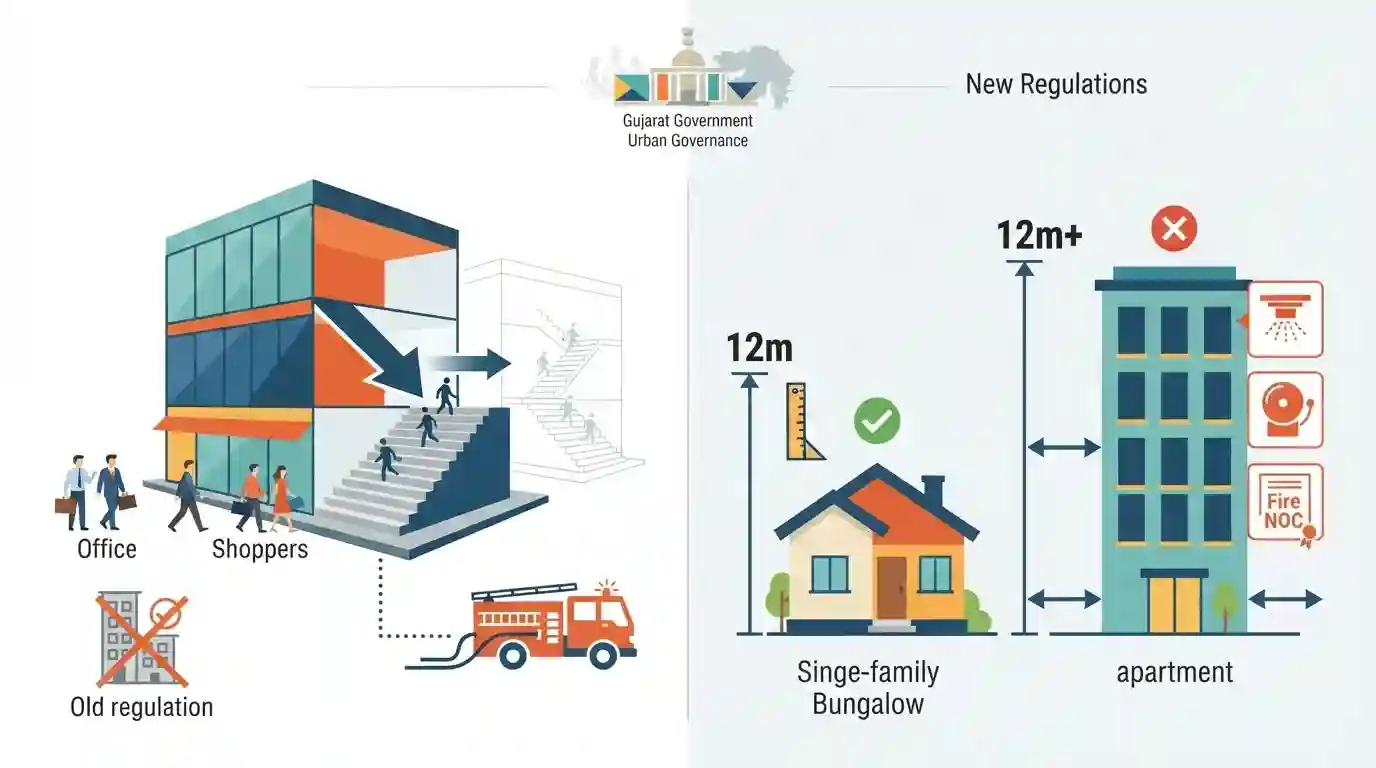
To enhance urban fire safety and streamline emergency evacuations, the Gujarat government is amending the Comprehensive General Development Control Regulations (CGDCR) to mandate 2-metre wide staircases in all commercial buildings across Ahmedabad, removing the previous height-based exemptions. Furthermore, to close regulatory loopholes, the state is capping the height of bungalows at 12 metres. Any residential structure exceeding this height will be legally classified as an apartment, thereby mandating strict compliance with fire NOC regulations and expanded margin space requirements.
મુખ્ય મુદ્દા
- The Gujarat government is mandating 2-metre wide staircases for all commercial buildings in Ahmedabad, irrespective of their height.
- The state is amending the Comprehensive General Development Control Regulations (CGDCR), which currently allows 1.5m staircases for commercial buildings below 25m in height.
- The regulation change is driven by the need for enhanced fire safety, allowing for swift evacuation during emergencies.
- Bungalow heights will be capped at 12 metres; structures exceeding this limit will be classified as apartments, requiring larger margin spaces and mandatory fire NOCs.
મહત્વપૂર્ણ શબ્દો
Comprehensive General Development Control Regulations (CGDCR)

A unified statutory framework in Gujarat governing building codes, urban zoning, structural heights, margins, and safety norms for all commercial and residential structures.
UPSC context
GS Papers I & II (Urbanization; Governance). Tests knowledge of urban planning policies and disaster resilience mechanisms in Indian cities.
Fire No-Objection Certificate (NOC)
A mandatory statutory clearance issued by fire authorities certifying that a commercial or high-rise residential building has successfully implemented required fire prevention and life safety measures.
UPSC context
GS Paper III (Disaster Management). Highly relevant for assessing urban building safety regulations and mitigating human-made hazards like structural fires.
Ahmedabad Municipal Corporation (AMC)
The elected urban local body established in 1950, responsible for administering civic infrastructure, delivering municipal services, and enforcing local policies across the city of Ahmedabad.
UPSC context
GS Paper II (Local Governance). Crucial for studying the 74th Constitutional Amendment, urban decentralization, and municipal administration mechanisms.
Ahmedabad Urban Development Authority (AUDA)
A statutory planning body established in 1978 to oversee and regulate infrastructural development, town planning schemes, and zoning in the rapidly expanding urban areas outside direct AMC boundaries.
UPSC context
GS Papers I & II (Urbanization). Illustrates the statutory mechanisms required to manage rapid suburban sprawl and ensure sustainable town growth.
Confederation of Real Estate Developers' Associations of India (CREDAI)
The apex national advocacy body for private real estate developers in India. Established in 1999, it promotes ethical business practices, self-regulation, and policy advocacy for the housing sector.
UPSC context
GS Paper III (Infrastructure & Economy). Important for understanding real estate governance, RERA compliance, and public-private partnerships in urban development.
પ્રિલિમ્સ ટ્રેપ
The National Building Code (NBC) is a mandatory central statute governing structural fire safety across all States.
The NBC is merely a recommendatory document published by the Bureau of Indian Standards (BIS). It becomes legally binding only when States formally adopt it into local building bye-laws.
સંલગ્ન સ્થિર ખ્યાલો
How is jurisdiction over 'Fire Services' defined in the Indian Constitution?
- State Subject: Falls broadly under Entry 5 (Local Government) of the State List, making it primarily a state responsibility.
- 12th Schedule: Inserted by the 74th Constitutional Amendment Act (1992), listing fire services as a core municipal function.
- Article 243W: Provides the constitutional framework for State legislatures to devolve powers to Urban Local Bodies (ULBs) for actual execution.
What is the regulatory framework for building fire safety in India?
- NBC 2016: Published by the Bureau of Indian Standards (BIS), Part 4 of this code acts as India's recommendatory central standard for life and structural safety.
- Model Bye-Laws: The Ministry of Housing and Urban Affairs provides this master template for states to draft local development control regulations.
- Local Execution: State-specific laws (like Gujarat's CGDCR) integrate these central models into legally binding municipal codes, mandating provisions like fire NOCs.
આંતર-વિષય પેટર્ન
Urban Margins & Heat Islands
Stricter margin spaces required for buildings above 12m not only facilitate access for fire tenders but also improve urban wind flow, directly mitigating the Urban Heat Island (UHI) effect in dense cities.
Decentralization & Disaster Response
Fire safety highlights a critical 74th Amendment gap: while functionally listed in the 12th Schedule, regulatory power and engineering norms often remain heavily centralized at the state government level.

Expect a Mains question linking Urban Disaster Management (fires), the 74th CAA, and enforcement gaps in municipal building bye-laws.
સંલગ્ન PYQ · 2
સંલગ્ન PYQ · 2
- 2026GPSC_PRELIMSGS1
The term 'Mayday', seen in the news in the context of recent maritime and aviation incidents, refers to:
- 2026GPSC_PRELIMSGS1
Consider the following statements about earthquakes: 1. The maximum damage due to an earthquake occurs at its epicentre. 2. In areas close to the epicentre, the earthquake waves reach the earth's surface obliquely in a 'to-and-fro movement', thereby causing maximum damage. Which of the above statement(s) is/are correct?
