Bilateral Trade Deficit and Strategic Autonomy in Russia Ties
Source:Indian Express ↗
Why It Matters
Demonstrates the practical application of India's 'strategic autonomy' in foreign policy, balancing historical ties with Russia against pressure from the West. The discussion on trade deficits and de-dollarization is vital for analyzing the long-term economic shifts and financial resilience strategies emerging from the Ukraine conflict and subsequent sanctions.
Summary
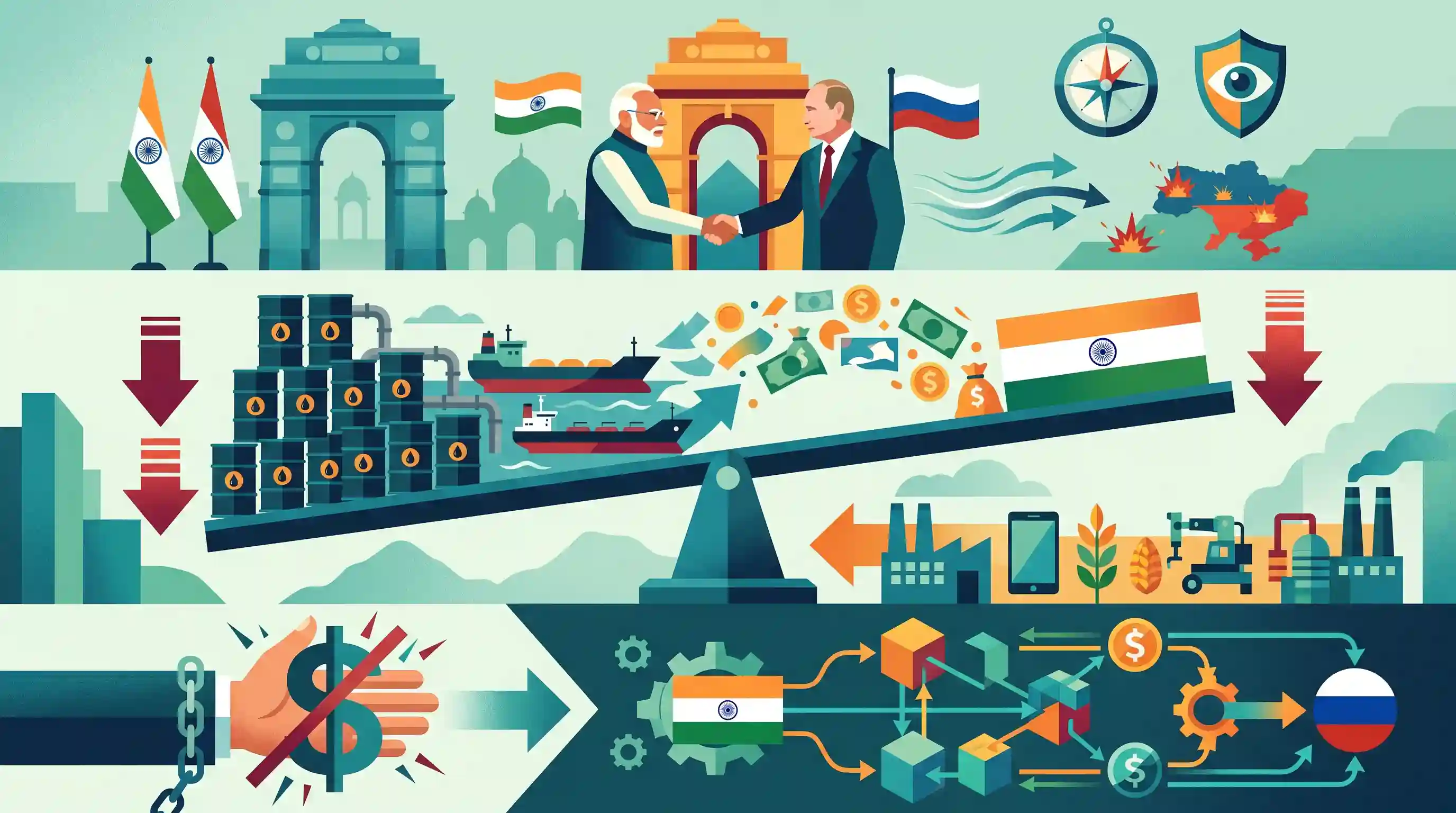
Ahead of President Vladimir Putin's scheduled annual summit visit to New Delhi, Russia has lauded India's "very friendly" and objective stance on the Ukraine conflict. Kremlin spokesperson Dmitry Peskov highlighted PM Modi's diplomatic engagements and reaffirmed Russia's appreciation for India's strategic autonomy. Addressing economic ties, the Kremlin acknowledged the widening trade deficit caused by India's heavy reliance on discounted Russian crude oil and promised to increase imports from India to balance the trade. Furthermore, Peskov strongly advocated for de-dollarization, suggesting the development of alternative international trade architectures to counter the weaponization of the US dollar by Western nations.
Key Points
- The Kremlin commended India's objective and independent foreign policy regarding the ongoing Russia-Ukraine conflict ahead of President Putin's visit to India for the annual bilateral summit.
- Russia acknowledged the significant bilateral trade deficit resulting from India's massive imports of discounted Russian crude oil, stating its intention to boost imports from India to correct the imbalance.
- Russian spokesperson Dmitry Peskov emphasized the necessity of de-dollarization and the creation of alternative financial architectures for international trade to bypass the weaponization of the US dollar.
- Moscow expressed a willingness to welcome US diplomatic interventions to end the Ukraine war, provided they reflect genuine efforts toward peace rather than political maneuvering.
Important Terms
De-dollarization

The process of reducing reliance on the US dollar as a reserve currency and medium of exchange in international trade and financial transactions.
UPSC context
GS Paper 3 (Economy) and GS Paper 2 (IR); tests knowledge of global financial shifts and challenges to US dollar hegemony.
Strategic Autonomy
A state's ability to pursue national interests and adopt independent foreign policy decisions without being constrained or coerced by external powers or alliances.
UPSC context
GS Paper 2 (International Relations); tests understanding of India’s independent stance amidst global polarization and multi-alignment.
Trade Deficit
An economic condition where a country's imports exceed its exports; India currently faces a nearly $59 billion deficit with Russia due to heavy energy imports.
UPSC context
GS Paper 3 (Economy); tests analysis of bilateral trade imbalances and their impact on India’s current account.
Weaponization of the Dollar
The use of a dominant currency's global status, like the US dollar, as an instrument of geopolitical pressure through sanctions and financial exclusion.
UPSC context
GS Paper 2 (IR); tests understanding of economic statecraft and its consequences for global trade stability.
Kremlin
The fortified complex in Moscow that serves as the official residence of the Russian President and the symbolic seat of the Russian government.
UPSC context
GS Paper 2 (IR); relevant for understanding the executive drivers behind Russia’s foreign policy and bilateral summits.
Prelims Trap
"All India-Russia bilateral trade is currently settled in Indian Rupees to bypass Western sanctions."
Due to a massive trade deficit, Russia accumulated billions of 'trapped' Rupees, leading them to demand alternative currencies like the UAE Dirham and Chinese Yuan for crude oil settlements.
Static Concepts Connected
What is the Special Rupee Vostro Account (SRVA) mechanism?
- Definition: An account maintained by an Indian bank on behalf of a foreign bank, denominated in Indian Rupees (INR).
- Trade Settlement: Indian importers pay in INR into the SRVA; Indian exporters are paid in INR from the balances held in the SRVA.
- De-dollarization: It facilitates Rupee-denominated cross-border trade, reducing dependency on hard currencies like the US dollar and mitigating exchange rate risks.
How does a Nostro account differ from a Vostro account?
- Nostro Account: Meaning "our money on deposit with you," it is an account an Indian bank holds with a foreign bank in a foreign currency (e.g., SBI holding an account in USD in New York).
- Vostro Account: Meaning "your money on deposit with us," it is an account a foreign bank holds with an Indian bank in domestic currency (INR).
Cross-Topic Patterns
De-dollarization & RBI's Rupee Push
Western sanctions on Russia (such as the SWIFT ban) accelerated global efforts to find alternative payment architectures, directly catalyzing the RBI's 2022 framework for cross-border trade settlement in INR.
Trade Deficits & Trapped Currency
India's massive procurement of discounted Russian oil created a $40B+ deficit, exposing the limits of local currency settlement when trade is extremely asymmetric, resulting in billions of 'trapped' Rupees.

Vostro/Nostro account mechanics combined with the geopolitical drivers of de-dollarization (SWIFT bans) are prime targets for a 2026 Prelims economy question.
Linked PYQs · 2
Linked PYQs · 2
- 2020MainsGS2
What is the significance of Indo-US defence deals over Indo-Russian defence deals? Discuss with reference to stability in the Indo-Pacific region.
- 2025MainsGS2
"Energy security constitutes the dominant kingpin of India's foreign policy, and is linked with India's overarching influence in Middle Eastern countries.” How would you integrate energy security with India's foreign policy trajectories in the coming years?
