J&K Martyrs Day Restrictions Highlight Post-370 Political Friction
Source:Indian Express ↗
Why It Matters
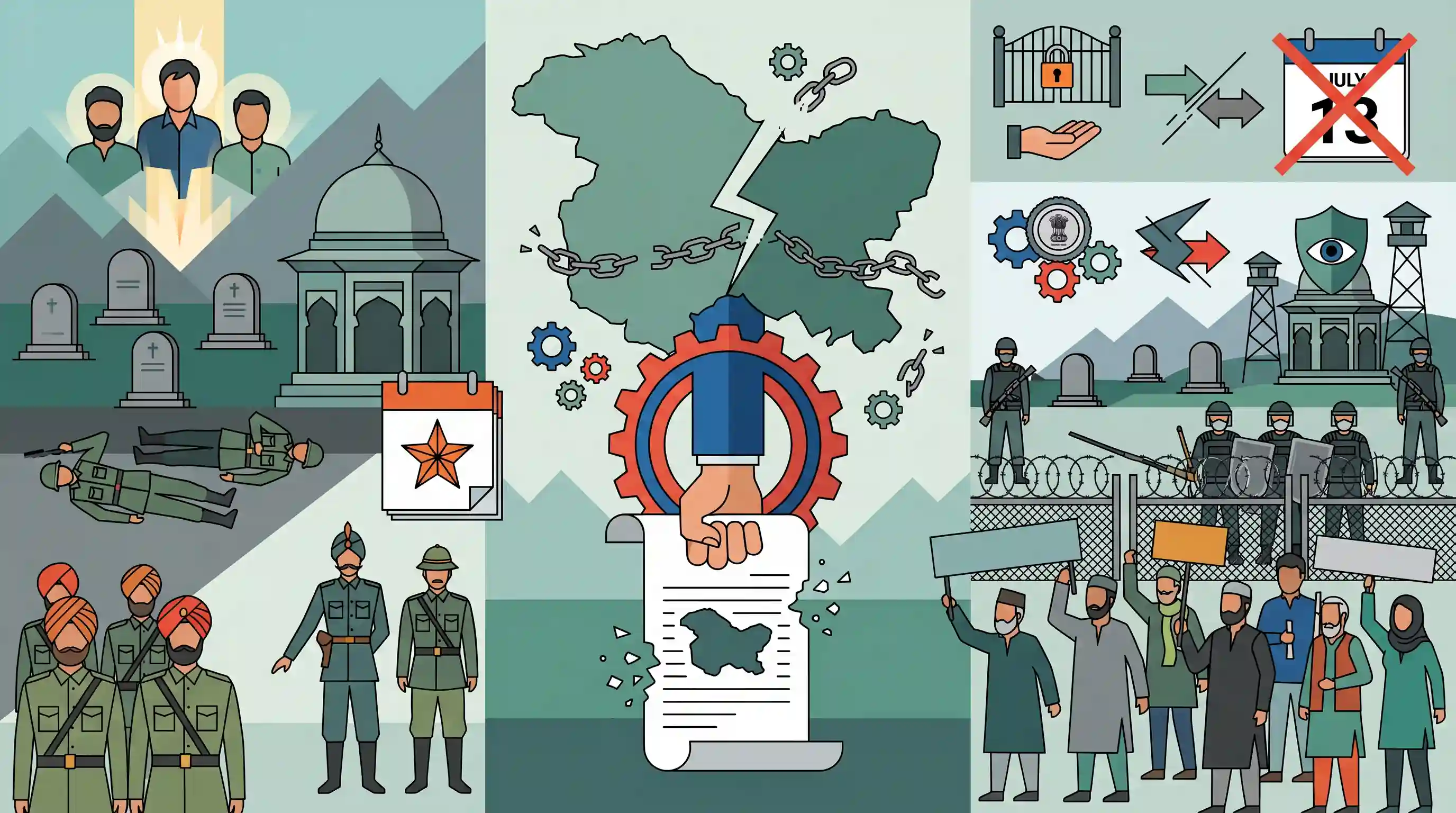
The removal of Martyrs' Day from the gazetted holiday list and restrictions on politicians illustrate the profound administrative and political shifts in J&K post-Article 370 abrogation. It highlights the ongoing tensions regarding historical memory, political freedom, and federal dynamics in the region.
Summary
Ahead of the historical Martyrs' Day on July 13, major regional political parties in Jammu and Kashmir resolved to visit the Martyrs' Graveyard at Naqshband Sahib in Srinagar. The day honors those who died fighting Dogra forces in 1931. Following the abrogation of Article 370 in August 2019, the Union Territory administration dropped July 13 from its official list of gazetted holidays. Since then, local authorities and security forces have regularly imposed restrictions on political leaders attempting to visit the graveyard, reflecting ongoing friction between regional political forces and the UT administration.
Key Points
- July 13 is historically observed as Martyrs' Day in Jammu and Kashmir, commemorating those killed by Dogra forces in 1931.
- Regional political parties have resolved to visit the Martyrs' Graveyard at Naqshband Sahib in Srinagar to pay their tributes.
- Following the abrogation of Article 370 in 2019, the UT administration removed July 13 from the list of gazetted holidays.
- The administration has frequently placed restrictions on political leaders attempting to visit the graveyard since 2019.
Important Terms
Article 370

A constitutional provision that granted special autonomous status to Jammu and Kashmir (1949-2019), allowing it a separate constitution and limiting Parliament's legislative powers over the state.
UPSC context
GS Paper II: Constitution and Polity. Tests understanding of asymmetric federalism and the historical evolution of J&K’s status.
J&K Reorganisation Act, 2019
Parliamentary legislation that bifurcated the State of Jammu and Kashmir into two Union Territories—Jammu & Kashmir and Ladakh—effective October 31, 2019, following the abrogation of Article 370.
UPSC context
GS Paper II: Federalism and Reorganisation of States. Essential for questions on administrative restructuring and internal security.
Martyrs' Day (July 13)
Annual commemoration of 22 Kashmiri protesters killed by Dogra forces in 1931. Formerly a gazetted holiday in J&K, it was removed from the official list post-2019 reorganisation.
UPSC context
GS Paper I: Post-Independence History. Relates to regional political identity and the evolution of democratic movements in princely states.
Dogra Dynasty
A Hindu Rajput dynasty that ruled the princely state of Jammu and Kashmir from 1846 to 1947, founded by Maharaja Gulab Singh under the Treaty of Amritsar.
UPSC context
GS Paper I: Modern Indian History. Relevant for studying the history of princely states and the geopolitical origins of the Kashmir conflict.
Union Territory (UT)
A federal administrative division in India governed directly by the Central Government through a Lieutenant Governor or Administrator appointed by the President of India.
UPSC context
GS Paper II: Polity and Governance. Tests knowledge of India’s administrative structure and Centre-State relations.
Prelims Trap
"The Legislative Assembly of the Union Territory of J&K has powers to legislate on all State List subjects."
False. The J&K Reorganisation Act explicitly excludes 'Police' and 'Public Order' from the Assembly's jurisdiction, vesting these powers solely with the Lieutenant Governor.
Static Concepts Connected
What defines the legislative boundaries of the J&K UT Assembly?
- Article 239A Model: The UT is modeled on Puducherry (Article 239A), having an elected assembly and a Chief Minister.
- Excluded Subjects: The assembly can legislate on State and Concurrent lists, except for 'Police' and 'Public Order', which remain under the LG's exclusive control.
- Public Order execution: Restrictions on politicians' movement under Article 19(1)(d) are executed by the LG's administration citing 'Public Order' (Article 19(5)).
How does the Naqshbandi Sufi order differ from the Chishti order?
- Orthodox strictness: Unlike the liberal Chishtis, Naqshbandis strictly adhered to Sharia law and opposed syncretic practices (e.g., opposing Akbar's Din-i-Ilahi).
- Rejection of Sama: Naqshbandis practice Zikr-e-Khafi (silent meditation), whereas Chishtis heavily utilize Sama (musical recitation) to attain spiritual ecstasy.
- Key Figures: Founded by Bahauddin Naqshbandi, it was popularized in India by Khwaja Baqi Billah and later Sheikh Ahmad Sirhindi.
Cross-Topic Patterns
Delhi & J&K UT power parallels
J&K's administrative friction over restricting political assembly ('Public Order') closely mirrors the Delhi LG vs elected government tussle, highlighting structural vulnerabilities in UTs with legislatures.
Treaties and princely state formation
The 1846 Treaty of Amritsar connects modern Kashmiri political grievances (against Dogra rule) directly to colonial-era British East India Company territorial sales following the First Anglo-Sikh War.

Expect a Prelims question contrasting Naqshbandi (orthodox, silent Zikr) with Chishti (Sama) orders, or testing J&K UT legislative limits.
Linked PYQs · 2
Linked PYQs · 2
- 2025MainsGS2
Discuss the nature of Jammu and Kashmir Legislative Assembly after the Jammu and Kashmir Reorganization Act, 2019. Briefly describe the powers and functions of the Assembly of the Union Territory of Jammu and Kashmir.
- 2016MainsGS2
To what extent is Article 370 of the Indian Constitution, bearing marginal note "Temporary provision with respect to the State of Jammu and Kashmir", temporary? Discuss the future prospects of this provision in the context of Indian polity.
